Groundbreaking Achievement: Chandrayaan-3 Triumphantly Lands on Moon’s Oldest Craters, Experts Enthralled

Chandrayaan-3 Lands in One of Moon’s Oldest Craters
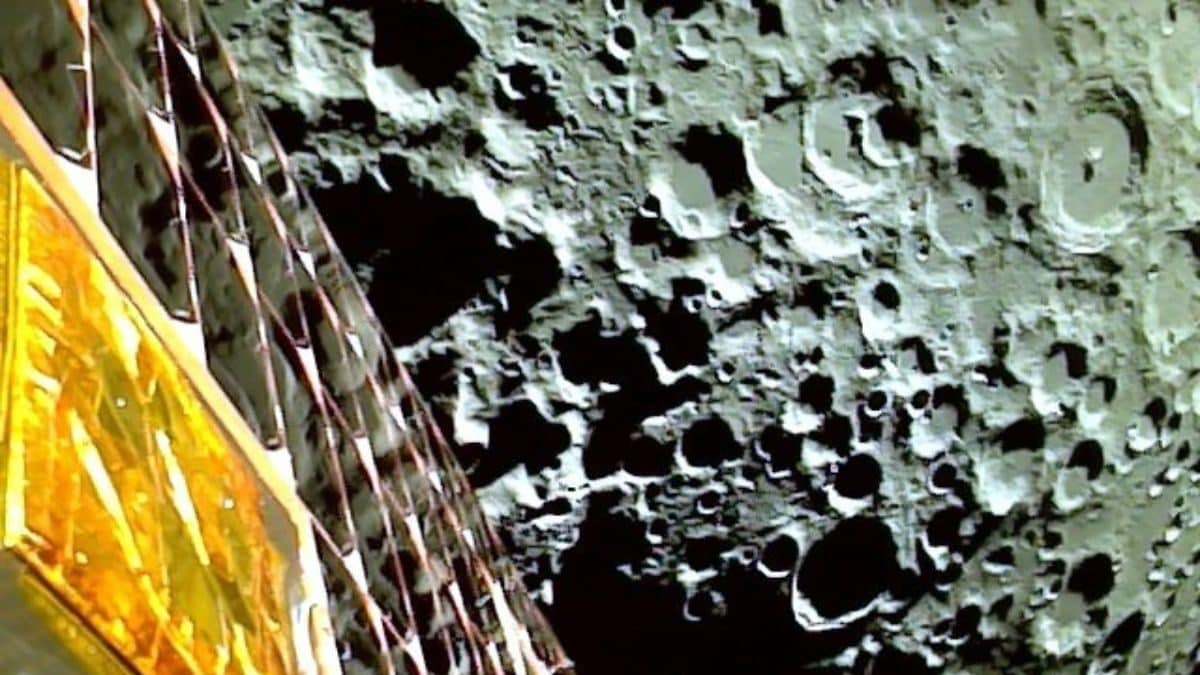
Researchers have revealed that India’s Chandrayaan-3 lunar mission has possibly landed in one of the Moon’s oldest craters. Images from the Lander Imager and Rover Imager on the Vikram lander show a crater formed during the Nectarian period, 3.85 billion years ago. This finding, confirmed by researchers from the Physical Research Laboratory and ISRO, suggests the site is in a unique geological setting.
The Chandrayaan-3 team, including Planetary Sciences Division’s associate professor S. Vijayan, highlights that these are the first on-site images taken at this Moon’s latitude, shedding light on the satellite’s evolution. A crater, created by asteroid impacts, is surrounded by displaced material, or ‘ejecta’. One half of the crater is buried under ejecta from the South Pole-Aitken basin, a significant impact basin over 300 km in diameter. The landing site, where the Pragyan rover explored, revealed material deposited from different Moon regions, suggesting one half of the crater was ‘degraded’ by South Pole-Aitken basin ejecta.
Vijayan elaborates that ejecta formation resembles sand displacement upon impact, pointing out that larger impact basins eject deeper sub-surface materials. The nearly semi-circular structure of the 160 km crater observed by Chandrayaan-3 supports this idea.
Further analysis of Nectarian period craters showed most were severely degraded, backing the discovery of a buried crater and indicating significant space weathering effects. The mission’s successful landing on August 23, 2023, near the Moon’s south pole, with the site named Shiv Shakti Point, provides new insights into the Moon’s geological history.
This discovery reaffirms the importance of landing missions in understanding planetary evolution, with on-site images showing unprecedented details of ancient lunar surfaces.
Journalistic Summary:
India’s Chandrayaan-3 mission may have landed in one of the Moon’s oldest craters, dating back 3.85 billion years. Researchers from ISRO and the Physical Research Laboratory analyzed images from the mission, revealing a crater partially buried by ejecta from the South Pole-Aitken basin. The findings suggest significant geological insights and feature material from different Moon regions. This successful mission, which landed on August 23, 2023, at Shiv Shakti Point, underscores the importance of lunar exploration in understanding our satellite’s history.
Original Story https://www.news18.com/india/no-other-missions-have-gone-chandrayaan-3-landed-on-possibly-oldest-craters-of-moon-say-researchers-9067830.html
Category :
Tags: