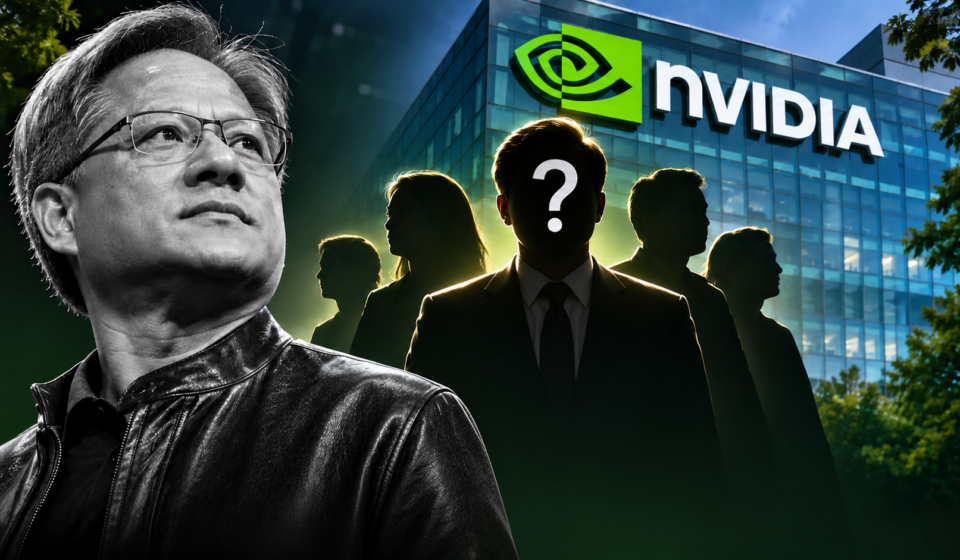
Succession at Nvidia: Leadership, Geopolitics, and the AI Ecosystem

The Hidden Dependency in Your AI Architecture
We design systems to survive server failures. We replicate databases, distribute workloads, and rehearse disaster recovery.
Yet many enterprise AI strategies leave a different dependency largely unexamined: the concentration of technology, expertise, and strategic influence within a single supplier’s ecosystem.
The supplied report makes claims about a leadership upheaval at Nvidia that I cannot independently verify. Rather than treat those claims as established news, I want to examine the underlying strategic question: how resilient is an enterprise when its AI roadmap depends heavily on one technology ecosystem?
Continuity is more than uptime
A leadership change does not make deployed GPUs stop working. Nor does uncertainty at a supplier automatically justify replacing its technology.
But enterprise architecture operates across longer timelines than an infrastructure incident.
Decisions about software support, product roadmaps, licensing, export compliance, and ecosystem partnerships can shape the economics of a platform for years. These are not merely procurement concerns. They influence what we build, how deeply we integrate, and how expensive future changes become.
I believe supplier governance belongs in architectural risk assessment-not because architects should speculate about personalities, but because technical dependencies sit inside commercial and institutional relationships.
A platform can be technically excellent while still creating concentration risk. Both statements can be true.
Portability has a price-and so does ignoring it
The simplistic response is: “Avoid lock-in.”
That sounds sensible until we examine production AI.
Performance often comes from specialised kernels, optimised libraries, interconnects, and carefully tuned deployment pipelines. Abstracting away every hardware-specific capability can sacrifice the very efficiency that makes a workload viable.
The better objective is not perfect interchangeability. It is a credible, tested ability to change direction.
For a chief architect, that means identifying where specialisation creates measurable value and where it merely creates unnecessary coupling.
Keep business rules separate from model-serving implementations. Define stable application-level interfaces. Preserve access to training data, evaluation datasets, model artefacts where licensing permits, and operational telemetry.
But do not confuse an API wrapper with portability.
A replacement model may behave differently. Embedding changes may require re-indexing. An alternative accelerator may demand substantial optimisation. Every transition needs evaluation against business outcomes, not just successful execution.
The right question is not, “Can we switch?”
It is, “What would switching cost, how long would it take, and what would deteriorate during the transition?”
Sovereignty needs operational proof
This matters directly to India’s expanding AI ambitions.
Locally hosted infrastructure can strengthen control, but physical location alone does not establish technological sovereignty. Software dependencies, maintenance access, contractual rights, and the availability of specialised skills also matter.
For public-service platforms and resource-constrained institutions, an elaborate multi-platform strategy may be unaffordable. Frugal resilience is more realistic: secure data access, maintain reproducible deployment documentation, test a smaller alternative, and define an acceptable degraded-service mode.
A citizen-facing service does not always need its most capable model during a disruption. It does need a safe, useful way to continue operating.
Four questions for the architecture review
Before approving the next major AI investment, I would ask:
- Where are we concentrated? Map dependencies across compute, software, models, cloud services, and scarce expertise.
- What must remain portable? Prioritise business-critical workflows rather than demanding universal portability.
- Have we tested the fallback? Measure quality, latency, cost, and recovery time on representative workloads.
- Who owns the transition? Assign responsibility across engineering, procurement, security, and legal teams before disruption occurs.
Founders should apply the same thinking internally. Document decisions, distribute technical ownership, and ensure that continuity does not depend on one indispensable individual.
The strongest technology strategy is not the one that predicts every disruption. It is the one that preserves meaningful choices when disruption arrives.
About the Author: Sanjeev Sarma is the Founder Director and Chief Software Architect at Webx Technologies. With a core focus on Generative AI integration, Cloud-Native Scalability, and Enterprise Software Architecture, he has spent over two decades driving digital transformation across Northeast India and beyond. Beyond his corporate leadership, Sanjeev is deeply invested in shaping the future of the IT industry. He serves as an Industry Expert on the Board of Studies for Assam Don Bosco University’s School of Technology, advises state technology committees, and actively mentors emerging tech startups at STPI. He brings a unique, dual perspective of high-level enterprise execution and future-ready academic curriculum development.