Decoupling the Edge: The Architectural Case for Cloud-Centric Robotics

When the Brain Leaves the Body: What a Failed Flying Camera Teaches Us About Architecture
Sometimes a product’s most important feature is something it deliberately stopped doing.
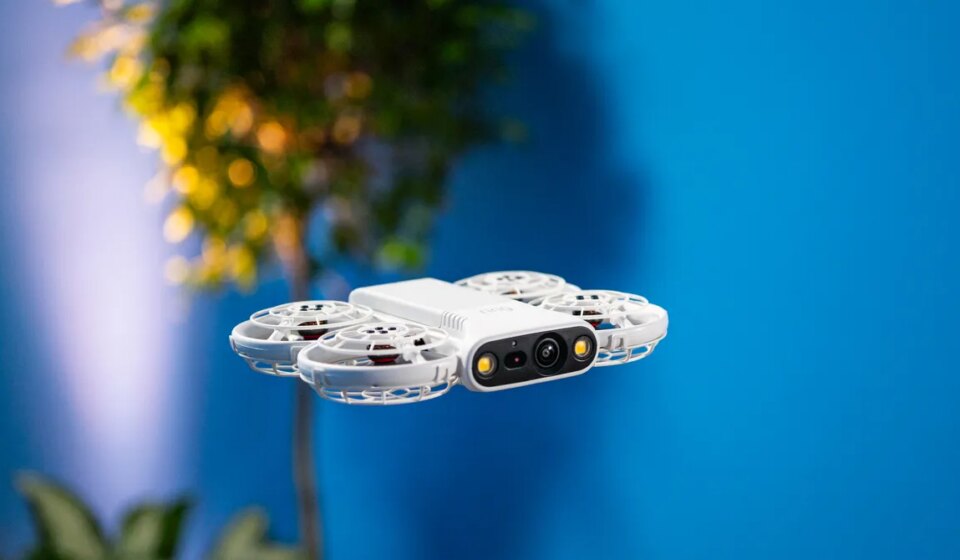
The story is simple. A company spent years trying to build an autonomous indoor security drone. Every edge case pushed the team to add more sensors. More sensors needed more onboard compute, which drained the battery faster and made the machine harder to fly. The way out was to move the intelligence off the device and into the cloud. The drone now streams video to remote servers, where an AI agent decides where it goes next. The device keeps only enough local logic to land safely if the connection drops.
I won’t comment on the gadget itself. The architectural pattern behind it is what interests me.
The Edge Case Spiral
Every architect has seen this trap. You start with a clean, self-contained system. Reality then delivers its long tail of exceptions, and each one gets patched with another component, another sensor, another rule. Complexity compounds while capability grows only linearly.
I have watched the same thing happen in enterprise software. A monolithic application keeps absorbing business exceptions until nobody can reason about it. Hardware has the same problem, only the penalty is physical: weight, heat and battery life. The software equivalent is latency, technical debt and fragile deployments.
The lesson is that when the edge cases are winning, the boundary you drew is probably in the wrong place.
Thin Edge, Thick Cloud
The new design separates actuation from cognition. The device does the minimum: fly, capture, and fail safely. The cloud does the thinking.
This is the same shift we saw when thin clients and SaaS replaced fat desktop software. It is also where AI agents are heading in the enterprise. Reasoning gets centralised, and the endpoints become light, cheap and replaceable.
The trade-offs are real, though:
- Latency vs. intelligence: A cloud brain is only as responsive as the network between it and the body. That works for a slow indoor patrol. It would not work for anything safety-critical at speed.
- Graceful degradation: The “land if connectivity is lost” fallback is the most mature design decision here. Every distributed system needs a defined safe state when it loses its brain, and too few teams design that first.
- Privacy and sovereignty: Continuous video streaming to remote servers concentrates sensitive data. Who holds it, under which jurisdiction, and with what retention policy are architectural questions, not legal footnotes.
- Operational dependency: Moving intelligence to the cloud turns a one-time hardware purchase into a permanent dependency on someone’s uptime, pricing and roadmap.
The Bharat Lens
This pattern matters for us in India, particularly in the Northeast. We build for environments where bandwidth is intermittent, power is unreliable and devices must be frugal. A cloud-brained architecture is tempting because it lets us deploy cheap hardware in the field. In places with patchy connectivity, though, the “offline safe state” becomes the real product.
Whether the system is a flood sensor in a river valley, an agricultural monitor or a field-service tablet, the question is the same: what does the device do when the network disappears? Our best designs here are not cloud-first or edge-first. They are connectivity-tolerant. They sync when they can, act locally when they must, and fail safely when neither is possible.
Takeaways
- Re-examine your boundaries when edge-case handling starts dominating your roadmap.
- Separate cognition from actuation where latency tolerances allow it.
- Design the failure mode first. Define what “safe” looks like with no connectivity before building the happy path.
- Treat data movement as a governance decision, not a plumbing detail.
- Count the lifetime cost of cloud dependency, not just the build cost.
Closing Thought
Good architecture is rarely about adding intelligence. More often it is about deciding where intelligence should live, and what the system does when that place becomes unreachable.
About the Author: Sanjeev Sarma is the Founder Director and Chief Software Architect at Webx Technologies. With a core focus on Generative AI integration, Cloud-Native Scalability, and Enterprise Software Architecture, he has spent over two decades driving digital transformation across Northeast India and beyond. Beyond his corporate leadership, Sanjeev is deeply invested in shaping the future of the IT industry. He serves as an Industry Expert on the Board of Studies for Assam Don Bosco University’s School of Technology, advises state technology committees, and actively mentors emerging tech startups at STPI. He brings a unique, dual perspective of high-level enterprise execution and future-ready academic curriculum development.