Thermal Storage as Strategic Infrastructure: Decoupling Comfort from Peak Power

The Fallacy of the General-Purpose Hammer: What Thermal Physics Can Teach Us About Enterprise Architecture
In both energy grids and enterprise cloud environments, we suffer from a common architectural blind spot: we love throwing expensive, general-purpose solutions at predictable, single-purpose problems. Whether it is deploying massive frontier AI models for basic data routing or draining high-end chemical batteries just to heat a living room, the financial and environmental cost of poor workload orchestration is staggering.
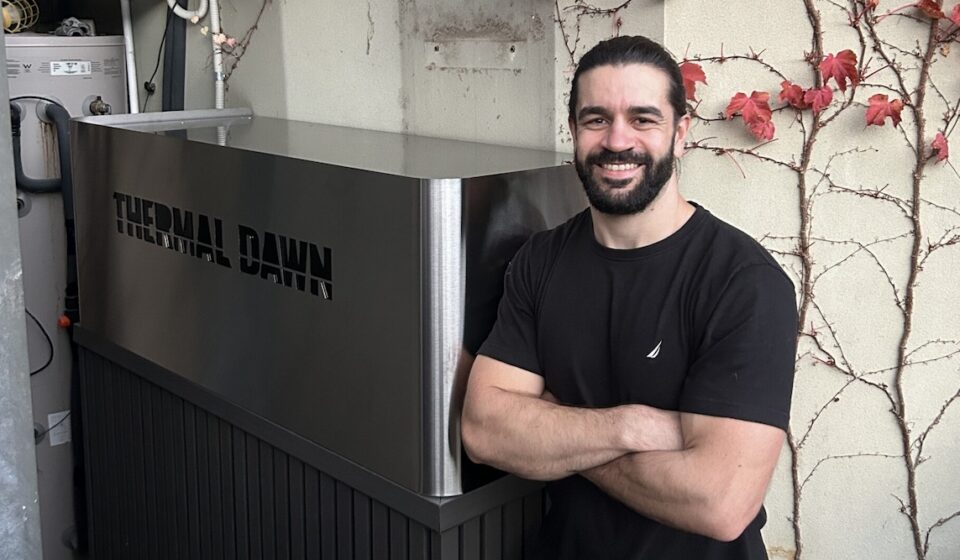
I recently came across a fascinating cleantech engineering case study from Australia that illustrates a much smarter approach to system design. To solve the problem of expensive evening heating peaks, engineers bypassed standard lithium-ion batteries entirely, instead pairing reverse-cycle heat pumps with Phase Change Materials (PCMs). By absorbing excess solar energy during cheap midday windows to freeze or melt specialized materials at specific temperatures, the system acts as a dedicated thermal battery-releasing stored warmth throughout the evening while the heavy compressors stay completely off during peak grid hours.
Separation of Concerns in Physical and Digital Systems
What struck me most about this development wasn’t just the thermodynamics, but the underlying architectural philosophy. The engineering team behind this system articulated a brilliant distinction: a chemical battery is expensive storage doing a general-purpose job, whereas thermal storage is cheap storage doing one heavy, predictable job exceptionally well.
As a Chief Software Architect, I see this exact anti-pattern play out in digital infrastructure every single day. Enterprises routinely exhaust their tier-one compute, memory, and database resources on heavy, predictable workloads that should be offloaded to specialized, lower-cost tiers.
We are seeing a massive recurrence of this in the current rush toward Generative AI. Organizations are routing routine, deterministic queries through massive, power-hungry Large Language Models (LLMs) instead of utilizing lightweight, domain-specific Small Language Models (SLMs), edge processing, or simple semantic caches. When you stop forcing your most expensive, general-purpose infrastructure to carry your most predictable loads, you drastically reduce operational burn and free up your core engines for high-value, dynamic tasks.
Intelligent Control Layers Over “Rip and Replace”
There is another critical lesson in this case study regarding legacy modernization. To deploy these thermal batteries, the engineers didn’t demand that homeowners tear down their houses or install futuristic ductwork. Instead, they integrated their smart control systems with existing hydronic pipes, and even used predictive algorithms to turn a home’s existing concrete floor slab into part of the thermal battery itself.
In enterprise transformation, we often fall into the trap of thinking modernization requires a complete “rip and replace” of legacy infrastructure. Yet, some of the most resilient systems I have architected over the past two decades relied on wrapping an intelligent orchestration layer around existing, “dumb” assets. By shifting the intelligence to the control plane-knowing precisely when to pre-compute, when to cache, and when to discharge-you can turn legacy bottlenecks into strategic buffers.
Frugal Engineering as a Competitive Moat
When I mentor emerging startup founders at STPI or review curriculum with academic boards, I constantly emphasize that constraints breed the best architecture. In developing ecosystems like Northeast India, where grid stability, last-mile bandwidth, and capital can be variable, brute-force engineering fails quickly. You cannot simply scale your way out of an inefficient design by buying more cloud credits or bigger batteries.
True innovation requires looking at the temporal nature of your data-or your energy-and designing asynchronous systems that do the heavy lifting when resources are abundant and cheap.
For CTOs, system architects, and founders building the next generation of resilient platforms, this physical-world breakthrough offers three clear architectural reminders:
- Decouple Heavy, Predictable Loads: Never use high-cost, general-purpose infrastructure (whether lithium-ion or high-tier GPU clusters) for predictable workloads that can be handled by specialized, cheaper mediums.
- Master Temporal Load-Shifting: Design systems that are time- and cost-aware. Pre-process, cache, and “charge” your workflows during off-peak windows so your core engines can idle during peak demand.
- Modernize via the Control Plane: Before ripping out legacy infrastructure, ask if an intelligent software orchestration layer can repurpose those existing assets into a systemic advantage.
Ultimately, whether we are architecting green energy grids or cloud-native enterprise software, sustainability and scalability are two sides of the same coin: doing more with less through the sheer elegance of design.
About the Author: Sanjeev Sarma is the Founder Director and Chief Software Architect at Webx Technologies. With a core focus on Generative AI integration, Cloud-Native Scalability, and Enterprise Software Architecture, he has spent over two decades driving digital transformation across Northeast India and beyond. Beyond his corporate leadership, Sanjeev is deeply invested in shaping the future of the IT industry. He serves as an Industry Expert on the Board of Studies for Assam Don Bosco University’s School of Technology, advises state technology committees, and actively mentors emerging tech startups at STPI. He brings a unique, dual perspective of high-level enterprise execution and future-ready academic curriculum development.