The New Defense Industrial Model: Autonomy, Speed, and Runway Independence

The Runway Was Never the Point
Every enterprise architect learns eventually that the most fragile part of any system is the one thing you cannot move.
A mainframe. A centralized data center. A fiber trunk running through a floodplain. A concrete runway baking in the sun, known to every adversary with a coordinate and a missile.
The aerospace industry built a century of doctrine on that last one. Then a defense startup went and deleted it.
The Signal
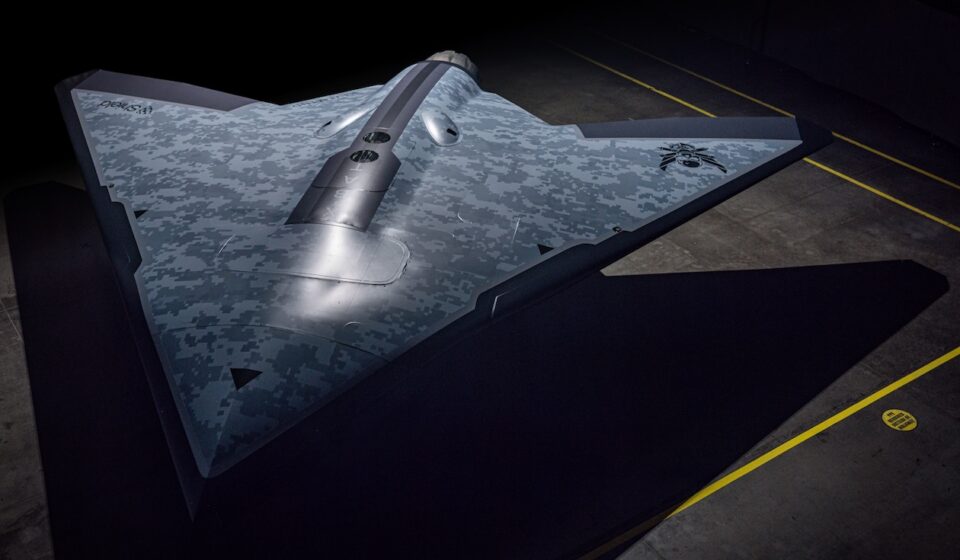
Shield AI recently unveiled a full-scale prototype of its X-BAT – an AI-piloted strike fighter that takes off and lands vertically, carries 2,000-pound class weapons, and is designed for a 1,000-nautical-mile combat radius. It was built in twelve months. Production is planned for roughly 150 aircraft a year by the early 2030s from a facility near Seattle. Their tagline is disarmingly literal: “Earth is our Runway.”
The Architecture Beneath the Headlines
Strip away the fighter-jet framing and what remains is a masterclass in distributed systems thinking, applied to physical hardware.
The runway was a single point of failure. Fixed, known, targetable. By making the launch platform a trailer small enough for a cargo ship or a naval destroyer, Shield AI didn’t just add mobility – it fundamentally changed the availability model of the entire system. The aircraft is no longer dependent on one survivable-only-by-defence asset at a known coordinate. It can be somewhere else. Anywhere else. Possibly many places at once.
That is the same shift enterprise architecture has been chasing for fifteen years – monolithic data centers giving way to edge nodes, guaranteed uptime giving way to graceful degradation, centralized command giving way to local autonomy. We discuss this in abstractions like “resilience” and “fault tolerance.” The defense sector is now executing it at the physical layer, where the failure mode is not a 503 error but a destroyed asset and a lost crew.
The second lesson is the timeline. Twelve months from blank-page design to full-scale prototype, in a domain where the traditional cadence is measured in decades, is not a tractable outcome for a waterfall process. It requires modular architecture, simulation-first validation, hardware-software co-design, and a culture comfortable flying with known unknowns. Most enterprise IT organizations are still fighting to hold a quarterly release cadence. The bar for “acceptable iteration speed” has moved – and it is moving against us.
Third, autonomy. An AI pilot is not a feature you bolt on. It is an architecture decision. It means the system must remain effective when disconnected from central command, when comms are jammed, when the human is out of the loop. Every architect who has deployed into low-bandwidth or intermittent environments – which is most of us – will recognize the problem. The answer isn’t more connectivity. It’s more local intelligence, deliberately designed in.
The Bharat Reflection
For those of us building technology in Northeast India, none of this is abstract.
Our terrain is unforgiving – hills, monsoons, floods, and long distances that make fixed infrastructure expensive and fragile. The systems that have actually worked for us – mobile-first connectivity over fiber, solar-assisted edge compute, satellite fallback – all share one principle: do not stake your availability on the asset you cannot protect or move.
That logic applies directly to medical drones, disaster response, and last-mile public service delivery. The design pattern is identical. Resilience through distribution, not through fortification.
What I Take Away
- Eliminate single points of failure at the architecture stage – not in the ops incident review.
- Compress iteration by treating simulation as a first-class engineering discipline, not a final test phase.
- Edge autonomy is a deployment choice. Make it deliberately, or it will be made for you by the environment.
- The organizations that matter in 2032 will be the ones who can move from concept to working prototype in a year, not a generation.
Closing Thought
The runway was never the real target. It was always the assumption. And the teams that question their assumptions fastest – whether they are building jets, platforms, or public infrastructure – will end up building the systems the rest of us quietly depend on.
About the Author: Sanjeev Sarma is the Founder Director and Chief Software Architect at Webx Technologies. With a core focus on Generative AI integration, Cloud-Native Scalability, and Enterprise Software Architecture, he has spent over two decades driving digital transformation across Northeast India and beyond. Beyond his corporate leadership, Sanjeev is deeply invested in shaping the future of the IT industry. He serves as an Industry Expert on the Board of Studies for Assam Don Bosco University’s School of Technology, advises state technology committees, and actively mentors emerging tech startups at STPI. He brings a unique, dual perspective of high-level enterprise execution and future-ready academic curriculum development.