
Six Decades On, Ringo Starr Walks Back Into Beatlemania’s New York Storm
Fifteen thousand voices can turn a concert into a fever dream. On August 29, 1964, inside Forest Hills Tennis Stadium in Queens, that fever reached temperatures the New York Times described with almost clinical alarm: a “flock of transistor radios blaring in a bull ring.”
The Beatles were halfway through their two-night engagement at the venue, closing a glorious, controversy-packed summer that had also welcomed Barbra Streisand, Harry Belafonte and Miriam Makeba, Joan Baez-with an unexpected Bob Dylan in tow-Johnny Mathis, Peter Nero, Trini Lopez, Count Basie and Woody Allen.
Yet while history remembers the supporting bill-Bill Black Combo, the Exciters, the Righteous Brothers and Jackie DeShannon-the press barely gave them the time of a polite nod. The quartet’s 25-minute set had become the only story, complete with thousands of predominantly teenage girls reaching a state that can only be described as beautifully uncivilised.
Robert Shelton, the same critic credited with helping introduce Dylan to America, captured the madness in the New York Times. The screaming was so overwhelming, he wrote, that the music itself became almost impossible to assess. Such was the power-and commercial appetite-of Beatlemania that the four young men from Liverpool had not merely filled a stadium. They had created a monster, and everyone, including the monster’s parents, was profiting handsomely.
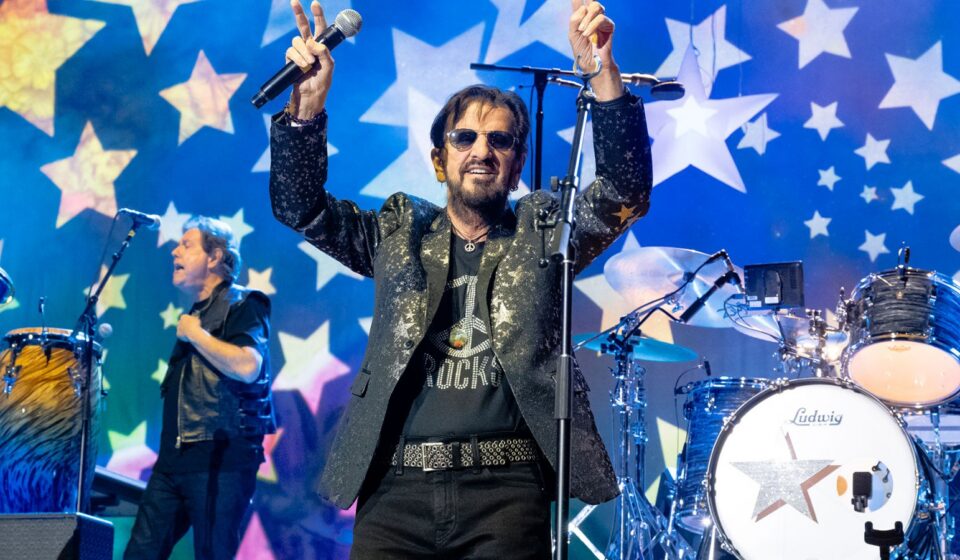
Six decades later, Ringo Starr returned to Forest Hills on October 1, opening with Carl Perkins’s “Matchbox.” His greeting was pure Starr: dry, warm and just sufficiently bewildered by time itself.
“It’s great to be back,” he announced, before admitting that he and the Beatles had played there in 1964.
Then came the promise. Starr said he would perform the same song he had played in those hysterical New York nights: the Shirelles’ “Boys,” a number he had first taken on stage with Rory and the Hurricanes. It was the only surviving link to that original set. The programme otherwise looked knowingly familiar—“Octopus’s Garden,” “Yellow Submarine,” “I Wanna Be Your Man” and “With a Little Help From My Friends”—but where were “I Want to Hold Your Hand,” “She Loves You,” “Twist and Shout” and “Long Tall Sally”? As for John Lennon’s “Good Night,” concertgoers have waited so long for Starr to sing it live that its arrival now qualifies as historical fiction.
His current All Starr Band has become something remarkably close to a permanent institution. Ringo has spent decades inviting famous musicians into the troupe, among them John Entwistle, Billy Preston, Felix Cavaliere, Peter Frampton, Jack Bruce and Simon Kirke. These days, his dependable companions are Toto’s Steve Lukather, Men at Work’s Colin Hay and Average White Band’s Hamish Stuart.
Their nightly ritual is wonderfully theatrical: each singer takes the baton for a defining hit—“Rosanna,” “Pick Up the Pieces,” “Down Under”—before the entire group collides in a stadium-sized chorus.
And there remains that magnificent Ringo phenomenon. He bounded through “With a Little Help From My Friends,” sprinted away and returned to close the concert with John Lennon’s “Give Peace a Chance.” Forget anti-ageing creams; the man is evidence that rhythm itself refuses retirement.
Shelton once warned that Beatlemania was “contrived hysteria.” Yet in Forest Hills, a white-haired woman held aloft a sign declaring that she had been there in 1964, then shook her hips through two rollicking hours. No hype, no choreography, no money-spinning machine-only the songs doing exactly what they were born to do.
For Ringo, another date beckons: Portland, Maine. To him, it is simply the next concert. The Beatles changed the world for 25 minutes. Starr, naturally, is still extending the encore.