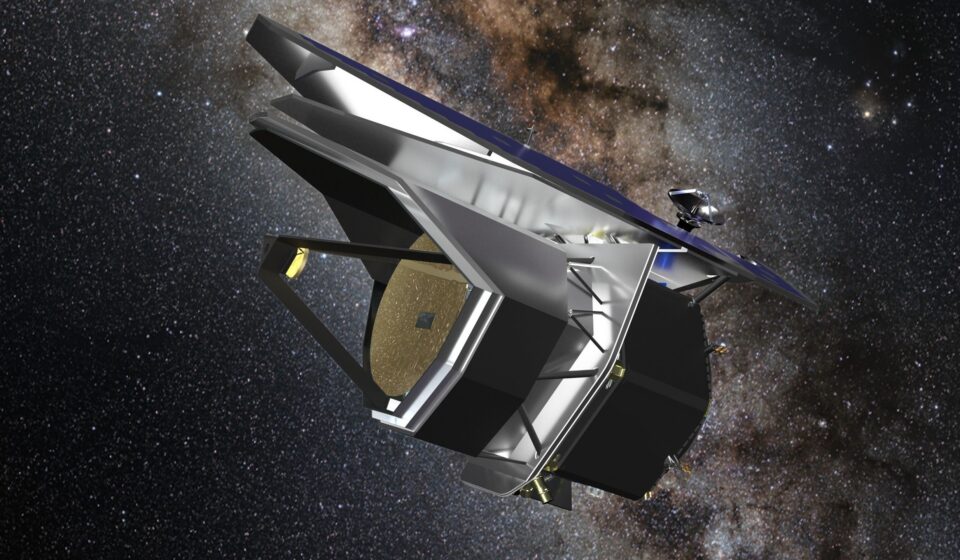

NASA announced Wednesday, Sept. 23, that it has selected PRIMA-the Probe far-Infrared Mission for Astrophysics-for development, moving the proposed space telescope into a preliminary design and technology phase. If development remains on track, project managers will review its progress before it advances toward a launch no earlier than 2033 for a five-year mission. PRIMA’s 1.8-meter telescope will study far-infrared wavelengths that the James Webb Space Telescope cannot detect, focusing on planet formation, galaxy growth and black-hole evolution. It is also the first mission in NASA’s new Probe Explorer class, designed to bridge the gap between flagship observatories such as JWST and smaller agency projects.
Unlike JWST, which was built to observe near- and mid-infrared light, PRIMA will examine longer far-infrared wavelengths. Astronomers hope these wavelengths will reveal information about the gas and dust from which planets form. Meredith MacGregor, an associate professor at Johns Hopkins University who studies planetary systems, said PRIMA will help quantify water’s role in planet formation and measure the gas mass and carbon and oxygen abundances in planet-forming disks. “We can’t actually address these science questions with JWST because the spectral lines that are required are only in the far-infrared,” MacGregor said.
The telescope will also study powerful molecular outflows from galaxies and how they influence star formation and the growth of supermassive black holes. Lee Armus, a Caltech staff scientist and PRIMA’s science operations lead, said the mission could reveal how these outflows shape galaxies over cosmic time. Alberto Bolatto, a University of Maryland astronomer and PRIMA co-investigator, said he was especially eager to explore “the things I don’t yet know.”
PRIMA has a project cost ceiling of $1.2 billion, excluding launch and other nonproject expenses. By comparison, JWST cost $10 billion at its 2021 launch, without accounting for inflation or launch expenses. The Probe Explorer class emerged from recommendations in the 2020 Decadal Survey, a consensus report produced by the National Academies. NASA funded $5 million studies for PRIMA and the Advanced X-ray Imaging Satellite in 2024 before choosing PRIMA based on its scientific value, alignment with the survey, development feasibility and potential to advance technologies for future large missions. NASA’s Jet Propulsion Laboratory will manage the project with assistance from other NASA centers and international agencies.
Original Source: https://www.livescience.com/space/space-exploration/nasa-teases-new-prima-telescope-that-could-peer-even-deeper-into-the-infrared-universe-than-the-james-webb-space-telescope
Category:
Tags:
Publish Date: 2026-09-26 02:26:00