The Enterprise Edge of Fast, Efficient Vision-Language Inference

The quiet revolution in AI: Efficiency on the edge is the real enterprise frontier
We often obsess over the massive scale of cloud AI, the billions of parameters, and the sheer raw power of datacenter GPUs. But as enterprise architects, the true frontier of digital transformation lies in the quiet, elegant efficiency of running complex models locally on the edge. The intersection of vision and language AI is particularly demanding, but algorithmic breakthroughs are quietly rewriting the rules of physics, memory, and latency.
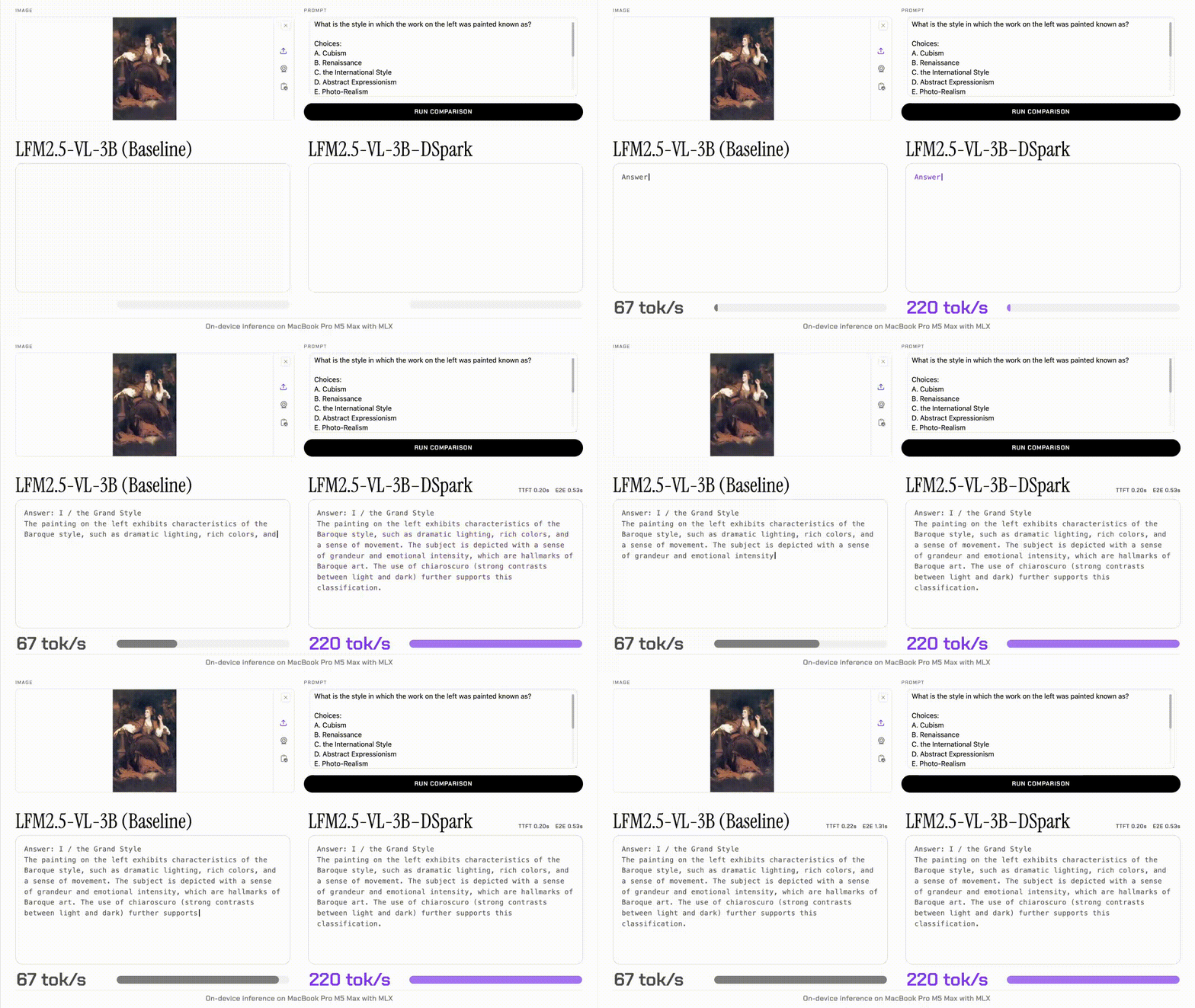
I recently came across a fascinating technical release detailing a speculative decoding framework tailored for vision-language models (VLMs). The core innovation is remarkably elegant: a lightweight, 280M-parameter “drafter” model that predicts candidate tokens, which are then verified by the larger target model. The result? A staggering acceleration in the decoding phase on-device, with a minimal increase in memory footprint, and zero loss in output quality.
The Architectural Elegance of Shared Modalities
What makes this development deeply significant from a research and architectural perspective is its modality-agnostic design. By projecting image patches and text tokens into a shared latent space before the tapped layers, the speculative mechanism operates on identical dimensional vectors regardless of the input type. This means the inference algorithm remains completely unchanged from pure text models.
For enterprise architects, this is a green light. It means we can apply the same optimization tricks developed for text-only LLMs to complex multimodal VLMs without fragmenting our system design. We are looking at a future where powerful visual reasoning models can run seamlessly on local hardware, offering privacy-first, low-latency solutions for sensitive enterprise workflows.
Navigating the Latency Bottleneck: Amdahl’s Law in Practice
However, a Chief Architect must always look at the trade-offs. As the analysis of this technology rightly points out, speculative decoding only accelerates the decode phase, not the prefill or the vision encoding stage. On edge devices, the prefill stage-which processes the heavy visual tokens-still consumes a significant portion of the end-to-end latency.
This is Amdahl’s Law in action: the overall speedup is capped by the part of the workload you cannot accelerate. While a significant speedup in decoding is spectacular for multi-turn conversations and interactive queries, the end-to-end gain will be more modest for single-shot, heavy image analysis. Enterprise architects must model this carefully: the real value of local VLMs lies in interactive, conversational use cases where the user is waiting for a stream of generated text, rather than in batch processing of static datasets.
The Edge Imperative: Frugal Innovation and Local Resilience
From my perspective, guiding digital transformation in regions like Northeast India, the importance of edge AI cannot be overstated. In geographies where network connectivity is intermittent, bandwidth is expensive, and data sovereignty is paramount, the ability to run a high-performance VLM locally on standard edge hardware is transformative. It enables offline-first applications for field agents, local visual search, and privacy-compliant document processing without relying on constant cloud connectivity.
This is where frugal innovation meets cutting-edge research. We do not always need the largest model in the cloud; we need the most efficiently structured model at the edge. The progress in speculative decoding for VLMs represents a massive step towards democratizing access to high-quality multimodal AI, making it viable, cost-effective, and resilient for the real-world constraints of global enterprises.
Key Strategic Takeaways for Enterprise Architects:
- Prioritize Hybrid Inference Architectures: Design systems that can dynamically route heavy prefill tasks to the cloud while executing interactive decoding locally on the edge.
- Embrace Speculative Decoding for Latency Reduction: For conversational VQA and multi-turn visual tasks, speculative decoding is no longer a niche research paper-it is a practical tool for unlocking massive performance gains.
- Design for Data Sovereignty: Local VLM execution is a powerful lever for compliance, especially when processing sensitive visual data containing personal or proprietary information.
The future of enterprise AI is not just about who has the biggest supercomputer; it is about who can deliver the most intelligent, responsive, and resilient experiences at the edge. The tools to do so are arriving now, and they are smarter than we think.
About the Author: Sanjeev Sarma is the Founder Director and Chief Software Architect at Webx Technologies. With a core focus on Generative AI integration, Cloud-Native Scalability, and Enterprise Software Architecture, he has spent over two decades driving digital transformation across Northeast India and beyond. Beyond his corporate leadership, Sanjeev is deeply invested in shaping the future of the IT industry. He serves as an Industry Expert on the Board of Studies for Assam Don Bosco University’s School of Technology, advises state technology committees, and actively mentors emerging tech startups at STPI. He brings a unique, dual perspective of high-level enterprise execution and future-ready academic curriculum development.