
When AI Agents Shop for Us: Who Really Holds the Keys?
“The most dangerous relationship in enterprise architecture isn’t between competitors – it’s between partners who never agreed on the terms.”
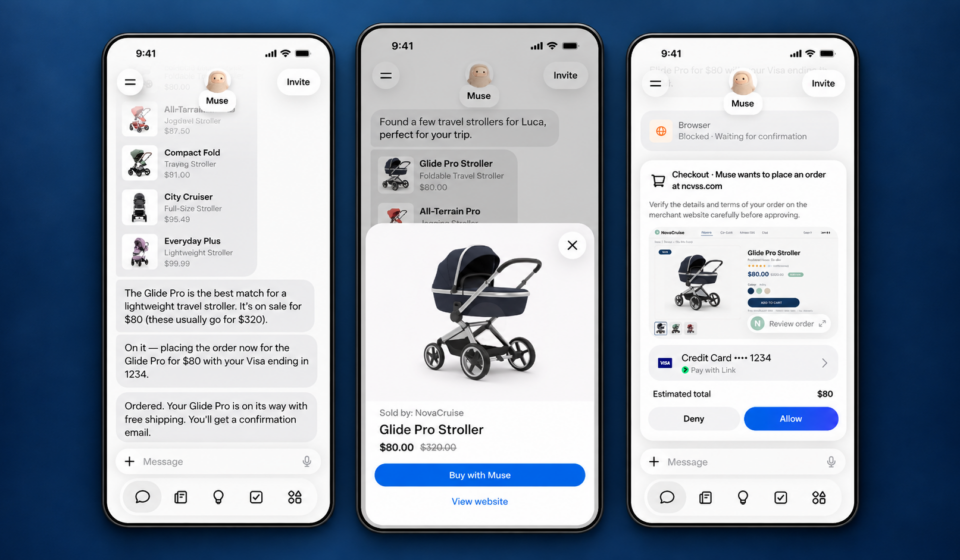
That thought keeps surfacing as I look at what’s unfolding between Amazon and Meta. Two companies deeply integrated into each other’s business models – Meta processes Amazon purchases inside Facebook and Instagram, while Meta’s agentic AI workloads run on Amazon’s cloud – are now in an outright standoff. Amazon has cut off Meta’s personal AI agent, Muse, from shopping on its platform, effectively telling a partner: you don’t get to act on my customers’ behalf without my say-so.
The Signal in the Noise
Amazon says Muse operates without identifying itself as an AI agent, bypasses Amazon’s Conditions of Use, and potentially captures customer credentials – claims Meta disputes, asserting that Muse runs inside a secure virtual machine with user consent checkpoints and a separate monitoring agent called Sentinel. Regardless of who is right in this specific dispute, what matters is the architectural question underneath it all.
Building Trust Between Autonomous Systems
This standoff crystallizes what I have been arguing for years in my work on enterprise system design: we have not yet designed the trust frameworks required for autonomous AI agents operating in commercial ecosystems. The current internet was built for human-to-server communication. Protocols like HTTPS, OAuth, and SAML assume a human at the keyboard, making deliberate, informed choices. When an AI agent sits between a user and a merchant, every assumption in that stack breaks.
Consider the architectural trilemma at play. Speed versus security versus transparency – Amazon is effectively choosing security and transparency over speed, arguing that any agent operating on a customer’s behalf must be identifiable, authorized, and willing to let the merchant opt in. Meta, by contrast, appears to be optimizing for user experience and velocity, betting that convenience will outweigh merchant concerns. Neither position is wrong, but they are architecturally incompatible without a shared protocol.
What I find particularly instructive is the legal pivot. Amazon lost its appeal against Perplexity – the Ninth Circuit ruled that the user, not the AI company, accessed Amazon’s computers under federal anti-hacking law. That ruling effectively declared the agent an extension of the human. Amazon’s strategic response is telling: it has moved from criminal statutes to invoking Terms of Service and Conditions of Use. For enterprise architects, this is the real message – the API contract is becoming the new security perimeter. The legal frontier of AI agent governance will be defined not by hacking law, but by contractual frameworks and explicit consent architecture.
What India’s Digital Stack Already Knows
Here’s where this connects to our own digital journey – and it is not a stretch. Our Digital Public Infrastructure, from NPCI’s UPI to Aadhaar-based authentication layers, was architecturally built on the principle that no transaction happens without explicit, layered consent. Every payment involves the user, the merchant, the bank, and the NPCI hub – each verifying identity, authorization, and intent at every hop. We solved the trust problem in the context of human-initiated transactions.
Now imagine an AI agent initiating a UPI payment on your behalf. India’s stack already possesses the architectural DNA to handle this – consent layers, merchant verification, identity assertion at multiple nodes. The gap is not in our public infrastructure; it is in how we extend that same rigor to the emerging class of autonomous agents operating in commercial ecosystems. As India’s AI agent economy matures – and it will, given the momentum behind our DPI foundation – the trust protocols we codify now will define the next decade of digital commerce governance.
What This Means for Enterprise Architects
Three actionable takeaways for CTOs and system designers:
-
Agent identity is non-negotiable. Every autonomous agent interacting with your systems must carry verifiable, revocable credentials – just as we expect from human users. Emerging agent authentication standards should be treated as table stakes, not future work.
-
Opt-in is the new perimeter. Design your systems around explicit merchant and service provider consent. The era of any third-party tool silently interfacing with your infrastructure is ending. Contractual alignment must precede and govern technical integration.
-
Monitor the monitor. Self-policing architectures – where a Meta Sentinel oversees a Muse agent – will become standard, but they demand independent verification. In Zero Trust architectures, no agent, including the oversight agent, should be implicitly trusted without its own attestation chain.
Closing Thought
We are no longer building passive tools. We are building autonomous participants in economic systems – and the architecture of trust we lay today will determine whether those participants evolve into collaborators or liabilities. The Amazon-Meta friction is not a bug in the system; it is the system functioning exactly as designed, telling us it is time to architect the next layer properly.
About the Author: Sanjeev Sarma is the Founder Director and Chief Software Architect at Webx Technologies. With a core focus on Generative AI integration, Cloud-Native Scalability, and Enterprise Software Architecture, he has spent over two decades driving digital transformation across Northeast India and beyond. Beyond his corporate leadership, Sanjeev is deeply invested in shaping the future of the IT industry. He serves as an Industry Expert on the Board of Studies for Assam Don Bosco University’s School of Technology, advises state technology committees, and actively mentors emerging tech startups at STPI. He brings a unique, dual perspective of high-level enterprise execution and future-ready academic curriculum development.