Beyond the Bridge: Architecting Energy Resilience With Military Precision

When Your Car Becomes Your Power Plant: What a Navy Veteran’s Clean Energy Mission Tells Us About the Future of Infrastructure
At the end of every complex energy transaction is a human waiting for the lights to stay on. Not a consumer clicking a button – a parent in Timor-Leste watching darkness swallow a city at 9 PM, or a fisherman in Fiji watching a supply ship fail to arrive for the third month in a row. Those moments are where the real conversation about energy architecture begins.
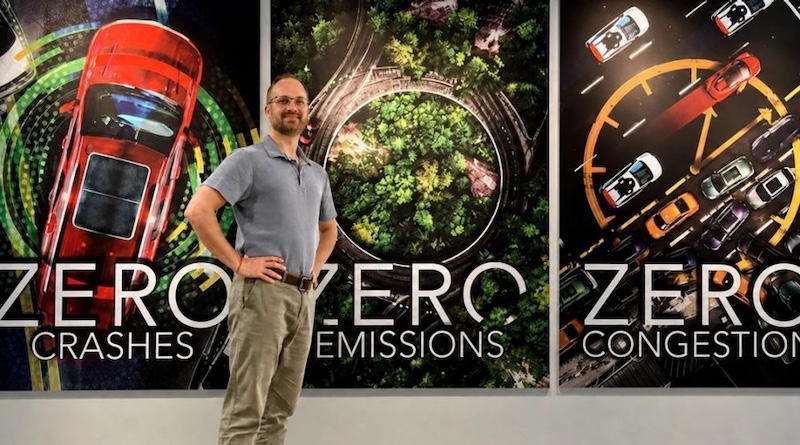
A recent profile highlighted how Taylor Searcy, a former Surface Warfare Officer who stood watch aboard the USS Lassen – responsible for navigating a $1 billion destroyer and over 300 sailors – transitioned into the role of Clean Energy Strategy Lead at General Motors. His journey from managing real-time situational awareness on a naval vessel to overseeing the energy infrastructure powering one of the world’s largest automakers offers a striking case study in how mission-critical thinking reshapes enterprise-scale energy systems. More notably, GM achieved a milestone in 2025: matching 100% of its U.S. electricity consumption with renewable energy, making it the first American automaker to reach that threshold. On top of that, the company is piloting bidirectional charging technology, effectively turning compatible EVs into home backup power systems.
Here is where I believe the real strategic conversation begins – and why most industry commentary misses it entirely.
We tend to discuss renewable energy adoption as an environmental goal and electric vehicles as a product category. But what Searcy’s trajectory and GM’s announcements actually reveal is a fundamental architectural shift: the convergence of energy generation, storage, distribution, and consumption into a single integrated system. This is not merely procurement. It is a complete re-architecture of how critical infrastructure operates.
Consider what GM’s 100% renewable matching actually demands at the systems level. It requires real-time energy sourcing orchestration, long-term Power Purchase Agreement architectures, grid-balancing mechanisms, and an enterprise-wide commitment that spans assembly plants, design centers, and corporate offices. For a company that also manufactures vehicles, this means treating the energy grid almost like an internal platform – one that must be reliable, cost-optimized, and resilient against disruption. The same discipline that an Officer of the Deck applies to watch-standing applies here: continuous monitoring, clear escalation protocols, and contingency planning for conditions that will inevitably change.
The bidirectional charging initiative takes this even further. When a GM EV can serve as a home backup generator through V2H (Vehicle-to-Home) technology, the vehicle is no longer just a product – it becomes a distributed energy resource. From an enterprise architecture standpoint, this means GM is designing its product ecosystem to interact with residential energy infrastructure. That is a profound systems design decision. It blurs the boundary between manufactured goods and grid infrastructure, requiring new standards for interoperability, safety, load management, and grid interconnection.
For those of us building enterprise platforms, the lesson is clear: the most durable architectures are the ones that anticipate second-order uses. Do not simply build a product; build a node in a larger network.
There is also a resonant parallel for Northeast India and the broader Indian context. The region’s energy landscape faces genuine challenges – grid instability in remote areas, dependence on intermittent supply chains, and the need for resilient last-mile infrastructure. The principle GM is pioneering at scale – treating every energy consumer as a potential producer and storage node – has direct implications for decentralized energy planning in geographically dispersed regions. Frugal innovation in energy architecture, where EVs and local renewable sources form microgrids rather than mere transportation units, could reshape energy access well beyond the automotive sector. The convergence of transportation and energy infrastructure is not a luxury of developed markets; it is a survival strategy for underserved ones.
Key Takeaways for Enterprise Leaders and Architects:
- Resilience is an architectural property, not a feature. GM’s renewable matching is not a marketing milestone – it is the result of layered contingency planning and long-term infrastructure investment that mirrors mission-critical systems design.
- Products should become platforms. Bidirectional charging transforms a vehicle from a endpoint into an energy node. Enterprises must design products with ecosystem-level interactions in mind from day one.
- Contingency thinking scales. The naval practice of planning around multiple courses of action translates directly to energy system design, where grid conditions, demand spikes, and supply disruptions are the norm, not the exception.
- Decentralized energy architectures are the next frontier. Whether in Michigan or Mizoram, the future belongs to systems where consumers and producers are integrated into resilient, bidirectional networks.
The conversation about clean energy is often framed as a trade-off – cost versus conscience, reliability versus transition. But what cases like this reveal is that the most compelling architectures turn that dilemma on its head. They make resilience and sustainability the same thing.
The mission changes. The principles do not.
About the Author: Sanjeev Sarma is the Founder Director and Chief Software Architect at Webx Technologies. With a core focus on Generative AI integration, Cloud-Native Scalability, and Enterprise Software Architecture, he has spent over two decades driving digital transformation across Northeast India and beyond. Beyond his corporate leadership, Sanjeev is deeply invested in shaping the future of the IT industry. He serves as an Industry Expert on the Board of Studies for Assam Don Bosco University’s School of Technology, advises state technology committees, and actively mentors emerging tech startups at STPI. He brings a unique, dual perspective of high-level enterprise execution and future-ready academic curriculum development.