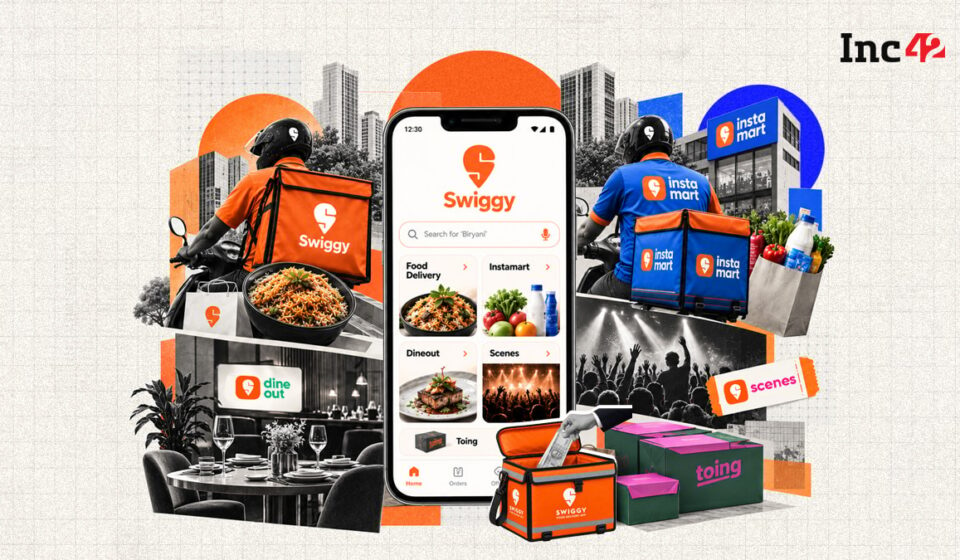
Architecting Swiggy’s Ecosystem: How Delivery Economics Fuel Platform Innovation

The Architecture of Strategic Loss: What Swiggy’s P&L Teaches Enterprise Platform Design
We often celebrate the profitable business and dismiss the loss-making one as a distraction. But what if I told you that in platform economics, the real strategic mastery lies not in profitability – but in knowing precisely which losses to engineer, and where to draw the financial boundaries between them?
Swiggy’s Q1 FY27 numbers tell a remarkably deliberate story. The company’s food delivery vertical generated ₹299 Cr in operating profit on ₹2,208 Cr revenue. Meanwhile, Instamart bled ₹778 Cr in adjusted EBITDA losses despite scaling to ₹7,907 Cr in Gross Order Value. Platform innovations – a sandbox for experiments like Toing and Crew – added another ₹131 Cr in losses. On the surface, this looks like corporate excess. Underneath, it is a masterclass in modular platform architecture.
Drawing the Boundary Lines
What strikes me most – and something I have often debated in technology strategy circles – is how Swiggy has architected separable economics within a single consumer-facing brand. Food delivery’s contribution margin of 7.6% on GOV is not just a number; it is the engine room. It funds the network, the technology stack, and the fulfillment infrastructure that newer verticals inherit without building from zero. This is precisely how well-designed microservices architectures function: a core service handles the critical path with precision, while satellite services experiment with new logic without destabilizing the mainframe.
Instamart’s contribution margin approaching break-even (-0.2% of GOV) at roughly 40% network utilisation is the pivotal data point. It signals that the experimental layer has begun developing its own economic gravity – but not yet enough to stand alone. For enterprise architects, this mirrors a familiar inflection point: when do you decouple a beta service into an independent product line? Swiggy’s answer is measured – wait for both product-market fit and business-market fit before allocating growth capital. That discipline, in my observation, is remarkably rare.
The Platform-as-a-Parent Model
Swiggy’s approach reflects what I would call a “platform-as-a-parent” philosophy – where the mature business acts as an incubator rather than just a profit center. Every expense line tells a story: ₹1,750 Cr in delivery charges is not merely a cost; it is shared infrastructure amortised across verticals. ₹1,160 Cr in advertising is not brand spend; it is cross-pollination capital. The ₹791 Cr consolidated loss is not failure – it is the price of optionality.
This has direct parallels in how we think about Digital Public Infrastructure in India. UPI’s architecture – a lean, efficient payment rail – enabled everything from BHIM to CBDC to offline payments. The core did not need to profit from every application built on top of it; its job was to provide a stable, scalable substrate. Similarly, in Northeast India, where last-mile connectivity and logistics remain critical bottlenecks, this model offers a compelling blueprint: core infrastructure investments – whether in logistics, data, or connectivity – must be designed to be shareable, not siloed. A well-architected backbone can make every downstream application cheaper to build and faster to scale.
What Enterprise Architects Should Take Away
- Design for separable economics. If your platform cannot isolate the profitability of one vertical from another, you cannot make strategic bets. Modular cost attribution is not accounting – it is architectural hygiene.
- Measure contribution margin, not just revenue. Revenue growth without margin visibility is a mirror telling you how fast you are falling.
- Resist premature scaling. Swiggy’s platform innovations operate with explicit capital discipline – funding experiments only until PMF and BMF are validated. Most enterprises scale failures because they cannot distinguish experimentation from commitment.
- Treat shared infrastructure as a strategic asset. That ₹1,750 Cr delivery network is Swiggy’s most valuable hidden asset – not because it generates revenue, but because it reduces the cost of every future bet.
The harder truth for founders and CTOs alike: sustainable growth often requires tolerating losses that are not symptoms of dysfunction, but expressions of strategic patience. The question is not whether you can afford to lose money – it is whether your architecture lets you understand exactly why.
About the Author: Sanjeev Sarma is the Founder Director and Chief Software Architect at Webx Technologies. With a core focus on Generative AI integration, Cloud-Native Scalability, and Enterprise Software Architecture, he has spent over two decades driving digital transformation across Northeast India and beyond. Beyond his corporate leadership, Sanjeev is deeply invested in shaping the future of the IT industry. He serves as an Industry Expert on the Board of Studies for Assam Don Bosco University’s School of Technology, advises state technology committees, and actively mentors emerging tech startups at STPI. He brings a unique, dual perspective of high-level enterprise execution and future-ready academic curriculum development.