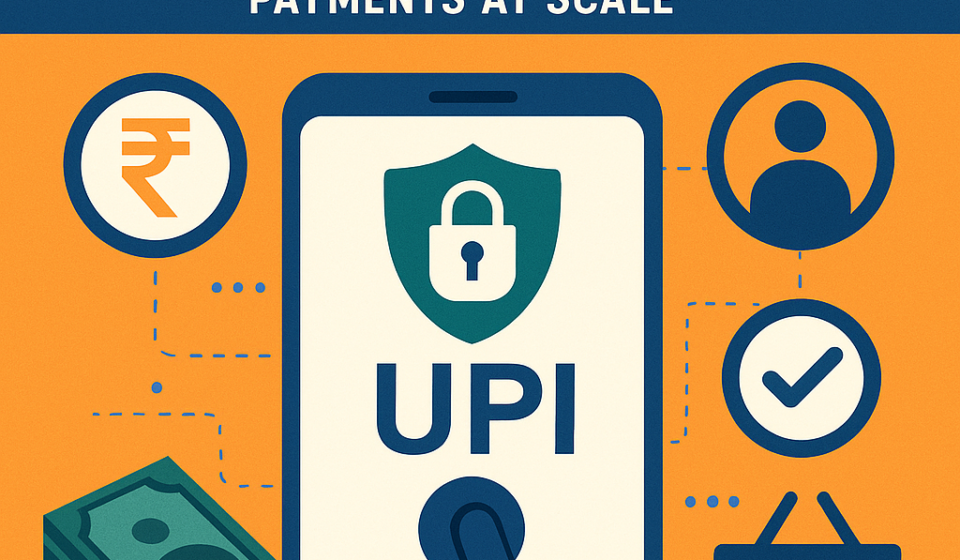
Monetising UPI: Architecting Inclusive, Secure Payments at Scale

Contrarian opening: Monetising a public rail is not the end of inclusivity – it can be the beginning of resilience.
After a decade of effectively free UPI rails, the National Payments Corporation of India (NPCI) has signalled a material shift: from October 15, select high-value P2M transactions (above ₹2,000) will attract an MDR of 0.4% (capped at ₹300), charged to merchants while P2P and small merchant flows remain subsidy-free. At first blush this feels like a policy about fees. But the architecture and long-term health of India’s payment stack are what’s really at stake.
Why this matters beyond the headline
UPI grew because it removed friction – financial, technical and commercial – and created a near-public good for digital payments. That model worked spectacularly while volumes scaled and costs were manageable. Today, volumes are orders of magnitude higher, threat vectors are wider, and operational costs (infrastructure, cybersecurity, dispute resolution, real-time settlement) are non-trivial. The introduction of MDR is an explicit recognition that rails need sustainable economics if they are to remain robust, secure and upgradeable.
Architectural implications for enterprise and fintech leaders
- Incentive alignment matters. A shared MDR pool that flows back to issuer banks, PSPs and app providers creates a clearer business case to invest in resilience – think stronger fraud engines, better encryption in transit and at rest, and higher SLAs for availability. This will alter vendor selection criteria: choose partners who can demonstrate measurable investments funded by predictable fees, not just zero-cost growth.
- Expect differentiation at the API and orchestration layer. Payment orchestration platforms and merchant acquirers will compete on value-added services – fraud scoring, chargeback automation, settlement velocity, analytics – not only on price. Architect systems to accept metadata-rich payment callbacks, flexible fee-routing, and fine-grained reconciliation.
- Build for observable economics. CTOs must instrument payments flows end-to-end: per-transaction cost attribution, MDR accounting, and profitability analytics by channel and merchant cohort. Without that telemetry, pricing decisions become guesswork and margin erosion follows.
- Security and fraud controls become a product investment, not a compliance checkbox. With a revenue stream, fintechs must prioritise signal-enrichment (device telemetry, geofencing, behavioral scoring) and invest in zero-trust controls for third-party integrations.
- Be cautious with behavioural nudges. Prohibiting direct pass-through to customers is sensible, but merchants may adopt indirect workarounds (minimum-basket requirements, “discount for cash” messaging, differential pricing). Systems must track and report on acceptance patterns to inform policy and compliance responses.
What this means for Bharat – the practical, regional angle
This change is particularly consequential for MSMEs outside metro corridors. The exemption for merchants receiving up to ₹1 lakh/month via QR is important – it preserves support for micro-enterprises. But for small-town and Northeast merchants who are just crossing thresholds, even modest MDRs can alter UX. Fintechs and banks should prioritise targeted onboarding and education: integrate MDR-aware reporting into merchant dashboards, offer tiered loyalty/discount programs, and subsidise high-value flows for growth-critical sectors (e.g., healthcare, education) where affordability matters.
Actionable recommendations (for CTOs, product heads, founders)
- Implement payment orchestration that supports dynamic routing, fee attribution and settlement prioritisation.
- Surface MDR impact in merchant dashboards and POS systems so business owners can make informed decisions.
- Invest MDR proceeds into measurable security outcomes – reduce fraud rates and MTTR; report these improvements to partners.
- Pilot merchant programs that absorb MDR for strategic categories to avoid demand-side distortion.
- Monitor for unintended behaviour (surcharging via pricing, acceptance decline) and be ready to iterate product and pricing responses.
Takeaways
- Monetisation of rails is a maturity signal, not a betrayal of inclusivity.
- The real test is whether MDR funding translates into demonstrable infrastructure, security and inclusion benefits.
- Leaders should treat MDR as a design constraint: build telemetry-rich, merchant-centric systems and reinvest fees into resilience and rural enablement.
Closing thought
Sustainable public goods require sustainable economics – if we design the incentives correctly, this change can turn UPI’s spectacular scale into durable infrastructure that serves every corner of India, not just the checkout counter.
About the Author: Sanjeev Sarma is the Founder Director and Chief Software Architect at Webx Technologies. With a core focus on Generative AI integration, Cloud-Native Scalability, and Enterprise Software Architecture, he has spent over two decades driving digital transformation across Northeast India and beyond. Beyond his corporate leadership, Sanjeev is deeply invested in shaping the future of the IT industry. He serves as an Industry Expert on the Board of Studies for Assam Don Bosco University’s School of Technology, advises state technology committees, and actively mentors emerging tech startups at STPI. He brings a unique, dual perspective of high-level enterprise execution and future-ready academic curriculum development.