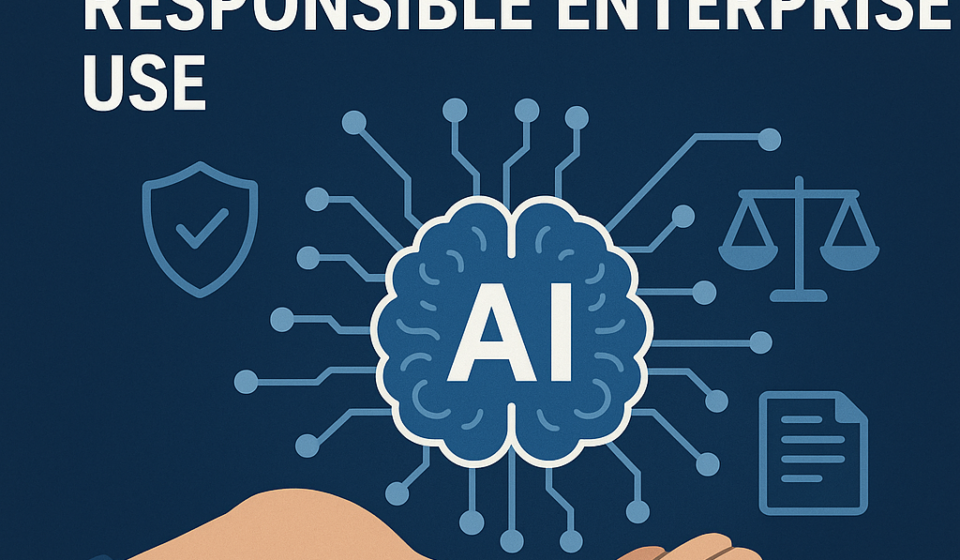
Beyond Blind Trust: Architecting AI for Responsible Enterprise Use

We obsess about making AI smarter. We rarely design systems to make people trust it for the right reasons.
A recent profile of an AI practitioner who moved from teaching into building organisational AI made me pause. The core idea – that trust in AI is as much a product of design choices and organisational processes as it is of model accuracy – is a timely reminder for anyone responsible for rolling AI into production at scale.
Why this matters for enterprise architecture
Many teams treat trust as a UX afterthought: improve model accuracy, add a dashboard, and hope people will adopt. But trust is a systemic property. In practice I see three intertwined domains that determine whether an organisation will welcome an AI assistant or circumscribe it: data architecture (what the AI can see), interaction design (how the AI speaks and signals uncertainty), and governance (who decides when the AI should be trusted).
Design choices change behaviour. Simple adjustments – explaining why an AI gave a suggestion, surfacing its limitations, or structuring the interaction – can materially change how teams rely on it, even when the underlying model hasn’t changed. That is powerful, and potentially dangerous: design can create a false sense of reliability. From an architecture standpoint, that implies we must build for calibrated trust, not maximal trust.
Practical implications and trade-offs
-
Data access and organisational memory: Modern assistants are most useful when they can surface institutional knowledge – meeting notes, decision logs, product docs. But centralising that memory into searchable indices (vector stores, RAG pipelines) amplifies risks: leakage, stale facts, and wrong provenance. Architects must choose between centralised searchable memory with strong access controls and federated/silos-aware retrieval that respects context and ownership. Trade-off: search effectiveness vs. data minimisation and privacy.
-
Explainability and provenance: Surface the chain-of-thought or retrieval provenance for every recommendation. Not because it’s always human-friendly, but because provenance supports audits, rollback, and human judgement. There’s a cost here: more tokens, higher latency, and engineering complexity. The alternative is invisible AI decisions that accelerate adoption but increase systemic risk.
-
Human-in-the-loop and decision boundaries: Define explicit decision classes where AI can act autonomously, where it should recommend, and where it must only assist. This “trust zoning” reduces blast radius and simplifies compliance. It also clarifies training needs for staff: when to accept, when to question, and when to escalate.
-
Monitoring and model lifecycle: Trust decays when models drift or when the data distribution changes. Integrate model monitoring, concept-drift detection, and a model registry into normal ops. Include “trust metrics” – not just accuracy, but measures of user override rates, disagreement rates, and provenance inquiries.
A note for Indian enterprises and startups
The lessons are especially relevant for many Indian organisations I advise. We have a lot of institutional knowledge trapped in personal inboxes, WhatsApp threads, and tribal knowledge. Building a searchable organisational memory can be transformative – but only if we design retention policies, multilingual support, and consent flows from the outset. Frugal architectures (lightweight vector stores, edge caching, selective persistence) can offer a practical compromise for SMEs and public bodies constrained by cost and data residency requirements.
Actionable takeaways
- Design for calibrated trust: make AI’s limits visible, and structure interactions so users can easily validate outputs.
- Treat provenance as first-class data: every answer should carry its evidence and lineage.
- Zone decisions: classify which actions AI can take, recommend, or must never take.
- Monitor trust, not just accuracy: track human override, confirmation rates, and model drift.
- Build privacy-aware memory: adopt selective indexing, access controls, and retention policies before you centralise organisational knowledge.
Closing thought
Trust in AI is not a binary you flip on; it’s a property you engineer – through data, interaction, and governance – and then steward over time.
About the Author: Sanjeev Sarma is the Founder Director and Chief Software Architect at Webx Technologies. With a core focus on Generative AI integration, Cloud-Native Scalability, and Enterprise Software Architecture, he has spent over two decades driving digital transformation across Northeast India and beyond. Beyond his corporate leadership, Sanjeev is deeply invested in shaping the future of the IT industry. He serves as an Industry Expert on the Board of Studies for Assam Don Bosco University’s School of Technology, advises state technology committees, and actively mentors emerging tech startups at STPI. He brings a unique, dual perspective of high-level enterprise execution and future-ready academic curriculum development.