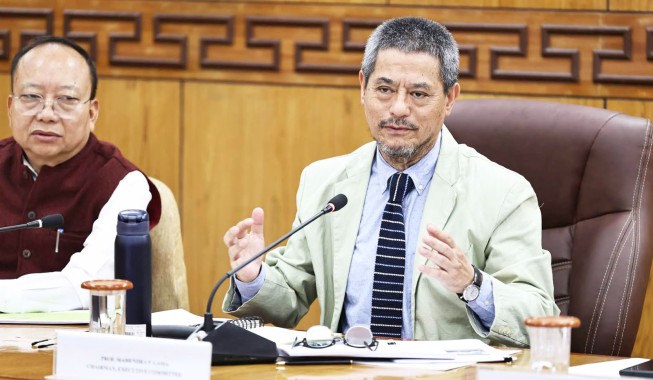

Prof. Mahendra P. Lama on Monday, September 14, 2026, dismissed claims that a draft “road map” for resolving the long-running Gorkhaland demand envisaged including Sikkim within any proposed separate state, saying the document neither contained a map nor any text suggesting Sikkim would be part of such a state.
Lama was responding to remarks by the president of the Citizens Action Party (CAP) Sikkim, which he called “insinuating, irresponsible and condemnable.” The draft, circulated among members of the Civil Society of Darjeeling in July 2026, is titled “Road Map for a Permanent Political Solution: 4 Options/Pathways: Preliminary Discussion Draft for a Separate State.”
The draft outlined four possible pathways: creation of a full-fledged state (as India’s 29th), formation of a Union Territory, an “autonomous State” within West Bengal, and a proposal for a North Bengal State that could, in theory, include contiguous areas of neighbouring states. Lama said the fourth option described a potential North Bengal State made up of Darjeeling and Kalimpong districts, the Dooars region covering Jalpaiguri and Alipurduar districts, Chopra in Uttar Dinajpur, and other West Bengal districts — with the possibility of contiguous areas of neighbouring states being included. He stressed that the reference to “other contiguous States” has been misrepresented as referring to Sikkim.
“The adjoining States vary from Bihar and Jharkhand to Assam and Meghalaya,” Lama said, adding there was “no question of seeking to dismember or dislocate Sikkim.” He explained the fourth pathway was largely a contingency plan intended to prepare people in Darjeeling, the Terai and the Dooars for a sudden announcement from the Centre about a separate North Bengal State.
Lama also noted that, given changing political circumstances in West Bengal, the version of the document submitted to the central authority in August 2026 contained only the first three pathways. He said the draft emphasized the need for prior discussion among key stakeholders on constitutional status, political representation, geographic boundaries, powers and functions, institutional structures, financial devolution and governance arrangements.
Describing his involvement with the Gorkhaland issue as a “lifelong social commitment,” Lama urged political actors not to exploit the sensitive question of Indian Gorkha identity and statehood for what he called “low-level political propaganda.” He reminded readers that the Gorkhaland demand has a long history — pursued for nearly 119 years, with many having sacrificed their lives in the struggle for identity and statehood.
Original Source: https://www.sikkimexpress.com/news-details/lama-rejects-claim-that-gorkhaland-roadmap-includes-sikkim
Category:
Tags:
Publish Date: