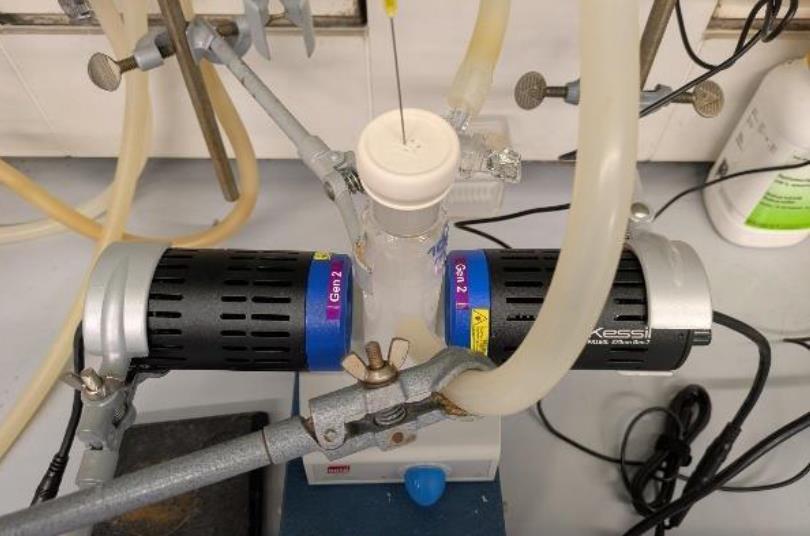

A team led by Roopender Kumar at University College London has developed a simple, bench-top method to generate hydrogen radicals under mild conditions using off‑the‑shelf reagents. The technique works at about 30°C, uses a violet LED, a low‑cost sulfur-based organocatalyst and hydrazine, and-Kumar says-requires “no precious or toxic metals, no hydrogen gas, no pressure equipment.” The advance removes the extreme temperatures, electrical discharges or ionising radiation previously needed to make these highly reactive atoms, making hydrogen radicals far more accessible to ordinary synthetic laboratories.
Hydrogen radicals are the simplest radical species-one proton bound to one electron-but they have been notoriously hard to produce under practical conditions. Kumar’s team showed that combining hydrazine with the sulfur catalyst forms an intermediate that, when irradiated with near‑UV light, yields protonated hydrazine carrying an extra electron. This unusual neutral Rydberg radical rapidly fragments into hydrazine and a free hydrogen atom, which can then engage directly in reactions such as hydrogenation and dehalogenation.
The method delivers practical results. For alkene hydrogenation the group reports yields as high as 96% on a gram scale across a broad substrate scope while tolerating sensitive groups such as aryl chlorides, bromides and carbamates-functionalities that conventional palladium catalysts would often destroy. Kumar’s team also tested structurally related targets including fluoxetine‑like molecules, menthol derivatives, terpenoids and amino acids. Notably, the hydrogenation of allyl glycine proceeded without scrambling stereochemistry, the authors report.
Independent experts welcome the work. Maxie Roessler of Imperial College London, who was not involved in the study, called the ability to generate hydrogen radicals with simple near‑UV sources “a big breakthrough,” saying it should make hydrogen‑radical reactions “far more accessible, allowing a broader range of researchers to explore and exploit this species.”
Kumar argues the controllable, metal‑free approach could change how chemists think about radical processes and offers “the first real hope of more accessible alternatives” for greener radical chemistry. If widely adopted, the technique could expand practical routes for hydrogenation, dehalogenation and other transformations that rely on the free hydrogen atom.
Original Source: https://www.chemistryworld.com/news/simple-technique-makes-it-easier-to-access-and-exploit-hydrogen-radicals/4024180.article
Category:
Tags:
Publish Date: 2026-09-15 18:57:00