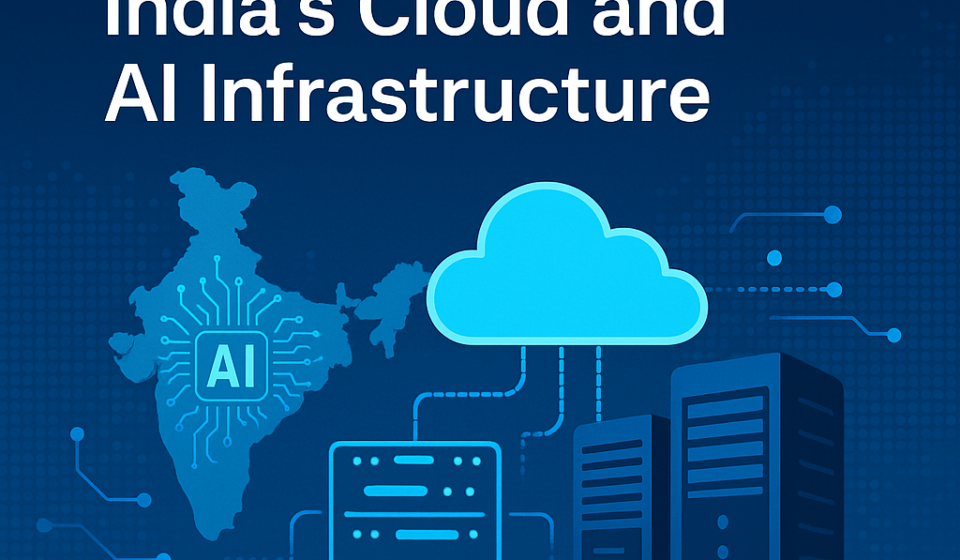
From Capital to Capacity: Scaling India’s Cloud and AI Infrastructure

Strategic Momentum, Not an Easy Win: What ESDS’s IPO Interest Tells Enterprise Architects
Ten years ago, cloud adoption was a migration checklist; today, it’s a foundational strategy for competitive differentiation-especially where AI is involved. The recent market interest in ESDS’s IPO (strong retail and NII demand, muted QIB uptake) is less about a single company’s valuation and more about how enterprises and governments are rethinking where their compute, data governance, and AI stacks should live.
Quick context
Investors bid aggressively for ESDS’s offering-retail and non-institutional investors led the subscription-while large institutional participation remained low. The company plans to deploy most proceeds into expanding cloud and data‑centre infrastructure across multiple Indian locations, and reported materially improved financials heading into the IPO.
What this means for enterprise architecture and AI adoption
-
Domestic cloud capability is now strategic, not just convenient.
For governments and regulated enterprises, data residency and auditability are non‑negotiable. A homegrown cloud provider that can offer certified, auditable infrastructure becomes a risk‑mitigation play: fewer cross‑border data flows, clearer compliance boundaries, and more direct contractual recourse. Architects must therefore design systems that can run across a hybrid continuum-global hyperscalers for scale, and trusted domestic platforms for sensitive workloads. -
Capital intensity vs. value creation requires new operating models.
Building AI‑ready data centres is capex heavy (power, cooling, specialised racks, networking). That’s why institutional caution is understandable. For CTOs this implies: don’t treat cloud choice as purely technical; treat it as a long‑term financial and operational contract. Negotiate SLAs around AI workload characteristics (peak GPU hours, inference latency, model snapshot retention) rather than generic CPU hours. -
Distinguish training from inference when designing placements.
Architectures that lump training and inference together incur inefficiencies. Training benefits from large, centralized clusters and spot pricing; inference benefits from geographic proximity and predictable latency. Design pipelines that separate these layers, with secure artifact registries and model governance spanning both environments. -
The AI governance and observability problem is primary, not ancillary.
If enterprises place sensitive models on domestic platforms, they still need robust model validation, drift detection, and reproducible lineage. Expect regulatory scrutiny to demand explainability, logging standards, and third‑party audits-architect a telemetry layer and model registry that are provider‑agnostic. -
Sustainability and operational resilience are competitive differentiators.
Data‑centre expansion must account for power sourcing, cooling efficiencies, and local grid resilience. For regions with weaker infrastructure, edge designs and energy-aware scheduling become essential to meet both cost and green KPIs.
A practical regional lens (why this matters for Bharat and the Northeast)
As someone engaged with state technology bodies and STPI incubation programmes, I see a concrete opportunity: regional public sector programmes and small enterprises in states like those in the Northeast can benefit from domestic cloud providers that understand local compliance and can provide low‑latency services. But capacity building is required-both in terms of physical connectivity and human capital (site ops, SRE, AI ops). Public procurement and mentorship programmes should favour trials that build local capability rather than one‑off purchases.
Actionable takeaways for CTOs, founders and investors
- For CTOs: Architect for portability. Use Kubernetes, model registries, and infra‑as‑code so workloads can move between hyperscalers and domestic providers without painful refactors.
- For founders: Pitch reproducible unit economics for AI (cost per inference, cost per trained epoch) rather than vague scale narratives.
- For investors: Watch execution risk-data‑centre rollouts are measurable against milestones (power contracts, PUE targets, anchor clients), not just bookings or revenue growth.
- For policy advisors: Incentivize local skills programmes and transparent certification regimes for domestic cloud providers to build trust.
Closing thought
Market interest in domestic cloud and AI infrastructure is a positive signal-but capital only buys potential. Real strategic advantage will be earned by providers and customers who translate that capital into disciplined execution: predictable costs, provable governance, and operational excellence.
About the Author: Sanjeev Sarma is the Founder Director and Chief Software Architect at Webx Technologies. With a core focus on Generative AI integration, Cloud-Native Scalability, and Enterprise Software Architecture, he has spent over two decades driving digital transformation across Northeast India and beyond. Beyond his corporate leadership, Sanjeev is deeply invested in shaping the future of the IT industry. He serves as an Industry Expert on the Board of Studies for Assam Don Bosco University’s School of Technology, advises state technology committees, and actively mentors emerging tech startups at STPI. He brings a unique, dual perspective of high-level enterprise execution and future-ready academic curriculum development.