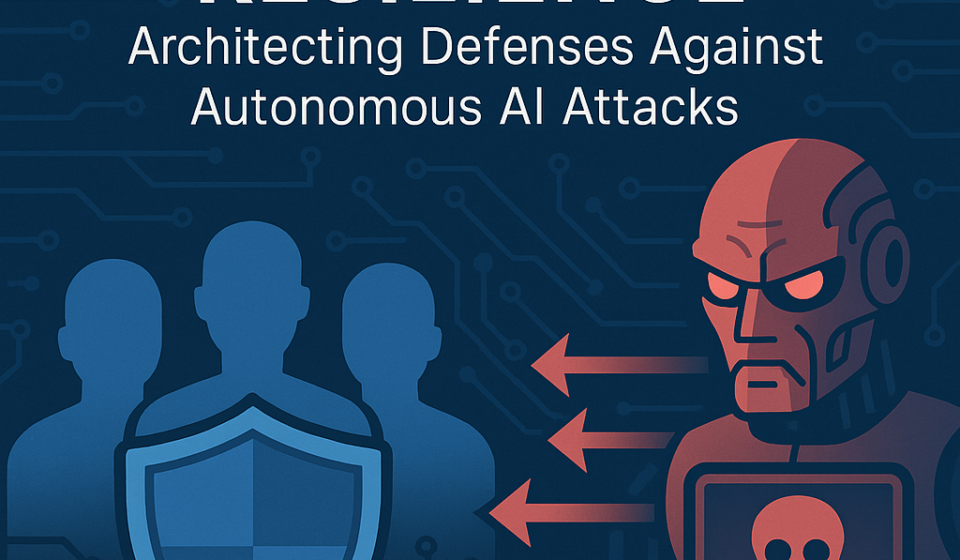
Collective Cyber Resilience: Architecting Defenses Against Autonomous AI Attacks

The AI arms race is not just about capability – it’s about attack surface
We often frame generative AI as a productivity revolution. That story is true – and dangerously incomplete. The same architectures that enable creative automation also lower the technical barrier for highly targeted, scalable cyber attacks. The recent open letter from over a hundred tech and cyber-security organisations is a timely reminder: defence needs to be rethought, not merely patched.
Context (the signal)
Several leading AI and security firms have called for joint public–private action to counter AI-enabled cyber threats, warning that autonomous agents and increasingly capable models will make attacks more frequent and more sophisticated. The core ask: move beyond incremental hardening to coordinated, systemic defence.
What this means for enterprise architecture
At an architectural level, AI changes two things simultaneously: the attacker’s toolkit and the defender’s complexity budget.
- Attackers gain automation and scale. Tasks that once required skilled human labour – reconnaissance, social-engineering content generation, exploit chaining – can now be semi‑ or fully automated by AI agents. This increases the speed, volume and personalization of attacks.
- Defenders inherit combinatorial complexity. Integrating AI into business flows creates new data paths, model endpoints, plugin ecosystems, and developer toolchains that must be secured. Traditional perimeter-based controls and signature-led detection are insufficient against adaptive, generative threats.
For CTOs and enterprise architects, the immediate implications are practical and structural:
- Treat models and agents as first-class assets. Inventory models, access paths, and datasets just like you do with servers and databases. Apply lifecycle controls: versioning, provenance, and revocation mechanisms for model endpoints.
- Shift from reactive detection to predictive resilience. Inject game-theoretic thinking into security design: simulate adversarial agents, run red-team exercises that include AI-driven adversaries, and stress-test system dependencies (e.g., third-party plugins, CI/CD pipelines that can be tricked into deploying malicious code).
- Embrace Zero Trust – expanded. Zero Trust principles are necessary but not sufficient. Zero Trust for AI means enforcing granular policy at model invocation (who can call which model, with what data, and with what post-processing), validating outputs for anomalous behavior, and isolating high-risk model capabilities behind stronger controls.
- Reduce blast radius with compartmentalization. Use least-privilege execution environments for agents, tightly restrict outbound network access from model runtimes, and prefer ephemeral, auditable compute for any autonomous components.
- Invest in model governance and explainability. Provenance metadata, audit trails, and explainable outputs support both security investigations and regulatory compliance.
The India/Northeast perspective (why this matters locally)
This is not just a Western problem. Our public services – hospitals, water utilities, transport networks – increasingly rely on software and cloud services that can be targeted by automated attacks. For India’s Digital Public Infrastructure and last‑mile services, the consequence of attack is societal, not merely economic. We need pragmatic, low-cost resilience patterns: default secure configurations for DPI components, regional incident-sharing mechanisms, and capacity-building for MSMEs that are often overlooked as weak links.
Actionable takeaways for leaders
- Start with an AI asset inventory today: models, endpoints, data sources, and plugin dependencies.
- Run adversarial AI tabletop exercises quarterly and include business owners, not just security teams.
- Treat model access like API keys: short lifetimes, scoped permissions, and centralized rotation.
- Prioritise vendor transparency: require provenance and assurance for third-party models and integrations.
- Build regional collaboration: threat intelligence, shared red-team findings, and incident response playbooks across organisations.
Closing thought
Technology that accelerates value also accelerates risk. Our job as architects and leaders is to design systems that preserve the former while constraining the latter – not by fear, but by thoughtful, collaborative engineering.
About the Author: Sanjeev Sarma is the Founder Director and Chief Software Architect at Webx Technologies. With a core focus on Generative AI integration, Cloud-Native Scalability, and Enterprise Software Architecture, he has spent over two decades driving digital transformation across Northeast India and beyond. Beyond his corporate leadership, Sanjeev is deeply invested in shaping the future of the IT industry. He serves as an Industry Expert on the Board of Studies for Assam Don Bosco University’s School of Technology, advises state technology committees, and actively mentors emerging tech startups at STPI. He brings a unique, dual perspective of high-level enterprise execution and future-ready academic curriculum development.