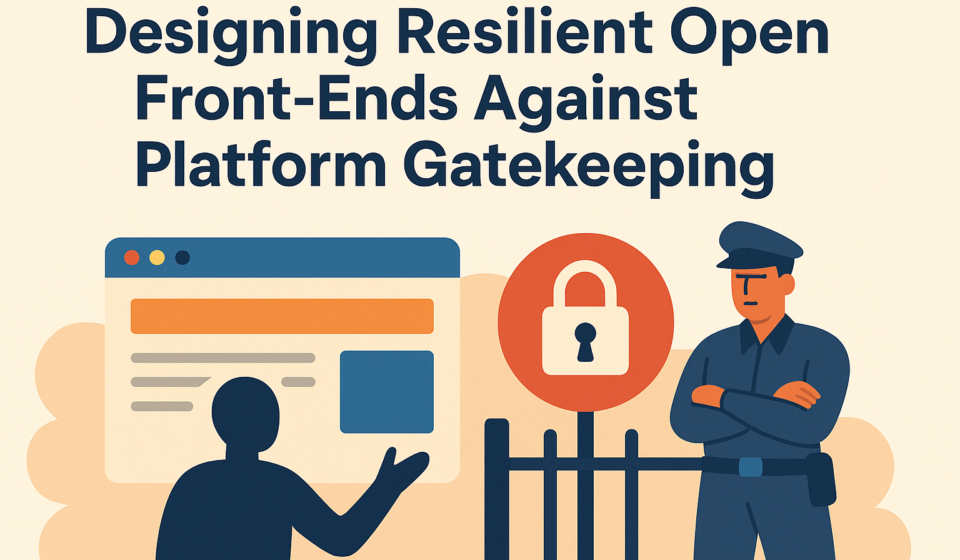
Designing Resilient Open Front-Ends Against Platform Gatekeeping

When platform convenience becomes a single point of failure
I recently came across an important development: on 24 August 2026, X Corp issued cease‑and‑desist notices to the maintainers of Nitter – an open‑source, privacy‑focused front‑end that let people read X posts without logging into the official app. That takedown request, and the visible legal pressure on instance hosts, is a small story with a large architectural moral.
Why this matters (two‑sentence signal)
Nitter was not a novelty; it was a practical adaptation to a world where platform APIs, tracking, and monetisation increasingly gate access to public conversation. The legal move against it highlights a growing structural tension between platform control and third‑party innovation – and enterprise architects should be paying attention.
What it means for system designers and product leaders
At its core this is a dependency and governance problem. Many organisations – research teams, media houses, compliance groups, and startups – build capabilities that implicitly rely on downstream platform access: public posts, user metadata, trends. When that access is mediated by a single vendor, three realities follow:
- Control risk becomes operational risk. A platform can change API rules, introduce rate limits, or, as in this case, pursue legal remedies that render a technical workaround unsafe. That turns a useful integration into a brittle dependency overnight.
- Legal and ethical boundaries matter. Open‑source ingenuity (scraping, proxying, reverse‑engineering) often solves immediate usability problems, but it exposes maintainers and users to legal exposure. Enterprises must treat data ingestion as a product with legal SLAs and compliance checks, not a developer convenience.
- The “open web” is not uniformly open. Publicness of content does not equal free license to reproduce, re‑serve, or monetise it. Architects who assume otherwise will be surprised.
Practical architecture trade‑offs and tactics
Speed vs. resilience: Quick hacks (scrapers, unofficial clients) accelerate delivery, but they do not buy long‑term resilience. Design for graceful degradation: cache essential datasets, maintain last‑known states, and separate business logic from direct platform calls.
Contract over dependency: Wherever possible use official APIs backed by contractual terms and SLAs. If an API is paid, model that as a recurring cost of doing business rather than an optional add‑on.
Legal as non‑functional requirement: Include data provenance, consent capture, and IP review in the design phase. For public datasets used in analytics or products, require legal sign‑off before operationalisation.
Invest in portability and standards: Avoid proprietary lock‑in by modelling data interchange with open standards (e.g., ActivityPub, RSS‑based syndication where available, or other interoperable formats). Portability reduces rebuild costs if a data source disappears.
When decentralisation helps – and when it doesn’t
Decentralised protocols and federated architectures promise lower single‑point control, but they bring their own complexity and trust models. They are not magic bullets: governance, moderation, and discoverability remain hard problems. The real win is combining decentralised primitives with robust governance and clear incentives.
A brief note for Indian practitioners
India’s Digital Public Infrastructure (DPI) experience shows that legal and technical openness can coexist when backed by clear contracts, standards and public‑interest mandates. Private platforms, however, operate on different incentives. Indian enterprises and researchers should therefore prefer official integrations or DPI‑style neutral intermediaries where national policy or research needs require continuity of access.
Actionable takeaways
- Inventory platform dependencies and classify them by legal and operational risk.
- Treat data access as a product: assign owners, SLAs, budgets, and contingency plans.
- Prefer contractually backed APIs for production workloads; cache and version harvested data.
- Build for portability: export/import paths, schema migration plans, and open interchange formats.
- Engage with standards bodies and DPI initiatives – help shape interoperable options rather than rely on fragile workarounds.
Closing thought
The Nitter episode is less about one project and more about a fundamental design question: who gets to decide how public conversation is accessed and preserved? Architects who accept vendor control without strategy will inherit fragility; those who plan for portability, legal clarity and resilient design will turn platform volatility into manageable risk.
About the Author: Sanjeev Sarma is the Founder Director and Chief Software Architect at Webx Technologies. With a core focus on Generative AI integration, Cloud-Native Scalability, and Enterprise Software Architecture, he has spent over two decades driving digital transformation across Northeast India and beyond. Beyond his corporate leadership, Sanjeev is deeply invested in shaping the future of the IT industry. He serves as an Industry Expert on the Board of Studies for Assam Don Bosco University’s School of Technology, advises state technology committees, and actively mentors emerging tech startups at STPI. He brings a unique, dual perspective of high-level enterprise execution and future-ready academic curriculum development.