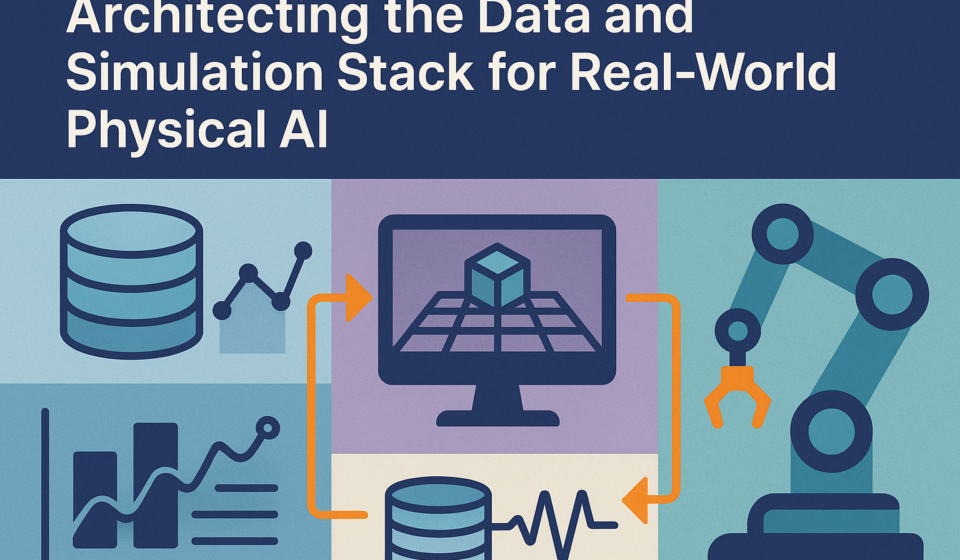
Architecting the Data and Simulation Stack for Real-World Physical AI

The robots are getting more agile – but not yet more valuable
Why we’re excited about physical AI is obvious: improved locomotion, better sensors, and huge investment dollars. But that applause misses the harder question for enterprises and builders: when does a robot stop being a demo and start being a reliably value‑creating system?
A quick signal from the field: heavy investor interest, large valuations, and fast‑growing developer meetups coexist with a persistent “robotics data crisis” – sparse, narrow, expensive training data and simulation gaps that prevent robust, real‑world performance. Meanwhile, the most mature deployments remain task‑specific (autonomous vehicles, excavation, industrial arms), not general‑purpose humanoids.
What this really means for architects and CTOs
Physical AI is not a pure hardware problem nor a pure ML problem – it’s a systems problem. Enterprises looking to adopt or build robotic capabilities must treat robots like distributed cyber‑physical platforms that require the same production rigor as any large‑scale software system. That has five direct architectural implications:
-
Data as the product: High‑fidelity visual, lidar and force/torque streams are expensive to store and process. Organisations must design data pipelines that prioritize labelled, task‑relevant slices (not raw hoarding), support efficient replay for simulation, and enable fast triage for failure cases. Think searchable, queryable sensor lakes with tight retention and versioning policies.
-
Simulation ≠ reality, but it’s indispensable: Simulators accelerate iteration, but model bias from synthetic environments leads to brittle behaviour in the wild. The right pattern is hybrid sim‑to‑real workflows – calibrated simulators for edge cases plus continuous, small‑scale field trials to close the loop.
-
Modular, instrumented stacks: Build clear separation between perception, task planning, and actuation with strong observability. Versioning models independently from controllers; use feature flags and canary deployments in physical trials, and log semantic failures (not just raw telemetry).
-
Vertical focus wins in the near term: A specialized robot that does one job well is far more commercially viable than a generalist that succeeds sporadically. For enterprises, the path to ROI is narrow verticals – industrial inspection, last‑mile logistics, agri‑automation – where success metrics are measurable and data collection is repeatable.
-
Compute & cost pragmatism: GPUs optimized for photorealistic simulation will help, but they are expensive. Edge inference, model distillation, and clever sensor fusion can reduce the deployed compute footprint while maintaining reliability.
A practical blueprint for founders and enterprise teams
- Start with a measurable task and instrument everything: define SLAs (success rate, mean time between failures) and design the data collection to test those SLAs.
- Prioritize data‑ops: searchable datasets, semantic indexing, and replayable episodes are more valuable than larger but unstructured logs.
- Use progressive deployment: simulated stress‑testing → controlled field pilots → scaled rollouts with automated rollback.
- Invest in MLops for physical systems: model lineage, drift detection, and continuous evaluation against real‑world benchmarks.
- Consider co‑design tradeoffs: hardware–software co‑design can accelerate solutions for narrow domains; insist on modularity so you don’t lock yourself into a single embodiment.
The India angle (focused, not forced)
There’s a genuine opportunity here for Indian engineering teams to lead in task‑specific robotics. Agriculture, construction, and solar‑farm maintenance are high‑impact verticals where repeatable environments and clear KPIs make data collection tractable. Frugal innovation – cheaper sensors, edge‑first inference, and domain‑tailored simulation – can reduce deployment cost and speed adoption across semi‑urban and rural settings. Public research institutions and industry partnerships can accelerate dataset creation and validation while keeping data governance local.
Takeaways
- Physical AI’s bottleneck is not mechanics: it’s data, tooling, and production practices for real‑world reliability.
- Narrow, measurable use cases create commercial value and generate the data to scale.
- Architecture must treat robots as observable, versioned cyber‑physical platforms with robust sim‑to‑real feedback loops.
- Cost‑effective compute and pragmatic MLops are essential to move from demos to deployments.
Closing thought
We are still defining what “useful” looks like for embodied AI – the winning systems will be those that treat uncertainty as a feature to manage, not a bug to explain away.
About the Author: Sanjeev Sarma is the Founder Director and Chief Software Architect at Webx Technologies. With a core focus on Generative AI integration, Cloud-Native Scalability, and Enterprise Software Architecture, he has spent over two decades driving digital transformation across Northeast India and beyond. Beyond his corporate leadership, Sanjeev is deeply invested in shaping the future of the IT industry. He serves as an Industry Expert on the Board of Studies for Assam Don Bosco University’s School of Technology, advises state technology committees, and actively mentors emerging tech startups at STPI. He brings a unique, dual perspective of high-level enterprise execution and future-ready academic curriculum development.