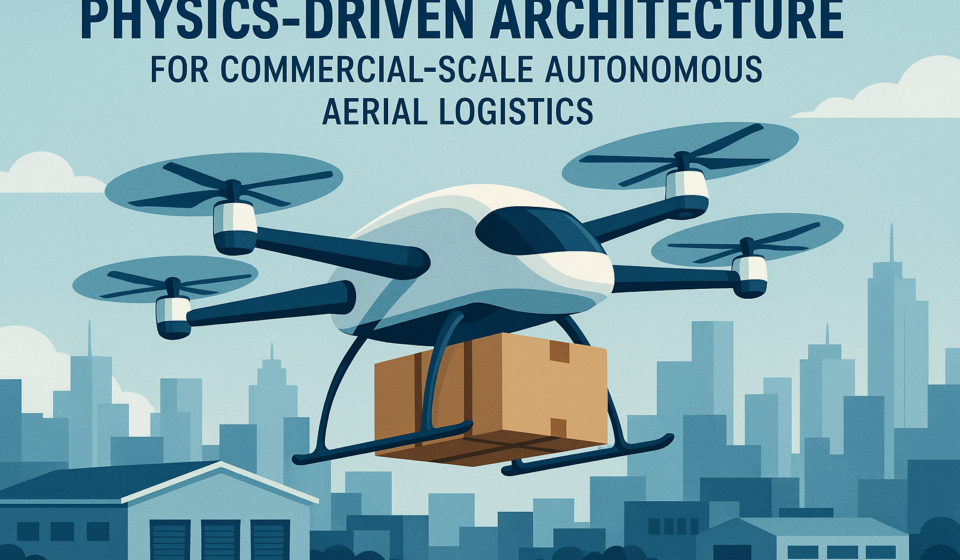
Physics-Driven Architecture for Commercial-Scale Autonomous Aerial Logistics

The human waiting for a critical diagnostic sample is the simplest way to see why this moment matters. For years we have treated last-mile logistics as a solved software problem; the physical world kept telling us otherwise. Recent moves in autonomous, lightweight aircraft are not merely another delivery gadget – they are an inflection point in how we think about system-level trade-offs between physics, economics and software.
A succinct signal: an Indian aerospace startup has just raised meaningful capital to move from demonstration flights to commercial-scale manufacture and operations, reporting over a thousand autonomous healthcare flights and a live commercial test in Andhra Pradesh. That shift – from prototypes to industrialised networks – is what deserves our attention.
Why this matters for architects and CTOs
- Rebalancing the stack: Traditional logistics assume heavy, centralised assets (trucks, hubs). Lightweight autonomous aircraft invert that calculus: the vehicle becomes a thin, software-defined transporter optimized around payload efficiency. For architects, that means designing systems where the edge (vehicle intelligence, local decision-making, intermittent connectivity) is first-class, and the cloud orchestrator is more a conductor than a micromanager.
- From pilots to production: Moving to 10,000 flights/day is no longer a robotics problem alone – it is an operations and systems engineering challenge. Scale exposes new failure modes: airspace deconfliction, mission scheduling at telecomm scale, telemetry ingestion and real-time analytics, fleet-wide software updates, and supply-chain readiness for spare parts. These are problems more akin to telecom OSS/BSS and aviation operations than to an R&D lab.
- Safety, certifiability and cryptographic identity: Autonomous aircraft require end-to-end provenance – authenticated missions, tamper-evident telemetry, and auditable routing decisions. Enterprises must bake in PKI, hardware-rooted identities, and secure OTA update paths from day one. Regulatory bodies will demand audit trails; architects must design them without creating unbearable latency or cost.
- Edge compute & resilience: Many missions will operate beyond reliable cellular coverage. That pushes computation to the vehicle: sensor fusion, local autonomy, and fail-safe controllers. The cloud remains essential for mission planning, model training, and historical analytics, but the runtime control plane must tolerate network partitions and provide deterministic safety behaviors.
- Interoperability and standards: As drone corridors and cargo airspace evolve, systems that can interoperate with Uncrewed Traffic Management (UTM) and regional digital airspace platforms will win. Proprietary point solutions will struggle unless they adopt open telemetry formats, mission-exchange APIs, and governance-friendly interfaces.
A practical checklist for founders and enterprise leaders
- Invest in simulation and digital twins early. Validating millions of mission-hours in the virtual world catches systemic issues far cheaper than field trials.
- Treat manufacturing and logistics as equally strategic as autonomy. Scaling hardware production, repair networks, and supply chains is a long-tail problem that determines unit economics.
- Design for secure identity, attestation, and post-mission auditability. Compliance will be table stakes for commercial contracts in healthcare and retail.
- Build multi-modal integration layers. Autonomous aircraft will be part of a broader logistics fabric – integrate APIs with warehouse management, e-pharmacy systems, and local transport providers.
- Plan for orchestration at telecom scale. Scheduling, congestion management, and pricing need near-real-time optimization engines.
A note for India (and the Northeast)
This is a uniquely Indian opportunity. The combination of dense urban demand, hard rural connectivity, and evolving regulatory frameworks creates fertile ground for a freight-airscale model. For Northeast India – where terrain and infrastructure create natural last-mile friction – aerospace-enabled logistics could be transformative for healthcare supplies and time-sensitive goods. But the gains will only materialize if policy, digital airspace infrastructure, local manufacturing ecosystems and MSME participation move in lockstep.
Takeaways
- The strategic shift is from prototype novelty to industrial operations; the system boundary expands from individual vehicles to full-stack logistics networks.
- Software and cloud architectures must be redesigned for edge-first autonomy, high-assurance identity, and scale operations.
- Success demands simultaneous attention to regulation, manufacturing, secure communications, and real-world economics – not just better flight control algorithms.
Closing
We often celebrate breakthroughs in autonomy as robotics milestones; the real test is whether those breakthroughs can be woven into resilient economic systems that lower cost, save time, and – most importantly – serve people when seconds matter.
About the Author: Sanjeev Sarma is the Founder Director and Chief Software Architect at Webx Technologies. With a core focus on Generative AI integration, Cloud-Native Scalability, and Enterprise Software Architecture, he has spent over two decades driving digital transformation across Northeast India and beyond. Beyond his corporate leadership, Sanjeev is deeply invested in shaping the future of the IT industry. He serves as an Industry Expert on the Board of Studies for Assam Don Bosco University’s School of Technology, advises state technology committees, and actively mentors emerging tech startups at STPI. He brings a unique, dual perspective of high-level enterprise execution and future-ready academic curriculum development.