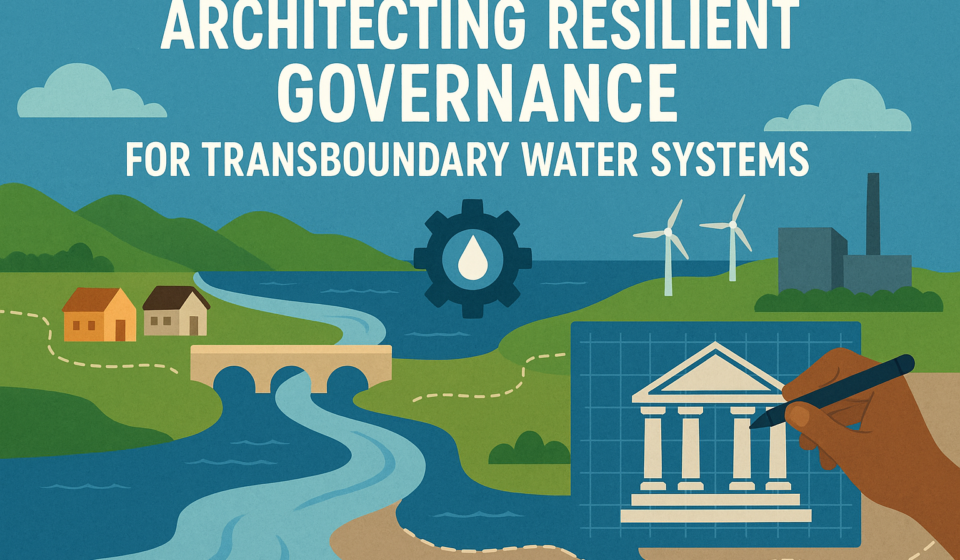
Architecting Resilient Governance for Transboundary Water Systems

Strategic Zoom-Out: When legal fights expose architectural brittleness
We tend to treat water, energy and software systems differently – but the failure modes are the same. Last month’s legal challenge to the federal Colorado River plan is not just a headline about inter-state politics; it’s a case study in what happens when governance, models and legacy rules collide with a non‑stationary environment. The result: brittle decisions, adversarial actors, and delays that make adaptation harder when time is the scarcest resource.
The signal in the noise (brief)
A new ten‑year federal plan proposed steep cuts to Colorado River allocations for some states while leaving others largely untouched. Nevada sued, arguing the plan violates long‑standing compacts and disproportionately harms its population and economy. Experts warn that historic allocation assumptions no longer match current flows, and that litigation will complicate urgently needed basin‑wide reductions.
What this means for architects, CTOs and policy designers
-
Non‑stationarity breaks assumptions. Many enterprise architectures – and many public policies – were designed on the premise that historical averages are reliable predictors of the future. Climate change has ended that assumption for water basins; the same is happening for demand patterns, cyber risk, and supply chains. As architects, we must stop designing to point estimates and start designing for distributions and tail events. Practically: move from single‑scenario capacity planning to continuous stress‑testing across a wide range of climate, regulatory and legal outcomes.
-
Legacy compacts are technical debt. The 1922 compact and subsequent agreements reflect institutional constraints the basin must still honour. In software terms, these are legacy constraints that dictate interfaces and allocations. When new realities change the resource envelope, retrofitting governance is expensive and slow. The lesson: anticipate and architect for governance extensibility – contract templates, change control paths, and sunset clauses that allow quicker rebalancing.
-
Federated data and transparent models reduce friction. One reason litigation becomes the default is asymmetric information and opaque decision logic. Basin‑level observability – shared hydrology models, open metadata, versioned scenarios, and auditable decision rules – creates trust and reduces incentives to litigate. For enterprises, federated data platforms with strong provenance and explainability are the equivalent: they turn disputes into negotiations.
-
Multi‑stakeholder systems need mechanism design, not top‑down edicts. Basin governance mirrors multi‑tenant systems where states, tribes and countries are stakeholders. Simple top‑down rules will be resisted; resilient solutions combine incentives (market or credit mechanisms), guaranteed minimums, and contingency triggers. Architects should collaborate with economists and legal teams to design enforceable, incentive‑compatible allocation mechanisms that are clear, automated where possible, and auditable.
-
Litigation is a time and opportunity tax. Courts slow operational agility. Contingency architecture must therefore plan for operational continuity under legal uncertainty – just as businesses maintain degraded yet safe operating modes during compliance reviews. Build fallbacks, operational playbooks and transparent communication channels in advance.
A note on India and river basins
This topic has a clear parallel in India’s inter‑state river disputes and the need for basin‑level digital public goods. The same design principles apply: invest in shared hydrological data, open modelling, scenario planning and dispute‑minimising governance. For Northeast India – with its transboundary river dynamics and high social sensitivity – these are not academic ideas but practical frameworks for avoidable conflict.
Key takeaways for leaders
- Treat non‑stationarity as a core architectural requirement: model ranges, not points.
- Invest in federated, auditable data platforms to reduce asymmetric information.
- Design governance with extensibility: contracts that can adapt without breaking trust.
- Use mechanism design to align incentives across stakeholders; automation where legal clarity permits.
- Prepare operational continuity plans that assume litigation and regulatory uncertainty.
Closing thought
Infrastructure – whether hydrological or digital – is ultimately a social contract expressed through technical choices. When those choices are brittle, the social contract frays. Architects who design for adaptability, transparency and shared stewardship will find themselves not only building systems that survive change, but governing in ways that reduce conflict and accelerate collective action.
About the Author: Sanjeev Sarma is the Founder Director and Chief Software Architect at Webx Technologies. With a core focus on Generative AI integration, Cloud-Native Scalability, and Enterprise Software Architecture, he has spent over two decades driving digital transformation across Northeast India and beyond. Beyond his corporate leadership, Sanjeev is deeply invested in shaping the future of the IT industry. He serves as an Industry Expert on the Board of Studies for Assam Don Bosco University’s School of Technology, advises state technology committees, and actively mentors emerging tech startups at STPI. He brings a unique, dual perspective of high-level enterprise execution and future-ready academic curriculum development.