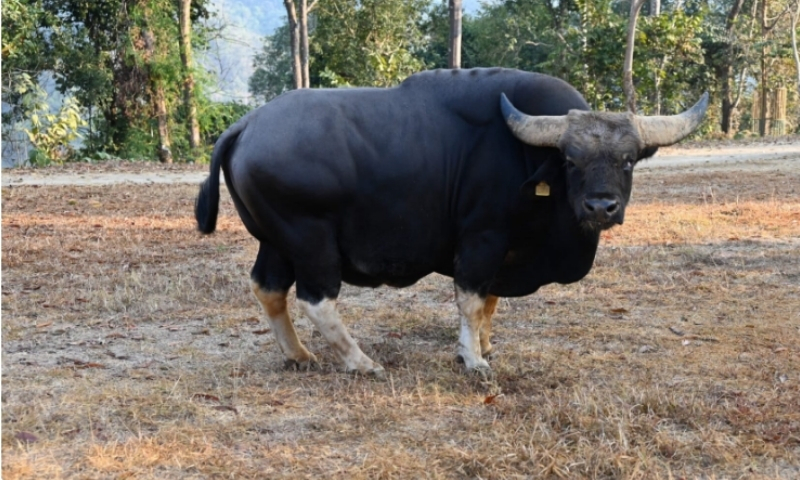

A new population-level whole-genome study of Arunachali mithun (Bos frontalis) warns of moderate inbreeding and a shrinking effective breeding population, even as the overall headcount remains relatively large. The research — described by its authors as India’s first population-scale whole-genome analysis of Arunachali mithun and published this year in the International Journal of Molecular Sciences — analysed complete genomes from animals sampled in East Siang and Lepa Rada districts to establish a genomic baseline for conservation and breeding.
The study sequenced roughly 30 gigabases of DNA per animal from 11 unrelated mithuns and identified nearly five million high-quality single nucleotide polymorphisms (SNPs). Across four independent genomic analyses the sampled animals showed moderate genomic inbreeding. Runs of homozygosity (ROH) analysis found 24,937 ROHs, more than 93% of which measured between 100 and 250 kilobases and none exceeded one megabase — a pattern the authors say points to historical demographic events rather than very recent intensive inbreeding.
Despite maintaining moderate nucleotide diversity and heterozygosity, the researchers estimate the population’s recent effective population size (Ne) at about 160 breeding individuals. The authors caution that Ne is a genetic measure of those contributing genes to the next generation and is usually much smaller than census counts. They also stress that the Ne estimate is based on genomes from only 11 animals, so broader sampling is needed to refine the figure and confirm whether similar trends occur across the mithun’s range.
The study also identifies a genetically homogeneous population in the Siang region — described by project scientists as Siangmi — distinguished by traits such as a convex forehead and shorter, smoother horns. Girish Patil S, director of the ICAR–National Research Centre on Mithun and a co-author, said the centre has already registered the Nagami as the world’s first recognised mithun breed and is characterising other populations so farmers can access central schemes limited to recognised breeds. Based on the 20th Livestock Census (2019), the researchers estimate some 20,000 Siangmi individuals within India’s nearly 384,000 mithuns, about 70% of which are in Arunachal Pradesh.
Scientists recommend moving beyond headcounts to evidence-based genetic management while preserving traditional semi-free-ranging husbandry. They highlight three key gaps: lack of individual animal identification, absence of parentage verification, and no systematic performance records linking traits to individual animals. The authors propose ear-tagging or biometric IDs, genomic parentage testing, and combined phenotypic–genomic record-keeping to guide structured breeding that conserves diversity and improves productivity.
Local breeders say they are already acting. Tadang Tamut, chairman of the Jomlo Mongku Mithun Farmers’ Federation, said the federation has signed an MoU with NRC‑Mithun and, over the past two years, ear-tagged and vaccinated more than 16,000 Siangmis while working to document every animal. Farmers hope formal breed recognition and a geographic indication (GI) tag will help protect the Siangmi from crossbreeding and preserve its cultural and economic value.
For communities in Arunachal Pradesh the decline in mithun numbers is felt deeply: for many, these semi-free-ranging bovines are a measure of wealth, status and inheritance, and scientists say timely, community-sensitive interventions are needed to secure both the animals’ genetic future and the cultural practices that surround them.
Original Source: https://nenow.in/top-news/arunachal-genetic-study-of-mithuns-flags-declining-breeding-population.html
Category: Arunachal,Environment,Northeast News,Top News
Tags:
Publish Date: 2026-08-16 07:30:00