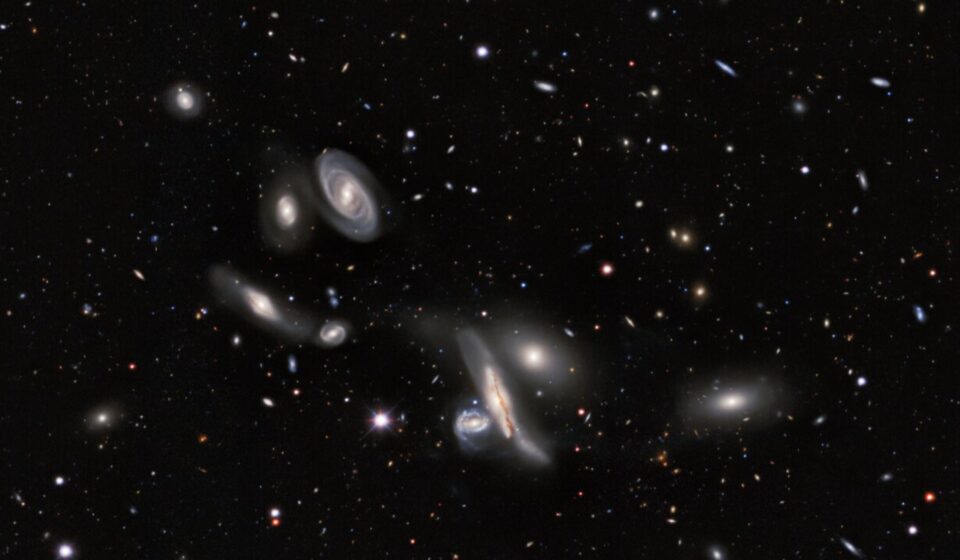

Astronomers have released the largest two-dimensional map of the sky to date: a 5.6‑trillion‑pixel mosaic that charts nearly 4 billion celestial objects across about three‑quarters of the heavens. The dataset, produced by the Dark Energy Spectroscopic Instrument (DESI) Legacy Imaging Surveys team, combines more than 263,000 telescope exposures gathered over roughly 13 years, spanning visible and near‑infrared wavelengths, according to a statement from NSF NOIRLab.
The map is designed as a detailed 2D foundation for DESI’s broader mission. DESI, mounted on the Nicholas U. Mayall 4‑meter Telescope at Kitt Peak National Observatory, measures spectra of galaxies and quasars. By determining redshifts — the amount starlight is stretched by cosmic expansion — researchers can calculate distances and convert the flat image of the sky into three‑dimensional maps of the universe.
DESI began its main survey in 2021 with the aim of tracing cosmic expansion over billions of years to better understand dark energy, the force thought to drive that expansion. By April 2026, the project had already mapped more than 47 million galaxies and quasars, producing the largest high‑resolution 3D map of the cosmos so far. Earlier DESI results have also hinted that dark energy might change over time rather than remain constant, a finding that challenges a core assumption of the standard cosmological model.
Researchers say the new Legacy Imaging Surveys map will be useful far beyond DESI itself. Previous releases of the dataset have been cited in over 1,800 scientific papers. The latest, higher‑resolution release should help astronomers hunt for rare objects and phenomena, study how galaxies evolve, and train artificial‑intelligence systems to process the vast data volumes expected from next‑generation observatories.
“This is part of the fabric of astronomy research now,” said David Schlegel, co‑lead of the Legacy Surveys and a scientist at Lawrence Berkeley National Laboratory, noting that scientists often begin investigations by opening the Legacy Imaging Viewer to see what they are studying.
Other projects are mapping the universe in complementary ways. Earlier this year, the Hobby‑Eberly Telescope Dark Energy Experiment (HETDEX) produced a different kind of 3D map by detecting faint Lyman‑alpha emission from hydrogen between galaxies, revealing structures from 9 to 11 billion years ago when star formation peaked.
“For our team, these data are fundamental to the investigation of the expansion history of the universe and the formation of our galaxy,” said Arjun Dey, co‑lead of the Legacy Imaging Surveys at NSF NOIRLab, adding that the skies belong to everyone and the survey gives the public a chance to marvel at their wonders.
Original Source: https://www.space.com/astronomy/scientists-create-largest-2d-map-of-the-universe-with-5-6-trillion-pixels-and-nearly-4-billion-cosmic-objects
Category:
Tags:
Publish Date: 2026-08-12 02:30:00