Architecting Adaptive AI Tutors: Balancing Scaffolding and Rigor

The right amount of help is not a feature-you have to teach a system how to choose it
Context
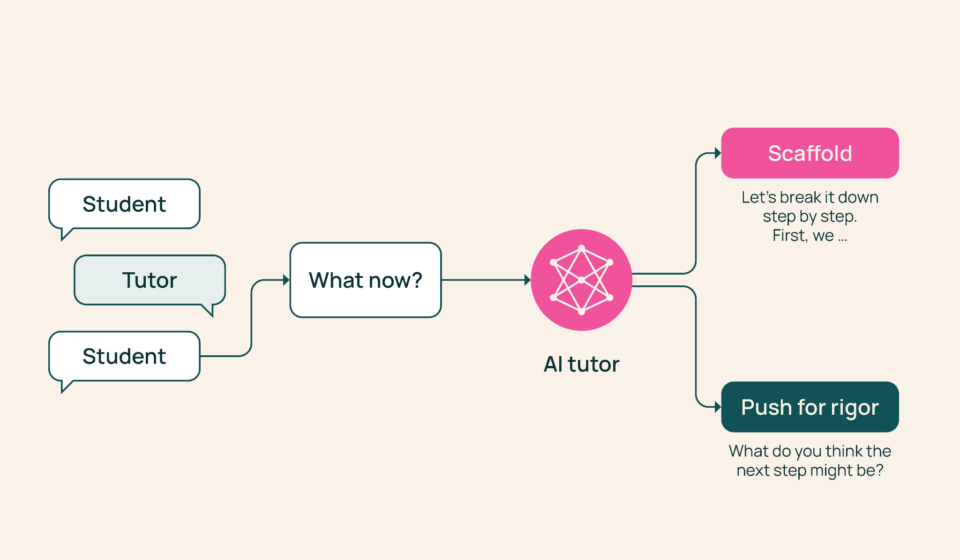
I recently reviewed a research preview called TutorMoments: a replay-based evaluation that uses real one‑on‑one math tutoring transcripts to test whether large language models can sensibly decide when to scaffold a student and when to push for deeper thinking. The study intentionally isolates decision points from authentic classroom interactions and measures whether models’ tutor responses match teacher judgments about the pedagogically appropriate move.
Why this matters for architects and product leaders
Most AI-for-education narratives treat “helpfulness” as a one‑dimensional goal. TutorMoments exposes the opposite: helpfulness and learning-support are context-sensitive and often in tension. For enterprises building AI tutors, this has three architectural implications.
-
Evaluation must be decision-point driven, not outcome-agnostic
Benchmarks that reward “helpful” language produce assistants that over-scaffold. Architectures should include replay and decision-point evaluation pipelines-mirroring how TutorMoments pauses at teacher‑marked moments-so models are judged on appropriateness, not fluency. This requires reproducible instrumentation (transcript capture, anonymization, deterministic replay) and metrics that capture false positives (over-helping) as clearly as false negatives. -
Human-in-the-loop design is non-negotiable
Teacher consensus is noisy and context-dependent. Systems should incorporate continuous human feedback loops: teacher adjudication, active learning for edge cases, and a lightweight review UI that surfaces “near-miss” decisions to educators. From a platform view this means designing low-latency review channels, differential rollout controls, and robust logging to trace model decisions back to input context and prompt variants. -
Trade-offs shift system design: latency, cost and trust
Prompt engineering can improve appropriateness, but it’s brittle. Enterprises must weigh model classes (few-shot prompting vs fine-tuning), deployment modes (cloud vs edge), and monitoring overheads. Pushing for rigor often needs longer, more complex interactions and higher compute; over-scaffolding favors short, canned hints. Plan for adaptive orchestration-route “hard” decision points to more capable models or to human tutors-and instrument costs and SLAs accordingly.
Practical risks and mitigations
- Simulated students are an imperfect stand-in. Only longitudinal deployment with real students links behavior to learning outcomes. Treat replay pipelines as screening, not validation.
- Dataset bias matters. TutorMoments used U.S. elementary/middle math transcripts; localized pedagogy and language patterns will change the decision boundary. Invest in representative, de‑identified local data and in methods like federated learning or secure enclaves to protect privacy.
- Explainability is essential. Teachers and regulators will demand interpretable rationales for why a tutor chose to scaffold or to push. Provide concise model rationales and provenance alongside recommendations.
A pragmatic Bharat connection
For Indian EdTech deployments-especially in under-resourced regions of Northeast India-the implications are immediate. Low-bandwidth and multilingual classrooms amplify the cost of over-helping: if models do the cognitive heavy‑lifting, students and local teachers lose opportunities to build reasoning habits. Practical steps for Indian deployments include prioritizing lightweight decision-point evaluations, collecting vernacular transcripts with teacher consent, and offering low-bandwidth fallbacks that surface teacher prompts rather than full answers.
Takeaways
- Reframe evaluation: measure pedagogical appropriateness at decision points, not conversational fluency.
- Build teacher feedback loops and lightweight review tooling into the platform from day one.
- Use a layered deployment: cheap, fast responses for routine support; stronger models or human escalation for high-risk decision points.
- Localize data and metrics-language, culture and curriculum change what “appropriate” means.
- Treat replay-based evaluation as screening; validate with longitudinal learning metrics before wide rollout.
Closing thought
If our goal is to augment human teaching rather than replace it, the most valuable capability we can build is not a smarter hint-generator but a tutor that knows when to be quiet.
About the Author: Sanjeev Sarma is the Founder Director and Chief Software Architect at Webx Technologies. With a core focus on Generative AI integration, Cloud-Native Scalability, and Enterprise Software Architecture, he has spent over two decades driving digital transformation across Northeast India and beyond. Beyond his corporate leadership, Sanjeev is deeply invested in shaping the future of the IT industry. He serves as an Industry Expert on the Board of Studies for Assam Don Bosco University’s School of Technology, advises state technology committees, and actively mentors emerging tech startups at STPI. He brings a unique, dual perspective of high-level enterprise execution and future-ready academic curriculum development.