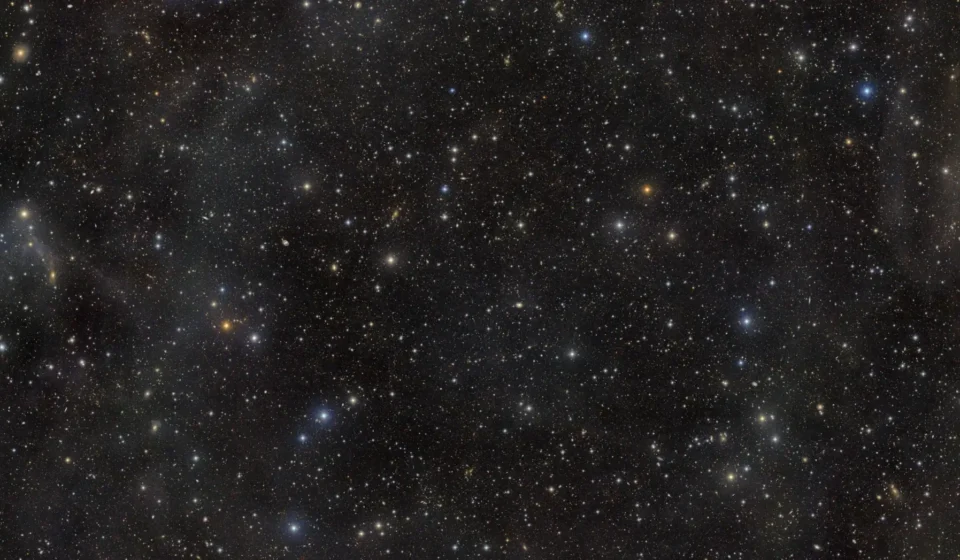

The Vera C. Rubin Observatory has released a new deep image of the COSMOS field that contains more than half a million galaxies and was built by stacking observations taken between April 2025 and January 2026. The coadded picture — assembled from many aligned exposures of the 3.2-gigapixel LSST Camera on the 8.4‑metre Simonyi Survey Telescope — not only reveals faint distant galaxies (some whose light has traveled roughly 12 billion years) but also sets the stage for repeated monitoring that will catch supernovae, flaring black holes and other transient events in near real time. The image and data were released by Rubin Observatory/NOIRLab/SLAC/AURA.
COSMOS is a well-studied, low‑foreground patch of sky that lies away from the crowded plane of the Milky Way, giving astronomers a clearer view of the distant universe. Rubin’s sensitivity is high enough to pick up faint wisps of our own galaxy’s dust as well as galaxies spanning a vast range of distances and ages. The field has been a multiwavelength reference region for more than two decades, with observations from Hubble (since 2003), Webb, XMM‑Newton, Chandra, Spitzer, Subaru, the Very Large Array and many other facilities.
At the heart of these new Rubin images is the LSST Camera, the largest digital camera ever built for astronomy. Its focal plane holds 189 science CCD sensors arranged into 21 rafts, cooled to about −100°C to limit thermal noise. Each exposure covers roughly 9.6 square degrees — an area equivalent to about 45 full Moons — allowing fast, deep coverage of large sky patches.
Rubin will return to the COSMOS field hundreds of times during commissioning and the survey proper, converting static atlases into an “animated” view of changing objects. Bob Blum, director of Rubin Observatory at NSF NOIRLab, called the COSMOS deep image “just the beginning” and said repeated visits will “provide our science community with a huge number of transient and variable objects like supernovae and other explosive transients for follow‑up and detailed study.” Phil Marshall, Deputy Director at SLAC, added that COSMOS’s wealth of prior data and Rubin’s repeated targeting make it an important testing ground for scientists preparing to work with LSST survey data.
Later phases, expected toward the end of 2026, will add individual‑visit and difference images — the latter subtract a reference image from a new exposure to highlight changes — and Rubin is already producing scientific alerts from difference imaging. Once fully operational, the system is expected to issue on the order of seven million alerts per night, pointing observers to supernovae, asteroids, active black holes and other transient phenomena. Over its planned 10‑year survey, Rubin aims to detect roughly 20 billion galaxies and 17 billion stars, generating a dataset of trillions of measurements that will deliver an unprecedented, time‑resolved map of the southern sky.
Original Source: https://www.zmescience.com/science/astronomy/rubin-cosmos-image-half-million-galaxies/
Category:
Tags:
Publish Date: 2026-08-06 03:44:00