Architecting Energy Resilience: Rapid Renewables to Cut Fossil Dependence

Strategic Shock, Rapid Architecture Change
Geopolitical shocks are rarely kind to planners – and yet they can be the most effective accelerant of long-delayed structural change. The European experience since early 2022 shows how a single external shock (the invasion of Ukraine) turned renewable-energy deployment from a policy objective into an urgent systems-priority, with measurable economic and operational consequences.
The signal
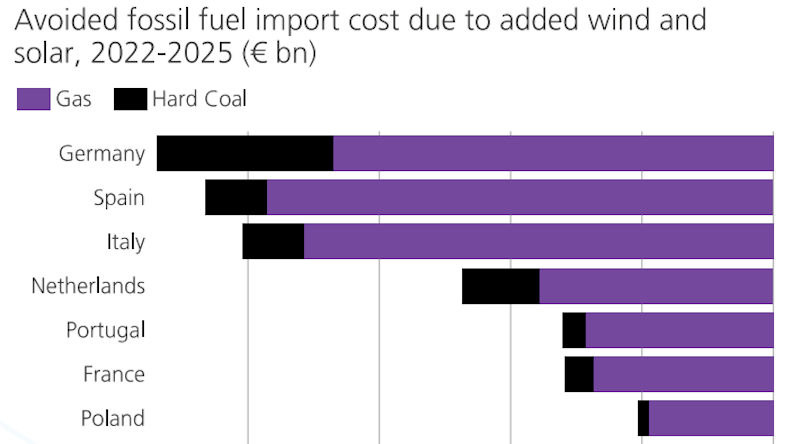
A recent industry analysis documented rapid growth in wind and solar across the EU between 2022 and 2025, with renewables rising from the low‑20s to roughly 30% of power supply and displacing substantial coal and gas generation. Analysts estimate tens of billions of euros in avoided fossil‑fuel import costs as a direct consequence of that accelerated deployment.
What this means for infrastructure architects
Treat energy like a digital platform. The transition underway is less about swapping one generator for another and more about re‑architecting an entire platform: generation, transmission, storage, markets, regulatory controls and data flows. Enterprise architects should read this through the same lens we use for software and cloud migrations.
-
Decoupling and modularity: Distributed renewables are analogous to moving from a monolithic data centre to microservices. You gain resilience and scale, but you must design for orchestration. Grid operators need high‑fidelity orchestration layers (market mechanisms, grid control, automated dispatch) to coordinate thousands of distributed resources. In software terms: orchestration, service discovery, and contract‑level SLAs matter.
-
Observability and real‑time control: Intermittent resources demand observability at a temporal granularity most legacy grids never required. Short‑term forecasting, state estimation, and automated corrective controls become as critical as monitoring APIs and telemetry for cloud services. Investing in digital twins, richer telemetry, and ML‑driven forecasting reduces both physical and financial risk.
-
Flexibility ≠ only storage: Many conversations reduce flexibility to batteries. In reality, flexibility is a portfolio: demand response, flexible generation, improved transmission, seasonal storage (green hydrogen), and smarter pricing all contribute. Architectures that bake in multiple flexibility modalities are more resilient and less risky than big, single‑technology bets.
-
Financial engineering and avoided costs: The avoided import bill is a useful metric because it reframes ROI from capex amortization to system‑level economic value (avoided volatility, geopolitical exposure, and balance‑of‑payments relief). Enterprises and public planners should include avoided externalities when evaluating infrastructure investments; otherwise the business case for rapid deployment often looks weaker than it really is.
Trade‑offs and technical debt
Speed vs. stability is the central trade‑off. Rapid deployment of renewables without commensurate investment in grid control, transmission, and market design creates operational fragility and hidden technical debt. The EU case shows the upside of acting fast – but it also highlights the follow‑on work required to turn near‑term gains into durable architecture.
A pragmatic Bharat angle
India’s energy challenges mirror parts of this story: import exposure, ambitious renewable targets, and the need for grid flexibility. For Northeast India specifically, hydropower and decentralized renewables can be architected as complementary components (seasonal storage vs. distributed generation). The lesson for Indian technocrats and startup founders is practical: integrate digital control, local manufacturing and skills development into deployment roadmaps, not as afterthoughts but as core design decisions.
Five strategic takeaways for leaders
- Design for orchestration: invest in control systems, market mechanisms and standards for interoperability.
- Prioritize observability: high‑frequency telemetry, forecasting models and digital twins reduce operational risk.
- Treat flexibility as a portfolio: combine storage, demand response, transmission and seasonal options.
- Evaluate investments by system value: include avoided imports, volatility hedging and national security benefits.
- Manage rollout as phased modernization: pair fast deployment with parallel upgrades to grid control and regulation to avoid technical debt.
Closing thought
Infrastructure change accelerated by crisis is neither accidental nor merely reactive – it offers a chance to rebuild systems with resilience and sovereignty in mind. The real test isn’t how quickly we install capacity, but how thoughtfully we re‑architect the platform that will carry societies for decades.
About the Author: Sanjeev Sarma is the Founder Director and Chief Software Architect at Webx Technologies. With a core focus on Generative AI integration, Cloud-Native Scalability, and Enterprise Software Architecture, he has spent over two decades driving digital transformation across Northeast India and beyond. Beyond his corporate leadership, Sanjeev is deeply invested in shaping the future of the IT industry. He serves as an Industry Expert on the Board of Studies for Assam Don Bosco University’s School of Technology, advises state technology committees, and actively mentors emerging tech startups at STPI. He brings a unique, dual perspective of high-level enterprise execution and future-ready academic curriculum development.