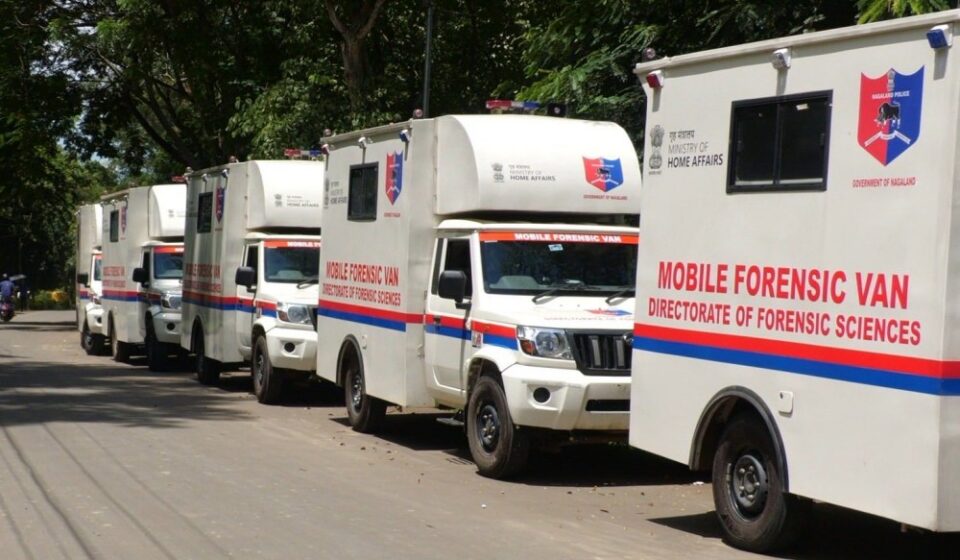

On July 27 at the Nagaland Police Complex in Chümoukedima, the Nagaland Police flagged off a fleet of 561 vehicles — the department’s largest single motor transport acquisition — funded under the Union government’s Assistance to States and Union Territories for Modernisation of Police (ASUMP) 2025–26 and the Modernisation of Forensic Capacities (2024–25) schemes. The package, part of a nearly Rs 150 crore allocation for police modernisation, includes 12 Mobile Forensic Laboratory vans, 64 motorcycles and a mix of buses, pickups, water tankers and passenger vehicles such as Jimnys, Vitaras, Scorpios, Boleros and Innovas. Chief Minister Neiphiu Rio performed the ceremonial flag-off.
Rio said the investment — a sharp rise from previous annual allocations of Rs 4–6 crore — will replace an estimated 35–40% of the department’s ageing fleet and called the new vehicles “instruments of public service, symbol of our commitment to modern governance and investigation, in the safety and security of every citizen in our state.” He framed the acquisition as part of a broader push to move the force from an armed-policing model toward professional, investigation-oriented and community-centred policing.
At a press conference, Director General of Police Rupin Sharma and Additional Director General of Police Sandeep M. Tamgadge acknowledged long-standing gaps in investigative capacity and civil policing. “Traditionally, Nagaland Police has been built up around armed policing,” Sharma said, adding that investigative capabilities, specialist personnel, tools and forensic aids “were not the focus.”
The rollout of mobile forensic vans is tied to new criminal laws that require forensic examination of scenes for offences carrying punishments exceeding seven years. Tamgadge said the vans will help overcome geographic constraints: the state currently has only one forensic science laboratory in Dimapur. Officials cited a June case in Kiphire where a forensic team from Dimapur reached a rape scene only the next day as evidence of the need for faster, mobile capacity.
Nagaland has 17 administrative districts and 12 forensic vans have been procured. Officials said the long-term aim is at least one van per district, but deployment will be prioritised to higher-crime areas to avoid underuse in low-crime districts. The state cabinet has approved separation of the Forensic Science Directorate from the police, and the department has asked the Nagaland Public Service Commission to fill five technical posts that have already been advertised.
On public resistance to post-mortems, Sharma urged compliance, stressing autopsies are necessary both to rule out foul play and to meet legal requirements for compensation. “Performing post-mortems is actually good. You never know, a seemingly genuine death can turn out to involve foul play,” he said.
Asked about the July 13 suspected IED blast that killed an Assam Rifles soldier, Sharma said investigators were “following several leads… so it is better that we do not share the details at this stage.” Deputy Chief Minister Y. Patton had said on July 17 the state would hand the probe to the National Investigation Agency; Sharma clarified that the final decision rests with the Union Ministry of Home Affairs and that the ministry had not yet given formal communication. “That decision has not yet been officially conveyed to us. Even if it has been taken, we have not received the formal communication,” he said.
Original Source: https://www.morungexpress.com/nagaland-police-evolving-from-armed-policing-to-civil-policing
Category: Nagaland
Tags:
Publish Date: 2026-07-27 22:54:00