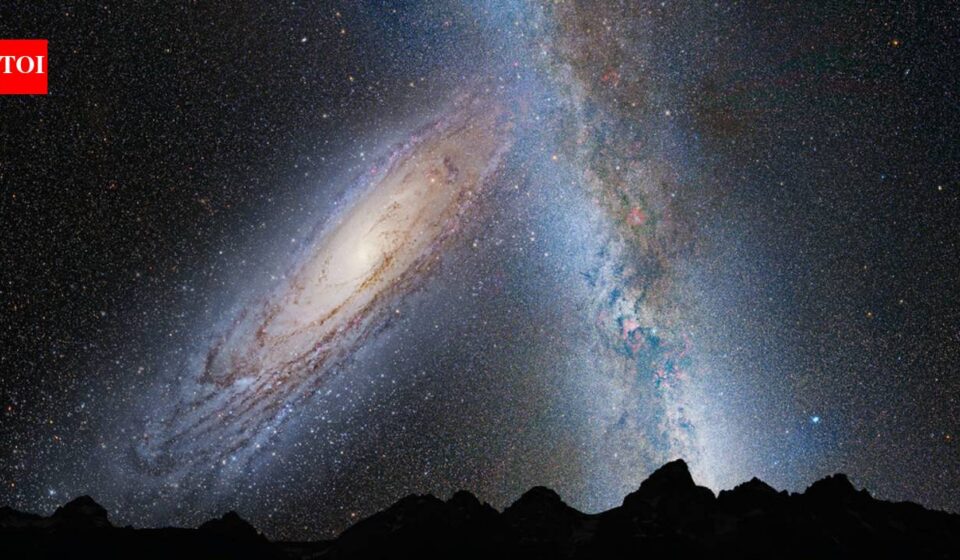

Researchers at Durham University say a head-on collision with a dwarf galaxy known as the Gaia Sausage about 10 billion years ago may have flipped the Milky Way by more than 90 degrees, radically changing the galaxy’s orientation long before the solar system formed. The team presented their results at the Royal Astronomical Society’s National Astronomy Meeting in Birmingham, reporting that a direct impact could have slowly rotated the Milky Way’s disc into its present position over hundreds of millions of years.
Using advanced supercomputer simulations, the researchers found that Milky Way–like galaxies experiencing such collisions frequently undergo a “disc flip,” a gradual reorientation driven by the momentum and mass of the incoming object. Lead researcher Kirill Batrakov said the transformation was not instantaneous and “probably takes at least a few hundred million years.” The simulations reproduce the slow, multi-step nature of the process rather than a sudden tumble.
The study grew out of an effort to explain puzzling motions among stars in the Milky Way’s halo, the spherical population surrounding the galactic disc. Data from the European Space Agency’s Gaia mission show a stark contrast: stars in the disc orbit the galaxy’s centre at roughly 220 kilometres per second, while halo stars rotate much more slowly, at about 25 kilometres per second. The Durham team argues that this unusually slow halo rotation is a signature of a major ancient collision followed by a disc flip.
The Gaia Sausage was identified in 2018 when astronomers traced a set of elongated, eccentric stellar orbits back to a single disrupted dwarf galaxy that plunged into the Milky Way. Although labelled a dwarf, the Gaia Sausage carried substantial mass-stars, gas and dark matter estimated at more than 10 billion times the Sun-large enough to influence the structure of the larger galaxy and help form the Milky Way’s central bulge and stellar halo.
Smaller mergers continue today, such as the ongoing assimilation of the Sagittarius dwarf galaxy, and the Large Magellanic Cloud is expected to merge with the Milky Way in several billion years. But researchers say these future encounters are unlikely to produce a comparable disc flip because the Milky Way is now far more massive than it was at the time of the Gaia Sausage collision.
Original Source: https://timesofindia.indiatimes.com/science/ancient-collision-with-the-gaia-sausage-dwarf-galaxy-10-billion-years-ago-may-have-flipped-the-milky-way-by-more-than-90-degrees-astronomers-say/articleshow/132567707.cms
Category:
Tags:
Publish Date: 2026-07-23 02:56:00