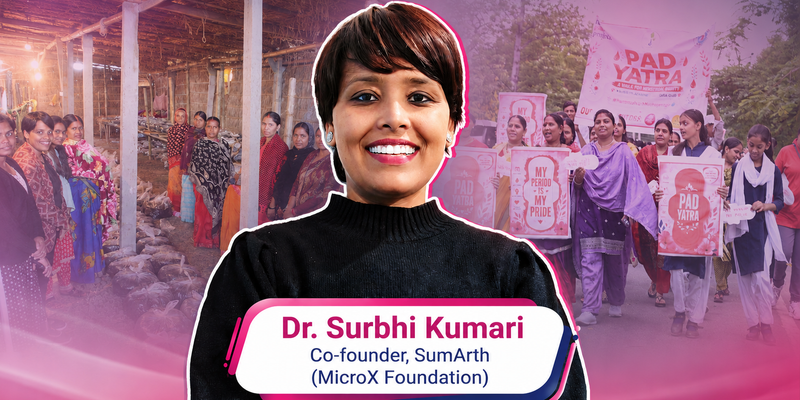
Architecting Scalable Community Systems for Menstrual Dignity and Livelihood

Human dignity is not a feature – it’s a design constraint.
Why this story matters
I recently read about Dr. Surbhi Kumari’s work in Bihar: community-led menstrual awareness programmes paired with climate-friendly mushroom farming to create both dignity and livelihood. The initiative moved households from silence to open conversation, and from dependency to small-scale enterprise – a powerful case of social product design and frugal systems thinking. The signal here is not only social change; it’s a repeatable architecture for last-mile impact.
What enterprise builders should notice
At its core this is an exercise in systems design with strong parallels to software and infrastructure architecture:
-
Modularity and composition: Periodshala, SABLA, Pad Yatra and mushroom-hut deployment are discrete modules that together form a resilient intervention. Like microservices, each module is independently deployable, measurable and adaptable to local context.
-
Low-footprint, climate-resilient engineering: Using local materials (bamboo, kusha grass) to manage microclimate reduces dependency on centralized utilities. For technology programmes, that’s the equivalent of designing for edge-first resilience – minimise coupling to unreliable central infrastructure.
-
Human-in-the-loop validation: The team prioritized dialogue, iterative persuasion and behaviour change before scaling. In product terms: test hypotheses in the field, invest in qualitative feedback, and treat communities as co-designers, not merely users.
-
Dual-value proposition: Combining health education with an income stream (mushroom farming) solved adoption and sustainability challenges. For any intervention, pairing utility (information/service) with a viable economic model increases resilience and adoption.
Strategic trade-offs and governance considerations
Scaling interventions like this requires explicit choices, with clear trade-offs:
-
Speed vs. Depth: Rapid roll-outs risk cultural resistance and superficial adoption. Slow, deeply iterative pilots build trust but require sustained funding and patient capital.
-
Centralisation vs. Local Autonomy: A centralised playbook accelerates roll-out but breaks when it ignores local norms. A federated model preserves context-sensitivity but increases coordination overhead.
-
Measurement vs. Respectful Research: Quantitative KPIs (e.g., NFHS‑5-style hygiene metrics) matter, but operational success often rests on qualitative shifts (boys carrying pads, families changing practices). Design monitoring systems that capture both while safeguarding privacy.
Practical patterns to adopt
If you are a CTO, founder, or program lead aiming to convert field pilots into scalable programmes, consider these patterns:
-
Build small, composable pilots: Launch with 3–5 coherent modules (awareness, supply chain, training, market linkage, documentation). Iterate one module at a time.
-
Adopt edge-first infrastructure: Prefer low-power, offline-capable tools (SMS, local kiosks, low-bandwidth dashboards) where connectivity is weak.
-
Make livelihoods the retention mechanism: Where behaviour change is required, pair education with an economic opportunity so beneficiaries have agency and repeatable incentives.
-
Document for replication: Invest early in simple reproducible SOPs (how to build a mushroom hut, how to run a padyatra). Documentation is the minimal viable public good for scale.
-
Design funding portfolios: Blend grants for behaviour-change work with revenue streams from productised services or market linkages to reduce single-source funding risk.
When this applies to Bharat (and why I mention it)
This model is especially relevant for Indian DPI and rural programmes: last-mile success depends on local materials, social capital and small-business economics as much as on ICT. Whether you’re designing a maternal-health workflow on a government stack or a last-mile agri-market connector, the lesson holds – marry human-centred design with frugal engineering and economic pathways.
Key takeaways
- Treat dignity as a non‑functional requirement: design interventions that preserve agency and identity.
- Prefer modular pilots with strong local feedback loops over monolithic national roll-outs.
- Use low-carbon, low-tech engineering where it materially reduces dependence on grid/central systems.
- Combine behaviour-change with livelihoods to create sustainable adoption.
- Document and publish repeatable playbooks early – replication is a product.
Closing thought
Real resilience is social and technical at once; the most durable systems are those that embed dignity into their architecture.
About the Author: Sanjeev Sarma is the Founder Director and Chief Software Architect at Webx Technologies. With a core focus on Generative AI integration, Cloud-Native Scalability, and Enterprise Software Architecture, he has spent over two decades driving digital transformation across Northeast India and beyond. Beyond his corporate leadership, Sanjeev is deeply invested in shaping the future of the IT industry. He serves as an Industry Expert on the Board of Studies for Assam Don Bosco University’s School of Technology, advises state technology committees, and actively mentors emerging tech startups at STPI. He brings a unique, dual perspective of high-level enterprise execution and future-ready academic curriculum development.