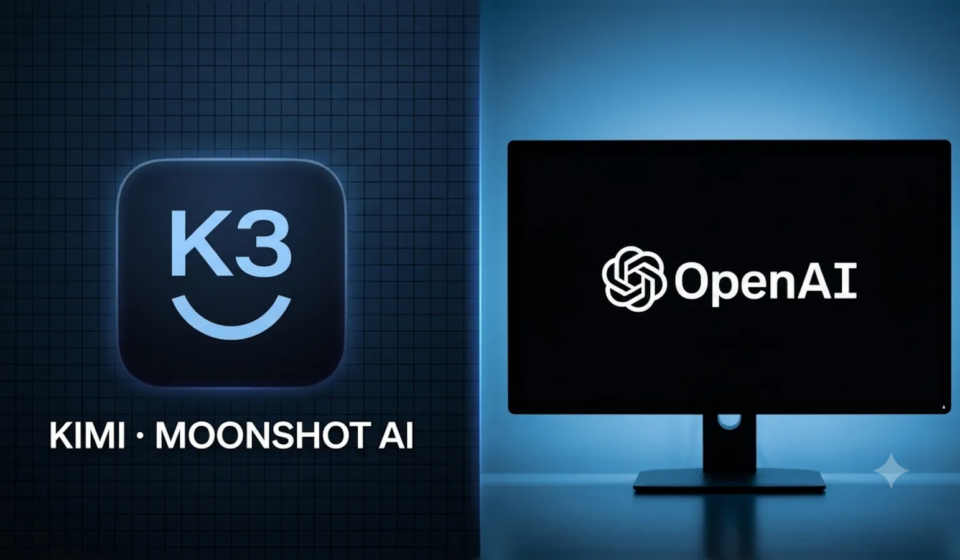

Last week Chinese startup Moonshot AI released Kimi K3, a 2.8‑trillion‑parameter model that immediately shifted the conversation about the global AI race. Within days analysts in Washington suggested America’s lead in frontier AI had narrowed to “a matter of weeks,” and Silicon Valley and global testers took notice. Moonshot’s move has reignited debate over whether China can catch up with-or even overtake-the US in foundational AI technology.
Kimi K3 is the largest open model published so far and is built as a mixture‑of‑experts: it contains 896 smaller expert networks and activates only 16 for any given task. That design lets the system scale to 2.8 trillion parameters without requiring impossibly large compute for every query. The model also supports a context window of about one million tokens — roughly the length of a long novel — useful for scanning large codebases or stacks of legal documents in a single pass.
Moonshot itself concedes K3 still trails OpenAI’s GPT‑5.6 Sol and Anthropic’s Claude Fable 5 on overall performance. Yet independent evaluations found K3 running shoulder to shoulder with strong US models such as Claude Opus 4.8 and OpenAI’s GPT‑5.5, and outperforming them on some coding benchmarks; Arena AI even ranked K3 first in front‑end web development. That closeness is what startled many observers: where Chinese labs were once considered six to eight months behind, Kimi K3 suggests the gap could now be measured in weeks.
Price and openness may be the real game changers. Dipal Dutta, CEO of RedoQ, says the contest “comes down to two different approaches” — closed, polished paid services from the US versus cheaper, open‑weights systems from China. Moonshot’s published rates are $3 per million input tokens and $15 per million output tokens, compared with roughly $5 and $30 for equivalent slices of GPT‑5.6 Sol. Moonshot also plans to release K3’s full weights publicly by July 27, enabling developers to download and run the model on their own servers rather than renting cloud access.
That does not mean OpenAI is suddenly obsolete. GPT‑5.6 is embedded in extensive product ecosystems — ChatGPT, coding and file tools, browsing and enterprise features — that a single open model cannot replicate overnight. Moonshot has acknowledged K3 can sometimes behave inconsistently and still needs polish.
Experts see a multipolar outcome rather than a single winner. “China’s models like Kimi K3 show that the global AI race is no longer about largest compute clusters or highest investment,” says Sanjaya G, CTO at VigyanLabs, but he warns the US retains advantages in frontier research, semiconductors, cloud infrastructure and commercialisation, while countries such as India can develop sovereign, domain‑specific AI.
Many industry voices also question the fixation on the “best” model. “Today’s frontier model is tomorrow’s commodity,” says Shrish Anand Lal of MiFiX.ai, arguing enterprises must prioritise governance, auditability and safe operationalisation over chasing marginal model leads. In short, Kimi K3 may not dethrone OpenAI, but by making high‑capability AI cheaper and open it has materially changed how the world will build on these systems.
Original Source: https://www.ndtv.com/artificial-intelligence/kimi-k3-vs-openai-whos-the-real-winner-has-china-overtaken-us-11803737#publisher=newsstand
Category:
Tags:
Publish Date: 2026-07-22 14:37:00