Architecting US EV Recovery: Policy, Market Design, and Platforms

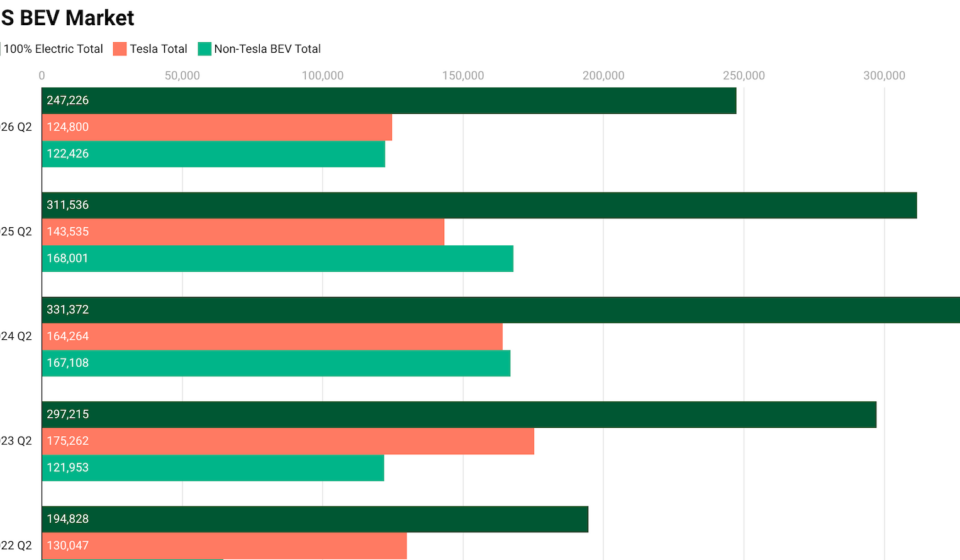
We obsess over quarter-to-quarter growth because it’s an easy headline. But a 21% fall in US EV deliveries between Q2 2025 (311,536) and Q2 2026 (247,226) is not just a headline – it’s a system signal. It tells us where incentives, supply chains, grid readiness, software maturity, and consumer economics are aligned – or not.
What the numbers reveal
I recently read an analysis that highlighted this decline alongside a sobering market-share fact: EVs accounted for just 5.9% of US vehicle sales in Q2 2026 (compared with China’s ~43% and Europe’s ~22%). The piece also noted that the Q2 2026 result was an improvement relative to some recent quarters, and that EV volumes remain substantially higher than they were in 2021 and 2022. Those contrasts are important because they show a market that is simultaneously maturing and still fragile.
How enterprises and architects should read this
As a chief architect, I view these oscillations as symptoms of architectural and policy-level friction rather than purely product-market failure. Three structural lessons matter:
-
Policy and product are tightly coupled. The 2025 spike tied to tax-credit timing shows how incentive design creates demand pulses. For platform owners and OEMs, that means planning for variability: elastic manufacturing supply chains, dynamic pricing, and inventory strategies that tolerate large demand swings without destroying margins.
-
Mobility is now an energy + software problem. EVs increase the coupling between transportation and power systems. Architects must therefore design ecosystems where telematics, charging infrastructure, grid signals, and enterprise billing interoperate. That requires cloud-native data platforms, common APIs for telemetry and charging (and advocacy for interoperable standards), and edge compute in vehicles to reduce latency for safety-critical and energy-control functions.
-
Data and software define long-term advantage. OEMs that treat vehicles as software-first products will avoid expensive architectural debt. Over-the-air update capability, secure boot and hardware roots of trust, standardized data schemas for vehicle and grid interaction, and an end-to-end security posture are now product differentiators – not optional extras. For enterprises building charging networks or fleet services, lifecycle software maintenance is a non-trivial ongoing cost that must be architected into the business model.
Operational trade-offs CTOs must weigh
- Speed vs. resilience: Rapid deployment of charging infrastructure without standardized telemetry or security invites long-term operational costs.
- Vertical integration vs. platformization: Complete vertical control eases integration with energy systems but increases capital intensity; platform approaches need robust APIs and governance.
- Centralized cloud vs. edge: Grid-response scenarios push compute to vehicle/charger edges; analytics and fleet orchestration can remain cloud-native, but your architecture must support distributed decisioning.
Lessons for India and the Northeast (a concise parallel)
The US experience underscores two lessons relevant to India: policy stability matters, and energy integration is critical. In India, where two- and three-wheelers dominate, adoption dynamics differ – but the core architecture requirement does not. India should prioritise distributed, solar-backed charging hubs, common telematics standards for fleet operators, and incentive approaches that avoid abrupt policy cliffs. In the Northeast, frugal innovation – low-cost telematics, resilient microgrids, and lightweight fleet-management platforms – can accelerate uptake while keeping capital requirements manageable.
Actionable takeaways
- Design for demand volatility: make supply chains and software deployments elastic and observability-driven.
- Treat vehicles as nodes in an energy-IT fabric: build APIs, telemetry standards, and security-first OTA processes.
- Invest in edge intelligence: enable local grid-response decisions at chargers and in vehicles to reduce latency and grid stress.
- Push for interoperable standards: for charging, telemetry, and billing to lower integration costs and accelerate network effects.
- For policymakers: prioritize clear, predictable incentive timetables and support for charging + storage co-investment.
Closing thought
Transitioning mobility is less about a single breakthrough and more about aligning incentives, grids, software, and industrial capacity – a systems engineering challenge whose winners will be the organisations that design for the long run, not the next quarter.
About the Author: Sanjeev Sarma is the Founder Director and Chief Software Architect at Webx Technologies. With a core focus on Generative AI integration, Cloud-Native Scalability, and Enterprise Software Architecture, he has spent over two decades driving digital transformation across Northeast India and beyond. Beyond his corporate leadership, Sanjeev is deeply invested in shaping the future of the IT industry. He serves as an Industry Expert on the Board of Studies for Assam Don Bosco University’s School of Technology, advises state technology committees, and actively mentors emerging tech startups at STPI. He brings a unique, dual perspective of high-level enterprise execution and future-ready academic curriculum development.