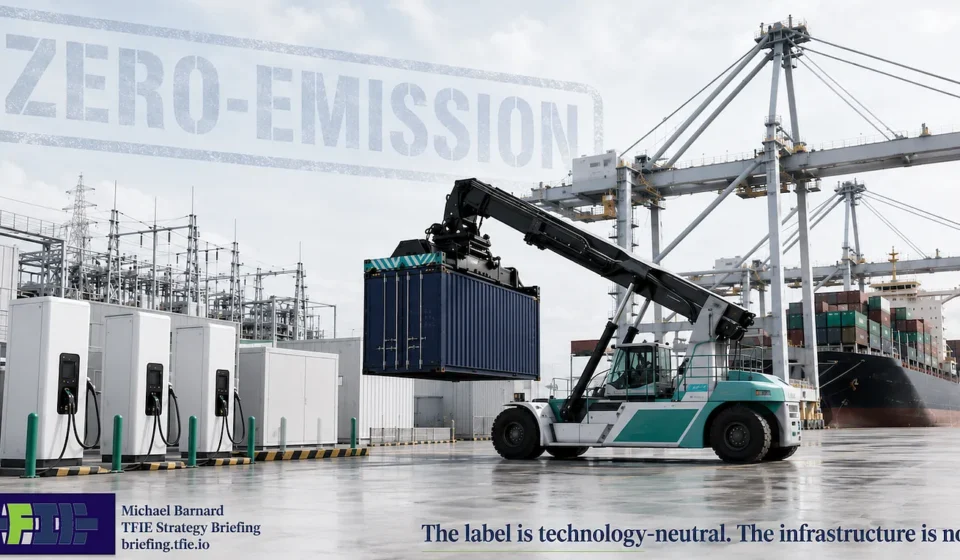
Procurement as Architecture: How Assets Shape Port Electrification

When “zero‑emission” becomes the cover story, look at the shopping list.
Context: I recently read an analysis of a major port’s decade‑long experiments with both hydrogen and battery electrification. Public statements stayed technology‑neutral, but procurement and infrastructure choices-chargers, high‑voltage interconnections, and commercial e‑cargo equipment-began telling a different, more durable story.
Why this matters for architects and decision‑makers
Two simple observations emerge that matter for any strategic technologist: words preserve political optionality; assets reveal operational intent. Buying demonstration fuel‑cell tractors proves a point about feasibility. Building repeatable charging infrastructure, training maintenance crews on high‑voltage systems, and placing orders for multiple battery machines create a system that’s harder to unwind.
Systems boundaries are the essential lens. A battery truck’s adoption curve is largely internal to a terminal: power upgrade, chargers, scheduling and technician skills. A hydrogen truck requires a supply chain-production, compression or liquefaction, transport, on‑site storage and dispensing-and a volume profile that justifies that entire ecosystem. The latter is not just a technology question; it’s an ecosystem and economics problem. In enterprise architecture terms, hydrogen is not a single component you replace in CI/CD; it’s a distributed platform with many external dependencies and failure modes.
Architecture lessons for CTOs and infrastructure planners
- Read procurement as architecture. Public policy and comms are useful signals, but the operational architecture is revealed by capital allocation and repeatable buys. For architects advising boards, audit procurement flows and maintenance plans as they are stronger predictors of direction than strategic statements.
- Model the full fuel system, not only the device. Total cost of ownership (TCO), reliability, and scalability must include upstream and downstream services: production capacity, logistics, regulatory compliance and outsourced maintenance. Incomplete models create hidden technical debt.
- Design for modularity and graceful migration. When infrastructure is expensive and long‑lived, prefer modular systems (e.g., electrical upgrades with capacity headroom, shared charging hubs) that permit multiple vehicle classes and future technology swaps without full replacement.
- Invest in operational learning. Chargers create institutional capabilities-scheduling discipline, high‑voltage safety, grid interactions-that reduce friction for subsequent deployments. Plan training, standard operating procedures, and supplier ecosystems early.
A practical parallel for India
This pattern isn’t only a West Coast phenomenon. Indian ports and large terminals operate as bounded systems with repetitive routes and centralized fleet management-conditions where electrification’s advantages become tangible quickly. For Indian decision‑makers, the leverage is similar: prioritize shared electrification infrastructure that serves multiple equipment classes, secure grid upgrades with renewable ingress, and structure public‑private partnerships so pilots can graduate to commercial financing. Hydrogen should remain a targeted option where corridor logistics or duty cycles truly demand it, but it must be evaluated as a full supply‑chain platform, not merely a vehicle technology.
Actionable takeaways
- Treat capital allocation as your strategic signal: where money flows, the system follows.
- Require full‑system TCO and reliability analysis before signing long‑term infrastructure contracts.
- Build shared, modular electrical infrastructure to maximize optionality and reduce lock‑in.
- Prioritize workforce training and maintenance practices-the human layer is what makes technical transitions sustainable.
- Reserve hydrogen for use cases where battery systems demonstrably fail the operational requirements after full systems analysis.
Closing thought
Technical transitions rarely pivot on a single announcement; they unfold where organizations invest operational muscle-training, procurement, and repeatable infrastructure. As architects, our job is to see beyond the slogans and design for the systems that will actually run tomorrow.
About the Author: Sanjeev Sarma is the Founder Director and Chief Software Architect at Webx Technologies. With a core focus on Generative AI integration, Cloud-Native Scalability, and Enterprise Software Architecture, he has spent over two decades driving digital transformation across Northeast India and beyond. Beyond his corporate leadership, Sanjeev is deeply invested in shaping the future of the IT industry. He serves as an Industry Expert on the Board of Studies for Assam Don Bosco University’s School of Technology, advises state technology committees, and actively mentors emerging tech startups at STPI. He brings a unique, dual perspective of high-level enterprise execution and future-ready academic curriculum development.