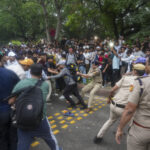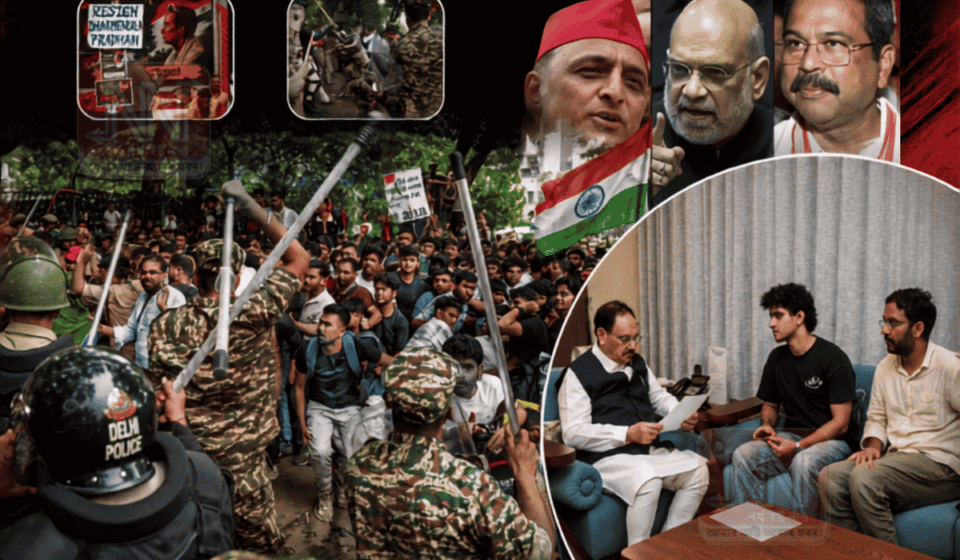

On Monday, during Parliament’s monsoon session, a protest organised by the self-styled Cockroach Janata Party (CJP) over allegations that the NEET-UG 2026 exam paper was leaked turned violent in New Delhi as thousands converged on Jantar Mantar and moved toward the Parliament complex. Protesters attempted to break police barricades; security personnel used tear gas and mild force to repel them, and several demonstrators were detained. Authorities said the action was taken after some protesters tried to rush the Parliament building.
CJP spokespeople Saurav Das and Ashutosh Ranka met central minister J.P. Nadda and handed over a written memorandum demanding three measures: the release of social activist Sonam Wangchuk, the resignation of Union Education Minister Dharmendra Pradhan, and Rs 1 crore in compensation for the family of a NEET candidate who allegedly died by suicide. The party said these demands are non-negotiable and form the core of the “Parliament Chalo” campaign.
The protest followed a 21-day hunger strike by Sonam Wangchuk; CJP founder Abhijit Deep said he called off his own indefinite hunger strike at Sonam’s request after Sonam was admitted to Safdarjung Hospital for treatment. Protesters said Sonam’s condition and the alleged exam irregularities motivated the mass action.
Clashes between police and demonstrators left several Delhi Police personnel injured, the force reported, alleging some protesters hurled stones and other projectiles at security staff. CJP countered with accusations of excessive force, claiming that Sonam Wangchuk’s wife and a 12-year-old girl named Geetanjali were beaten by police. Delhi Police denied those specific claims, calling the social-media posts that circulated the allegations false and misleading.
The demonstrations drew strong political reactions. Samajwadi Party MP Akhilesh Yadav condemned police baton charges on students and young protesters and said he would raise the issue in the Lok Sabha. Opposition leader in the Rajya Sabha Mallikarjun Kharge accused the government of trying to silence student voices through force. Leaders from the Aam Aadmi Party, including Manish Sisodia, Sanjay Singh and Atishi, attended Jantar Mantar and expressed solidarity with the student protesters.
The unrest disrupted city movement: Delhi Metro Rail Corporation closed five stations, including Rajiv Chowk and Patel Chowk, citing security reasons, causing major commuter inconvenience. Police also detained seven protesters near the Reserve Bank of India premises, and authorities in Ahmedabad arrested people who had staged local demonstrations in solidarity with the CJP action.
Within Parliament, Home Minister Amit Shah held a reportedly four-hour closed-door meeting with Education Minister Dharmendra Pradhan as officials sought to manage the fallout. Central Delhi has since seen a heavy security deployment, including the Rapid Action Force, and tightened access around key government buildings.
CJP said it is willing to enter talks with the government but maintained that no clear commitments have been received so far. With tensions subdued for the moment, the party indicated its next steps will depend on any formal response from the government.
Original Source: https://assam.nenow.in/cjp-parliament-chalo-protest-turned-tense-in-delhi-as-demonstrators-clashed-with-police-while-a-delegation-met-j-p-nadda-over-neet-ug-2026-demands/
Category: Popular Stories,দেশ,ৰাজনীতি,শিক্ষা,শীর্ষ সংবাদ
Tags:
Publish Date: 2026-07-20 19:53:00