From RoboCup to Deployment: Architecting Competitive Embodied AI Platforms

Ten years from now the most consequential robotics advances may not come from a single breakthrough motor or sensor – they will come from orchestration: software stacks, simulation pipelines, and reproducible research that let teams move from lab demos to reliable field systems. RoboCup 2026 in Incheon is less about which team scored the final goal and more about where that integration is heading.
Context
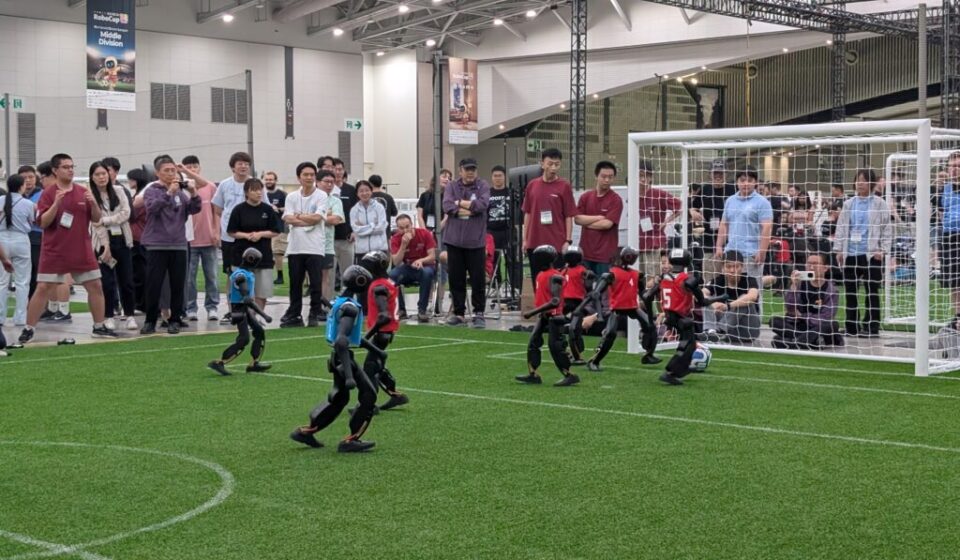
RoboCup 2026 concluded its humanoid league competitions in Incheon with top teams across small, middle and large divisions and a symposium running alongside the matches. Beyond trophies, the event highlighted two trends: (1) software and systems engineering are now decisive in embodied AI competitions, and (2) community-driven research challenges and awards are accelerating reproducibility and tooling.
What this really means for architects and CTOs
-
The balance has shifted: software orchestration > bespoke hardware tuning
The awards at RoboCup – notably “Best Humanoid Software” and the Open Research Challenge for embedded 2D/3D game analysis – underline a shift I’ve seen repeatedly in enterprise robotics projects: mechanical designs matter, but the scalable differentiator is software that orchestrates perception, planning and low-latency control across heterogeneous hardware. For enterprise teams this implies investing more in modular, testable middleware and less in one-off integrations that create long-term technical debt. -
Simulation-driven CI/CD is now a prerequisite
High-fidelity simulation (and sim-to-real pipelines) are how teams iterate tactics and validate controllers before risking fragile hardware. For organisations deploying robots or drones at scale, that means embedding simulation into the development lifecycle: automated scenarios, adversarial testing, and performance regression checks become as important as unit tests were for web services. -
Edge compute and model lifecycle management are operational imperatives
Humanoid soccer is a real-time systems problem – perception, decision-making and actuation under strict latency and safety constraints. Enterprises must treat robotic endpoints as full-stack services: orchestrated edge inference, versioned models, telemetry for drift detection, and secure OTA update mechanisms. The trade-off is familiar: pushing compute to the edge reduces latency but increases maintenance surface area and governance complexity. -
Benchmarks and shared datasets reduce research-to-production friction
Awards for open challenges and innovation show the community benefit of shared datasets and evaluative tasks. For industry, participating in or sponsoring similar open benchmarks accelerates hiring, reduces R&D overlap, and permits apples-to-apples evaluation of algorithmic choices. -
Safety, refereeing and standards scale beyond competition
Recognition for “Best Referee” is a useful signal – as autonomous agents enter human environments, impartial, auditable adjudication (whether software referees or regulatory frameworks) will be needed. Enterprises must design systems with explainability, audit logs, and deterministic fallback behaviours to meet compliance and public trust requirements.
A practical bridge to India (and the Northeast)
There is a clear, logical bridge between these trends and Indian needs: frugal, reliable robotics can help in agriculture, disaster response and eldercare. That bridge requires investment in shared testbeds, simulation labs, and university–industry collaboration so that teams in Assam, Guwahati and across the Northeast can convert talent into deployable, production-grade systems. From a mentorship and policy perspective, encouraging local participation in international challenges is one of the fastest ways to build systems-thinking skills at scale.
Takeaways for leaders
- Treat robotics as distributed systems: adopt versioned models, edge orchestration and telemetry-first operations.
- Embed simulation in CI/CD pipelines to lower hardware costs and shorten iteration cycles.
- Prioritise modular middleware and clear interfaces to avoid long-term integration debt.
- Engage with open benchmarks and research challenges to accelerate recruitment and reduce duplication.
- Build governance around explainability, auditable behaviour, and secure update paths.
Closing thought
Competitions like RoboCup are more than spectacle – they are stress tests for the architectural choices that will determine whether robotics becomes a reliable utility or a niche curiosity. The winning teams aren’t just those with the fastest actuators; they’re the ones who treat robots as software-defined, safety-first distributed systems.
About the Author: Sanjeev Sarma is the Founder Director and Chief Software Architect at Webx Technologies. With a core focus on Generative AI integration, Cloud-Native Scalability, and Enterprise Software Architecture, he has spent over two decades driving digital transformation across Northeast India and beyond. Beyond his corporate leadership, Sanjeev is deeply invested in shaping the future of the IT industry. He serves as an Industry Expert on the Board of Studies for Assam Don Bosco University’s School of Technology, advises state technology committees, and actively mentors emerging tech startups at STPI. He brings a unique, dual perspective of high-level enterprise execution and future-ready academic curriculum development.