Architecting Automotive Platforms for Global Scale: BYD vs Tesla

The age of single-metric dominance is over – and that’s a good thing for industry architects.
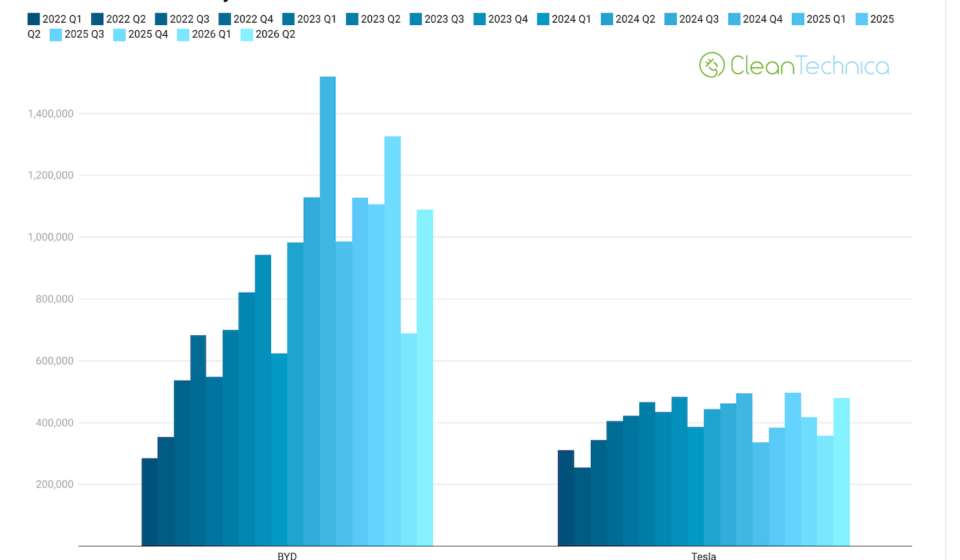
Ten years ago, headlines about the global EV market were shorthand for “Tesla vs. everyone else.” A recent industry analysis (Q2 2026) shows why that narrative no longer holds: BYD reclaimed the global BEV lead in Q2 2026 – selling 557,090 BEVs vs. Tesla’s 480,126 – and outsold Tesla handily on total passenger vehicle deliveries (1,088,382 vs. 480,126), aided by a large volume of exports. These quarterly swings matter less than the structural shifts beneath them.
Why this matters for architects and leaders
The headline – BYD ahead of Tesla this quarter – is noise unless you read the underlying system dynamics. Three architectural principles emerge that are relevant to CTOs, founders, and policy-makers:
-
Portfolio architecture beats point solutions
BYD’s advantage is not just volume; it is product breadth. BYD sells both large-battery plug-in hybrids and pure BEVs, enabling it to capture demand across different price points, geographies, and regulatory environments. In product-platform terms, BYD is leveraging a multi-variant architecture that stretches a core chassis and powertrain across multiple offerings. For enterprise architects, the lesson is familiar: narrow, best‑of‑breed solutions can win early, but sustainable scale is usually achieved by platforms that support configurable variants without rebuilding from scratch. -
Vertical integration and flexible supply chains reduce execution risk
Quarter-to-quarter swings in China’s auto market exposed how demand shocks cascade through suppliers, logistics, and capacity planning. BYD’s vertically integrated value chain – from battery cells to vehicle assembly – provides buffer and optionality. For software and systems leaders, this is an argument for owning critical interfaces (data contracts, provisioning, firmware pipelines) and building fallback modes that let core services continue when parts of the stack degrade. -
“Software-defined” is necessary, not sufficient
Tesla’s early lead was driven by software-first thinking: OTA updates, digital retail, and a user experience deeply coupled with vehicle firmware. That advantage remains vital. But the Q2 2026 results show software must be married to manufacturing-scale execution, pricing agility, and export logistics to convert tech leadership into consistent market share. In other words: software capabilities are necessary but must be integrated into an operational architecture that spans factory, supply chain, and aftermarket.
Practical implications – what leaders should do now
- Re-evaluate modularity: Design product platforms (physical or digital) with explicit variation points so new models or features can be launched with minimal rework.
- Treat supply chain as a real-time system: Invest in telemetry, predictive analytics, and “digital twins” for factories and logistics to simulate demand shocks and plan capacity.
- Align software and operations roadmaps: Ensure release cadences, QA, and rollback plans match physical production cycles; a failed OTA at scale is a systems design failure.
- Localize strategically: For companies entering export markets, build localized supply and service hubs that reduce time-to-market and regulatory friction.
- Scenario plan for margins, not only market share: High volumes can mask margin erosion; create KPIs that balance unit economics with growth.
A note for India and smaller OEMs
There is a clear parallel for India’s EV ambitions. The structural levers – modular platforms, localized battery and component ecosystems, and robust export-ready logistics – are within reach if industry and policy align. Rather than chasing quarterly headlines, Indian firms and state bodies should prioritize platform R&D, skills development for factory digitization, and export enablement to capture the next phase of EV growth.
Takeaways
- Quarterly winners matter for momentum; platform design determines resilience.
- Integrated product + supply + software architectures scale better than isolated technical advantages.
- Build with variability in mind: configurable platforms, telemetry-driven operations, and aligned software-ops roadmaps.
- For emerging ecosystems (including India), the opportunity is to leapfrog with modularity and export-readiness, not replicate single-product strategies.
Closing thought
Market leadership in 2026 will come less from isolated innovations and more from systems thinking – the ability to design, operate, and evolve complex platforms across hardware, software, and supply networks.
About the Author: Sanjeev Sarma is the Founder Director and Chief Software Architect at Webx Technologies. With a core focus on Generative AI integration, Cloud-Native Scalability, and Enterprise Software Architecture, he has spent over two decades driving digital transformation across Northeast India and beyond. Beyond his corporate leadership, Sanjeev is deeply invested in shaping the future of the IT industry. He serves as an Industry Expert on the Board of Studies for Assam Don Bosco University’s School of Technology, advises state technology committees, and actively mentors emerging tech startups at STPI. He brings a unique, dual perspective of high-level enterprise execution and future-ready academic curriculum development.
