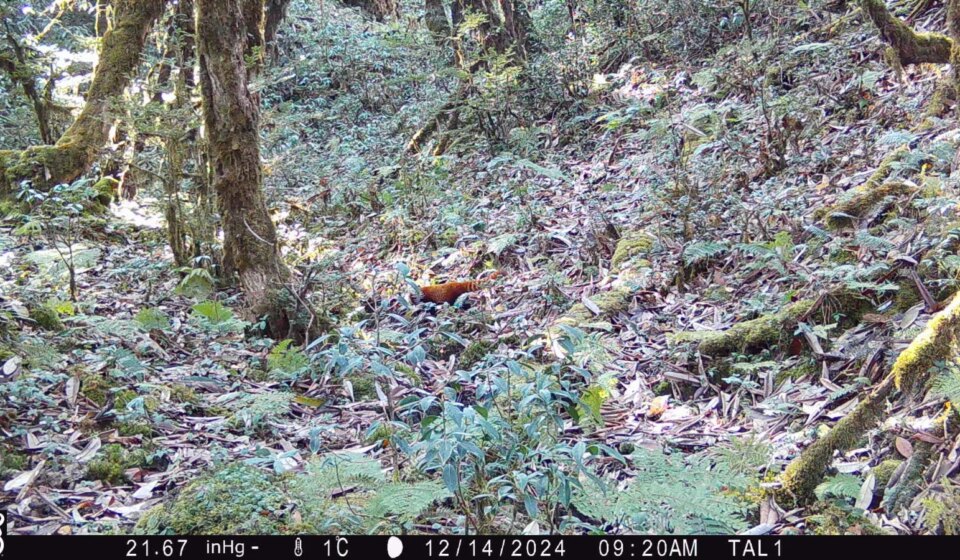

Researchers have captured the first photographic evidence of the Himalayan red panda (Ailurus fulgens) in the remote Yordi Rabe Supse Wildlife Sanctuary (YRSWS) in Arunachal Pradesh, a discovery reported in the latest issue of the Journal of Threatened Taxa. The images, taken by motion-triggered camera traps set up for a study of the Mishmi takin, were documented by Yomto Mayi (Zoological Survey of India and Wildlife Institute of India), Shantabala Devi Gurumayum (ZSI Arunachal Pradesh Regional Centre) and Salvador Lyngdoh (WII, Dehradun). The red panda was not the target species, making the find an unexpected conservation breakthrough.
Camera traps recorded the species at two sites roughly 12 km apart, at elevations of 2,409 metres and 2,848 metres, confirming its presence in two distinct forest ranges within YRSWS. One image was captured just two days after a camera was deployed, underscoring the animal’s local occurrence. The sanctuary covers about 397 sq km across West Siang and Siang districts and has seen little scientific study since it was notified in 2007.
The landscape of Yordi Rabe Supse-whose name translates locally as “a distant and faraway hill,” with Supse being a high peak-features steep slopes, rugged hills and deep gorges. Camera-trap locations showed almost pristine habitat: one site displayed no human activity during the study, while the other recorded only two visits by a field guide. Dense, moss-covered forests, bamboo patches, ferns and thick undergrowth provide suitable habitat for the endangered mammal.
The researchers say the discovery suggests YRSWS may act as an ecological corridor linking red panda populations in western Arunachal (including Tawang, West Kameng and Shi-Yomi) with central areas such as Mouling National Park. Such connectivity is vital to reduce inbreeding and lower the risk of local extinctions. Arunachal Pradesh already accounts for more than 90% of India’s estimated red panda habitat.
The authors call for strengthened, landscape-level surveys, community-led conservation, participatory habitat management and the integration of camera trapping with genetic studies to map population connectivity across central Arunachal. They also warn that proposed infrastructure projects-such as the Frontier Highway (NH-913) and hydropower developments-could fragment high-altitude forests and disrupt essential wildlife corridors. The team acknowledged support from the Arunachal Pradesh Forest Department, particularly the Divisional Forest Officer of Aalo Division and field staff, and noted that much of the state’s mountain habitats remain biologically unexplored.
Original Source: https://eastmojo.com/premium/2026/06/28/arunachal-hunt-for-takin-leads-scientists-to-new-red-panda-haven/
Category: Arunachal Pradesh,News,Northeast News,Premium
Tags:
Publish Date: 2026-06-28 10:00:00