Platform Architectures for Rapid Distributed-Solar Electrification

Contrarian observation: distributed growth doesn’t always shrink demand – it can create it.
Context
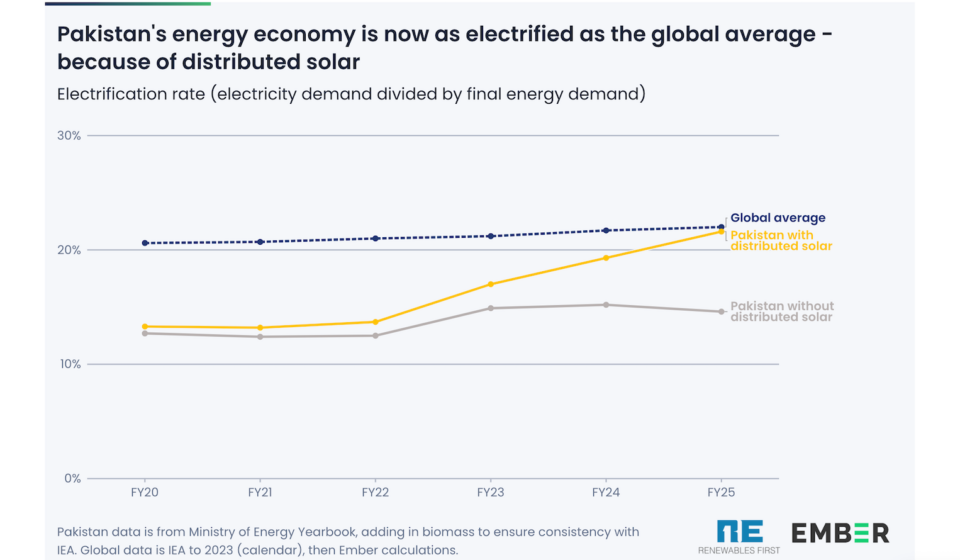
A recent analysis of Pakistan’s energy transition (Ember / Renewables First) shows that a rapid distributed-solar boom – roughly 27 GW of behind‑the‑meter capacity installed within two years – pushed electricity demand up by about 21% between FY23 and FY25 and raised the country’s electrification share to roughly 21.7% of final energy. The key signal: distributed energy resources (DERs) didn’t just replace fossil fuel generation; they unlocked latent demand and changed how consumers and businesses consume energy.
Why this matters for architects and CTOs
Most technology leaders instinctively map “distributed” to efficiency and demand reduction. The Pakistan case flips that assumption: cheap, reliable local supply reduced friction (and tariffs/loadshed risk), which in turn enabled higher consumption – particularly cooling, irrigation and industrial process electrification. For enterprise and public-sector architects this has three immediate implications:
-
Platform thinking for physical infrastructure: Electricity networks are becoming digital platforms the way cloud was a decade ago. Behind‑the‑meter assets are endpoints with telemetry, control hooks and commercial value. Treating them as passive endpoints is a design flaw – they must be integrated into planning, forecasting and settlement systems (DER management systems, VPP orchestration, real‑time pricing interfaces).
-
Data truth matters more than ever: Official statistics undercounted distributed generation until the dataset was rebased. Incomplete observability distorts planning, subsidy design and investment decisions. Modern grid planning requires high‑fidelity, near‑real‑time data ingestion from millions of edge devices – the same data‑engineering patterns we use for customer telemetries and fraud detection now apply to energy systems.
-
Speed vs. stability trade-offs: Rapid DER deployment delivers resiliency and import‑dollar savings, but it amplifies complexity for utilities – reduced daytime revenue, potential stranded thermal assets, frequency and voltage management challenges, and new cyber‑attack surfaces. The long‑term architectural choice is not “centralized or distributed” but “federated and observable”: modular control layers, open standards for inverters and secure OTA channels.
Actionable guidance for leaders
-
Invest in operational data fabrics that unify OT and IT. Real‑time ingestion, anomaly detection and predictive maintenance pipelines allow utilities and large enterprises to monetise and manage DERs without sacrificing reliability.
-
Prioritise DER orchestration capabilities (DERMS / VPP) and align commercial signals (time‑of‑use tariffs, demand response) so behaviour follows system needs rather than purely tariff arbitrage.
-
Incorporate scenario planning that models demand growth driven by DER adoption. Traditional load‑forecasting assumptions may under‑estimate growth where behind‑the‑meter economics are favourable.
-
Harden cyber and firmware supply chains. Millions of distributed inverters and batteries increase the attack surface; secure firmware updates and identity/authentication for devices are non‑negotiable.
Relevance to India and Northeast practitioners
This is directly relevant to India. Rooftop solar, agricultural solar pumps and commercial installations have similar potential to unlock latent demand – especially in hot, agrarian regions. For the Northeast, where microgrids and diesel displacement are active policy goals, the lesson is clear: pair hardware subsidies with digital metering, device registration and data assimilation so growth is visible and manageable. Startups and state agencies can collaborate on modular DER orchestration pilots that demonstrate tangible reliability and tariff outcomes before scale‑up.
Takeaways
- Distributed supply can increase total electricity demand by lowering friction and enabling new use-cases; plan for that.
- Data and interoperability are the strategic enablers – not just the operational nice‑to‑haves.
- Policy and commercial models must evolve in lockstep with technology to avoid financial and reliability stress on incumbent utilities.
- View DERs as strategic digital assets that require secure lifecycle management, not one‑off hardware deployments.
Closing thought
The energy transition is no longer a binary replacement of fuels; it’s an architectural shift – from unidirectional, commodity flow to a software‑driven, federated platform of energy, markets and services. Leaders who design for that complexity now will own the resilient systems of the next decade.
About the Author: Sanjeev Sarma is the Founder Director and Chief Software Architect at Webx Technologies. With a core focus on Generative AI integration, Cloud-Native Scalability, and Enterprise Software Architecture, he has spent over two decades driving digital transformation across Northeast India and beyond. Beyond his corporate leadership, Sanjeev is deeply invested in shaping the future of the IT industry. He serves as an Industry Expert on the Board of Studies for Assam Don Bosco University’s School of Technology, advises state technology committees, and actively mentors emerging tech startups at STPI. He brings a unique, dual perspective of high-level enterprise execution and future-ready academic curriculum development.
