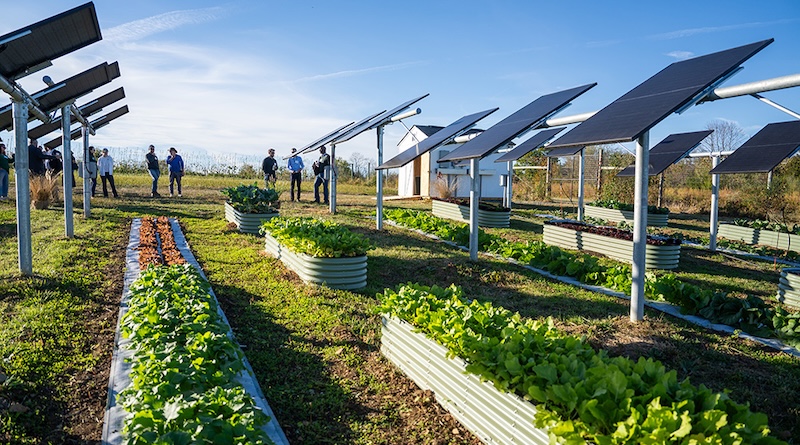
Architecting Agrivoltaics: Policy and Systems for Farm-Integrated Energy

We are accustomed to treating energy and agriculture as separate systems-one governed by utilities and markets, the other by seasons and soil. Virginia’s recent move to codify “agrivoltaics” as an intentional co-location of crops and solar generation forces a different mental model: farms as distributed, multi‑functional cyber‑physical platforms that must be designed for dual purpose, long lifespans, and evolving markets.
A policy signal worth noting
A state bill in Virginia (SB 340/HB 508) creates an enforceable definition for agrivoltaics and ties project approval to priorities such as maintaining agricultural productivity, aligning with existing farm businesses, and designing flexibility across a 25–30 year solar array lifespan. The law also explicitly enables on‑farm storage and participation in aggregated markets such as virtual power plants (VPPs).
What this means from an enterprise-architecture lens
As technologists and architects, we should read this as more than an energy policy: it’s a specification for a new class of distributed systems. Agrivoltaic sites are not just panels plus plants – they are integrated, long‑lived platforms that combine power electronics, batteries, IoT sensing, agronomy telemetry, marketplace interfaces, and regulatory compliance records.
Key architectural implications and trade-offs:
- Co‑design across domains. Mechanical layout (panel height, tilt, spacing) affects crop microclimates; electrical design (inverter sizing, export limits) affects farm economics. Architectures must enable joint optimization rather than siloed decision‑making. Practically, that means open data models for shading, irrigation, yield, and generation that planners and ML models can use together.
- Lifecycle and reversibility. Policies that guarantee agricultural priority over the 25–30 year panel life push designers toward modular, removable hardware and non‑destructive installations. That increases capex per MW but reduces long‑term land‑use risk – a design discipline akin to building for graceful degradation rather than brittle optimisation.
- Edge-first control and resilience. Farms demand local autonomy: islanding during outages, managing batteries for on‑farm loads, and supporting microgrid control when connectivity is intermittent. Edge compute that runs energy management, crop microclimate models, and safety checks is essential; cloud services should be orchestration and analytics layers, not single points of control.
- Market integration complexity. Enabling VPP participation creates requirements for secure APIs, latency‑aware telemetry, settlement reporting, and auditable state. Systems must expose standard interfaces so aggregators and utilities can reliably dispatch capacity without compromising farm operations.
- Data governance and farmer agency. Sensor and operational data can be monetized, but ownership and privacy must be explicit. Contracts and platforms must include consent controls, exportable data, and penalties for misuse – otherwise farmers may trade short‑term income for long‑term loss of control.
Opportunities for enterprise teams and founders
- Build interoperable platforms that model both agronomy and powerflow; start with a minimal set of common schemas (generation, SOC, soil moisture, canopy light) and expand iteratively.
- Offer modular hardware designs optimized for removability and low soil disturbance to meet policy-driven reversibility constraints.
- Develop VPP-ready middleware that packages farm flexibility into standard bids while preserving on‑farm priorities.
- Create regulatory sandboxes with states or national agencies to test business models that share upside with farmers while enforcing agricultural protection.
A quick Bharat note (why this matters here)
India’s smallholder landscape and high solar resource make agrivoltaics a compelling resilience strategy. But it will only scale if policy, subsidies, and digital public goods align-DPI for land records, standardized interconnection rules, and affordable edge-control stacks. The lessons from Virginia are a playbook: define agricultural priority, enable storage and market participation, and demand design flexibility.
Takeaways
- Treat agrivoltaics as a multi‑domain system: electrical, mechanical, software, and legal.
- Prioritize local resilience (edge compute + batteries) with cloud orchestration for markets and analytics.
- Build for reversibility and farmer data ownership to reduce long‑term socio‑technical debt.
- Standardize interfaces early so VPPs, utilities, and farmers can transact predictably.
Closing thought
When land is recognized as a platform rather than a single‑purpose asset, we can design systems that sustain livelihoods while decarbonizing power-if architects, policymakers and entrepreneurs commit to building for longevity, interoperability, and fairness.
About the Author: Sanjeev Sarma is the Founder Director and Chief Software Architect at Webx Technologies. With a core focus on Generative AI integration, Cloud-Native Scalability, and Enterprise Software Architecture, he has spent over two decades driving digital transformation across Northeast India and beyond. Beyond his corporate leadership, Sanjeev is deeply invested in shaping the future of the IT industry. He serves as an Industry Expert on the Board of Studies for Assam Don Bosco University’s School of Technology, advises state technology committees, and actively mentors emerging tech startups at STPI. He brings a unique, dual perspective of high-level enterprise execution and future-ready academic curriculum development.