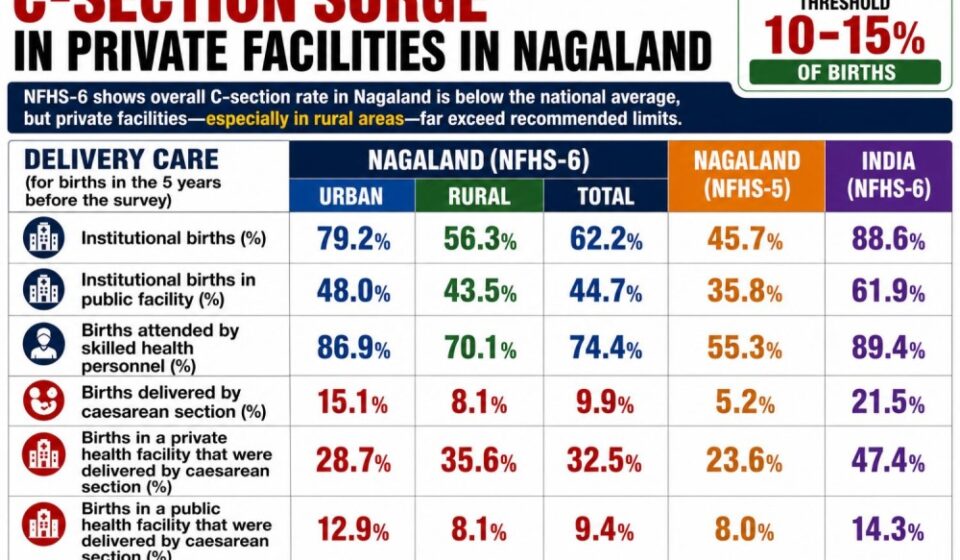

Dimapur, June 7 — Caesarean section (C‑section) deliveries in Nagaland have nearly doubled over the past five years, rising to 9.9% of births in the five years before the National Family Health Survey‑6 (NFHS‑6), up from 5.2% recorded in NFHS‑5, the survey’s India and State/UT fact sheets show. The increase is driven largely by high C‑section rates in private health facilities, which far exceed the World Health Organization’s recommended range.
NFHS‑6 (2023–24) reports that 32.5% of births in Nagaland’s private health facilities were by C‑section, compared with 9.4% in public facilities. The WHO benchmark widely cited by India’s Ministry of Health and Family Welfare suggests caesarean deliveries should account for about 10–15% of births at the population level; rates substantially above or below that range do not automatically indicate better outcomes for mothers or newborns.
Geography and facility type show contrasting patterns. Overall C‑section rates in Nagaland were 15.1% in urban areas and 8.1% in rural areas. In public facilities the urban rate was 12.9% versus 9.4% in rural areas. Among private facilities the pattern was reversed: 35.6% of births in rural private facilities were by C‑section, higher than the 28.7% reported in urban private centres. By comparison, nationally private facility C‑section rates were 57.4% in urban areas and 52.2% in rural areas.
The survey also highlights Nagaland’s relatively low use of institutional maternal care. Institutional births in the state stood at 62.2%, well below the national average of 88.6%. Similarly, 74.4% of births in Nagaland were attended by skilled health personnel, against 89.4% nationally. The state’s lower overall C‑section rate therefore coincides with lower institutional delivery and skilled attendance, even as private facility C‑section proportions remain high-particularly in rural areas.
About NFHS‑6: The sixth round of India’s flagship health survey was carried out in 2023–24 by the Union Ministry of Health and Family Welfare with the International Institute for Population Sciences, Mumbai, as the nodal agency. NFHS‑6 covered roughly 679,238 households nationally and collected data from 716,397 women and 100,977 men. In Nagaland, fieldwork ran from August 26, 2023, to March 5, 2024, covering 11,104 households, 9,693 women and 1,635 men. The provisional India and State/UT fact sheets were released on May 29; the full detailed report is still awaited.
Original Source: https://www.morungexpress.com/nfhs-5-c-section-deliveries-rise-in-nagaland-private-facilities-exceed-whos-threshold
Category: Morung Exclusive , Nagaland
Tags:
Publish Date: 2026-06-07 22:42:00