
NASA’s Nancy Grace Roman Space Telescope could transform the search for planets beyond our solar system by uncovering roughly 100,000 new exoplanets and thousands more through microlensing, dramatically expanding our view of worlds across the Milky Way. The mission will target regions largely unexplored by past surveys — including the densely packed galactic bulge and the far side of the galaxy — allowing astronomers to compare planet populations in environments very different from the Sun’s neighborhood.
Roman will use two complementary techniques: the transit method, which detects small dips in a star’s brightness when a planet crosses in front of it, and gravitational microlensing, where the gravity of a foreground star and its planets briefly magnifies light from a more distant star. Transit observations are expected to yield about 100,000 planets, favoring large, hot worlds that block more light and transit frequently. Microlensing should add more than 1,000 planets, including Earth- and Mars-mass worlds and planets in wide orbits — types often missed by other methods. Roman’s galactic bulge survey alone could produce more than 50,000 microlensing events, revealing planets, black holes, neutron stars and distant solar-system objects.
The telescope will also probe planetary atmospheres on a large scale. “Roman won’t analyze atmospheres in the same in-depth way as missions like NASA’s James Webb Space Telescope, but it will gather different information on a much larger scale,” said Robby Wilson, a postdoctoral fellow at NASA Goddard. By measuring secondary eclipses and orbit-phase brightness changes of hot Jupiters, Roman can estimate planet temperatures, day–night contrasts and atmospheric circulation across thousands of worlds.
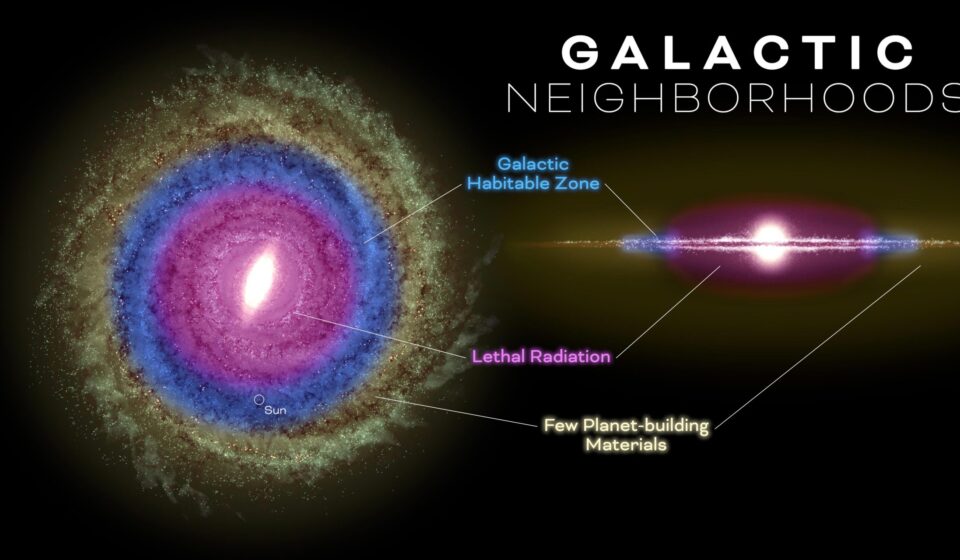
Studying stars across the Milky Way will shed light on how environment and chemistry affect planet formation. The Sun sits about 27,000 light-years from the galactic center and likely formed roughly 10,000 light-years closer in. Stars nearer the center tend to be older and richer in heavy elements — like silicon, oxygen and magnesium — which influence the size and frequency of planets. “Stars with more heavy elements tend to host more planets, especially giant ones,” Wilson said.
Scientists preparing for Roman are building software, simulations and machine-learning tools to detect planets in the flood of data and weed out false positives. “Roman will extend the search far enough to encompass other galactic habitats,” said Elisa Quintana of NASA Goddard, “which could help us learn how planet formation varies across different regions of the Milky Way.” All Roman data will be released publicly, inviting both professional and citizen scientists to join the next exoplanet revolution that could rival Kepler’s legacy.
Original Source: https://scitechdaily.com/nasas-roman-telescope-will-search-100-million-stars-for-new-worlds/
Category:
Tags:
Publish Date: 2026-06-05 01:14:00