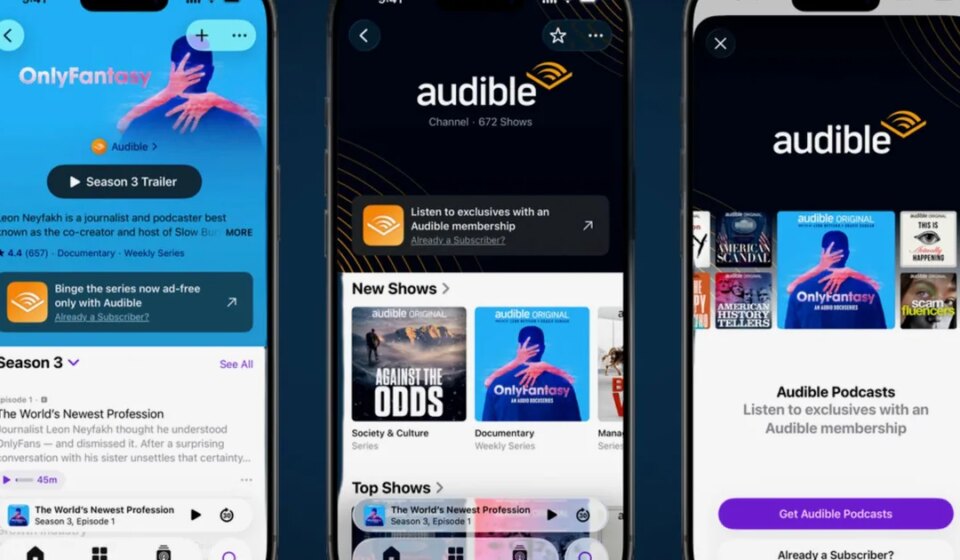

We obsess about product differentiation and platform lock‑in, but the Audible–Apple Podcasts tie-up is a reminder that reach often wins before features do. Distribution partnerships that reduce friction for listeners change the economics of content faster than any single UX innovation – and that should make architects and product leaders sit up and take notes.
Context
Audible has launched a connected subscription that lets Audible members stream a large slate of premium shows directly inside Apple Podcasts; memberships can link automatically and new customers can subscribe via Apple Podcasts. The rollout is live in key markets today and is scheduled to expand further; Apple Podcasts itself has recently added richer capabilities (video, Picture‑in‑Picture and offline downloads), while Audible has also introduced a lower‑priced Standard tier for new listeners.
Why this matters beyond “another consumer feature”
At surface level this is a consumer convenience play: fewer apps, less friction to listen. At systems level it’s an exercise in entitlement orchestration, cross‑platform identity, rights management, analytics fragmentation and new commercial flows. For any organisation building digital platforms – whether a media publisher, an enterprise software vendor or a DPI component – the technical and strategic lessons are the same.
Key implications for architects and product leaders
– Entitlement and identity are first‑class concerns. A “connected subscription” requires reliable account linking, token exchange, and idempotent sync between two large systems. Design a lightweight entitlement microservice that can issue and validate time‑bounded access tokens on behalf of third‑party platforms (OAuth + scoped JWT patterns work well). Plan for eventual consistency and idempotent reconciliation flows – user state will diverge; retries and audit logs are essential.
– Analytics and measurement get fragmented. When content is consumed inside partner apps, your telemetry may be partial or delayed. Treat partner telemetry as a separate signal and build a stitching layer that maps partner events to your canonical user and content IDs. Expect gaps; infer engagement via cohort trends rather than single events.
– Rights, DRM and offline access are a nuanced trade‑off. Offline downloads and cross‑platform playability expand reach, but they complicate licensing and DRM. Push for standardized entitlement schemas with partners and automate license revocation/expiry workflows. For creators, flexible licensing tiers (streaming vs download vs exclusive) will become a competitive advantage.
– Build vs. partner: short‑term reach vs long‑term control. Broad platform partnerships accelerate user acquisition but dilute the direct relationship with users and the in‑app monetisation surface. If you’re a content owner, balance partner distribution with a durable owned channel (email, direct app, account identity) and use partnerships to feed top‑of‑funnel growth.
– Operational resilience and edge considerations. Apple’s offline downloads and PiP features increase device‑side complexity. If you serve audiences in low‑bandwidth regions, implement adaptive bitrates, resumable downloads, and edge caching. These are not “nice‑to‑have” optimizations; they materially affect retention.
Practical checklist for CTOs / founders
– Build an entitlement microservice: OAuth + JWTs, refresh token policy, reconciliation jobs.
– Create a telemetry stitching layer: common IDs, ETL to your analytics warehouse, and synthetic metrics for gaps.
– Automate licensing workflows: issuance, offline license embedding, revocation.
– Design for offline‑first UX in low‑connectivity markets: resumable downloads, low‑bitrate encodes, background sync.
– Negotiate data‑sharing SLAs with partners: what events, frequency, and schema are shared.
– Keep a direct relationship channel (email, notifications) even while leveraging partners for distribution.
A Bharat note (brief and intentional)
For Indian publishers and creators, this model underscores the importance of distribution partnerships but also the need for offline‑first design. In regions with intermittent connectivity, the ability to download low‑bandwidth audio and resume playback reliably is as strategic as being listed on a major platform. Consider telco bundling and regional price tiers to improve affordability and reach.
Closing thought
Platform partnerships will continue reshuffle the balance between ownership and reach. The winners will be organisations that treat entitlements, telemetry and licensing as core platform services – not afterthoughts – and who design for the messy reality of federated ecosystems.
About the Author Sanjeev Sarma is the Founder Director of Webx Technologies Private Limited, a leading Technology Consulting firm with over two decades of experience. A seasoned technology strategist and Chief Software Architect, he specializes in Enterprise Software Architecture, Cloud-Native Applications, AI-Driven Platforms, and Mobile-First Solutions. Recognized as a “Technology Hero” by Microsoft for his pioneering work in e-Governance, Sanjeev actively advises state and central technology committees, including the Advisory Board for Software Technology Parks of India (STPI) across multiple Northeast Indian states. He is also the Managing Editor for Mahabahu.com, an international journal. Passionate about fostering innovation, he actively mentors aspiring entrepreneurs and leads transformative digital solutions for enterprises and government sectors from his base in Northeast India.