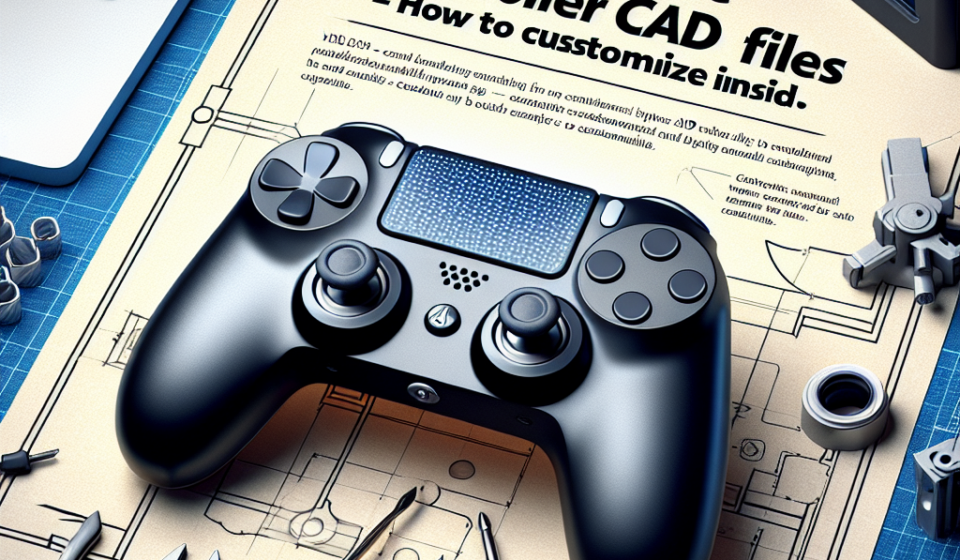

We celebrate open source in software as if it were inevitable. In hardware, openness still feels like a deliberate strategic choice – one that separates companies that merely ship products from those that create enduring ecosystems. Valve’s decision to publish CAD files for the Steam Controller’s shell under a Creative Commons license is a simple act with disproportionately large systemic implications.
Context – the signal in the noise
Valve has released the exterior CAD files for the Steam Controller, making the shell designs freely available for download under a Creative Commons license. The release covers the device’s outer casing only – not the electronics or internal assemblies – but it enables third parties to produce accessories, custom shells and derivative designs while the controller itself is out of stock.
Why this matters strategically
There are three broad shifts embedded in this move: democratization of hardware design, a new axis for ecosystem capture, and a nudge toward more sustainable product lifecycles.
– Democratization of hardware design: By placing shell CAD files in the commons, Valve lowers the barrier for makers, small manufacturers and tinkerers to participate. That means more rapid iteration of use cases, ergonomic experiments and localised adaptations – the kinds of innovations that rarely emerge inside a closed R&D pipeline.
– Ecosystem over product: Hardware businesses increasingly compete on the breadth and stickiness of their ecosystems, not just on the initial product. Open designs invite accessory makers, modders and community maintainers – effectively outsourcing long-tail product innovation to a global, low-cost R&D network. For companies, that can extend product lifespan and brand engagement without the cost of building every variant in-house.
– Circularity and repairability: Allowing custom shells promotes repairability and customization, which aligns with growing consumer demand for sustainable, long-lived devices. Even if the internals are proprietary, a replaceable exterior reduces waste and supports aftermarket markets.
Trade-offs every architect should weigh
Open-sourcing parts of a product is not purely altruistic; it introduces trade-offs that product and technology leaders must manage.
– Brand and quality control vs. innovation velocity: Community-made shells can improve the ecosystem but may vary widely in quality. Companies must decide whether to certify community products, provide reference manufacturing partners, or accept some product heterogeneity.
– IP and licensing clarity: Choosing the right license matters – permissive licenses encourage commercial reuse, while copyleft variants protect derivative openness. Legal ambiguity can stifle third-party contribution; clarity is a hygiene factor.
– Safety, compliance and security: External shells influence fit, heat dissipation and EMI behaviour. Enterprises must provide clear mechanical and safety guidelines if they want third-party hardware to be safe and compliant with regulatory regimes (telecom, safety, emissions).
Actionable steps for CTOs, founders and product leaders
If you’re responsible for product strategy or architecture, treat this as an invitation to rethink where you should open up and where you must retain control:
– Map core vs. non-core: Identify components that are strategic (firmware, security modules) and parts that can be open-sourced (enclosures, mounting hardware). Open the latter to stimulate third-party innovation.
– Publish reference docs and compliance notes: Supply clear dimensioned prints, ventilation specs, and EMC/thermal limits so community designs don’t create safety liabilities.
– Choose a license intentionally: Match business goals to license type. Document allowed commercial use, attribution requirements and modification rules.
– Create a certification or “partner” program: Offer optional branding or quality badges to community makers who meet testing criteria – a way to balance openness with trust.
– Engage local supply chains: Work with regional makerspaces, MSMEs and contract manufacturers to convert community designs into reliable, certified products – an opportunity for decentralized manufacturing and faster time-to-market.
Relevance to India and the Northeast
This pattern directly benefits regions with growing maker ecosystems, including Northeast India. Localised 3D printing shops, technical colleges and MSMEs can rapidly convert CAD files into accessories and small-batch products, creating jobs and demonstrating frugal innovation. For governments and industry bodies, facilitating easy access to certification support and small-scale manufacturing grants can turn open hardware releases into economic opportunity.
Takeaways
– Open design is a strategic lever, not just a PR move.
– Publish safety and compliance constraints alongside design files.
– Use licensing to align community innovation with business models.
– Local manufacturing ecosystems can convert openness into economic value.
Closing thought
We’ve long accepted that software thrives when it’s open; the next decade will show whether hardware ecosystems can learn the same lesson – not by abandoning proprietary advantages, but by choosing strategically where openness unlocks value.
About the Author Sanjeev Sarma is the Founder Director of Webx Technologies Private Limited, a leading Technology Consulting firm with over two decades of experience. A seasoned technology strategist and Chief Software Architect, he specializes in Enterprise Software Architecture, Cloud-Native Applications, AI-Driven Platforms, and Mobile-First Solutions. Recognized as a “Technology Hero” by Microsoft for his pioneering work in e-Governance, Sanjeev actively advises state and central technology committees, including the Advisory Board for Software Technology Parks of India (STPI) across multiple Northeast Indian states. He is also the Managing Editor for Mahabahu.com, an international journal. Passionate about fostering innovation, he actively mentors aspiring entrepreneurs and leads transformative digital solutions for enterprises and government sectors from his base in Northeast India.