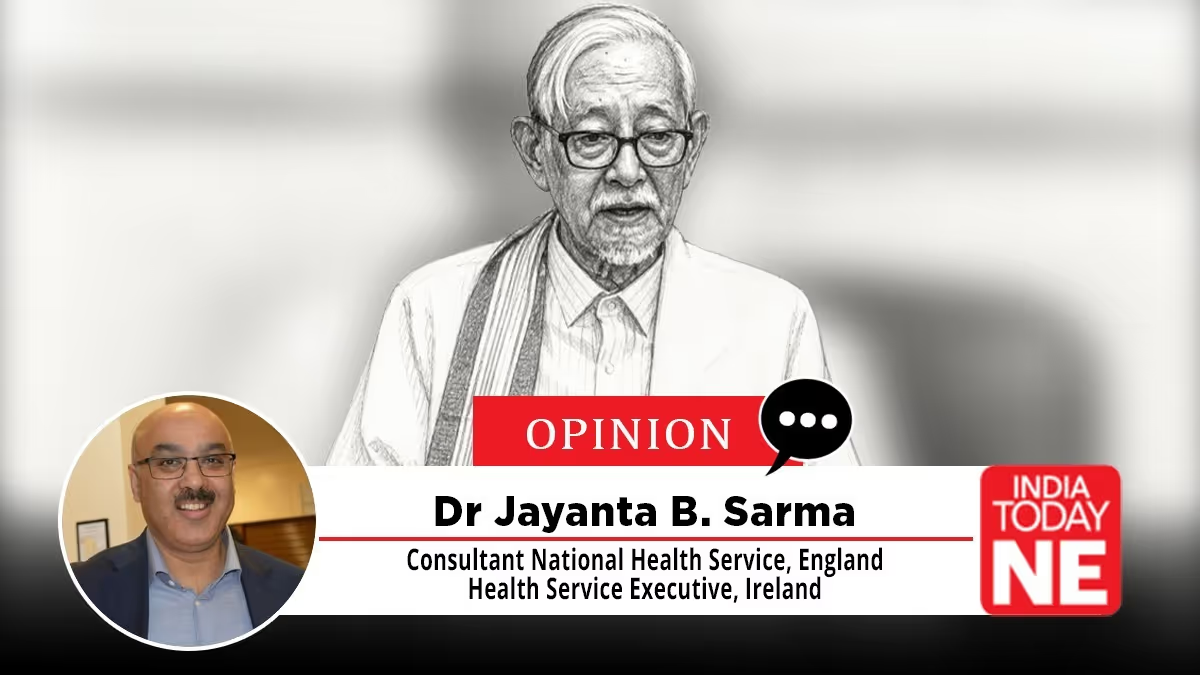

A recent Facebook post by veteran scholar Hiren Gohain has prompted a pointed critique from Dr Jayanta Biswa Sarma, who argues that the post exemplifies a narrowing of the public intellectual’s method-where conviction hardens into certainty while analysis loses breadth. Sarma says Gohain’s piece links several developments in Assam-declining student organisations, party positioning on the Citizenship Amendment Act, policy shifts on contractual teachers and student stipends, increased public borrowing, and a contested legal episode involving Pawan Khera-into a single narrative of systemic decline without sufficient evidence or analytical sequencing.
Sarma opens with Gohain’s diagnosis of waning student influence, noting the account of a past when student bodies held near-institutional authority on campuses and the present struggle to win student leadership. Gohain attributes the decline to “ambiguous and undefined positions” eroding trust. Sarma accepts the concern but says the claim is asserted rather than demonstrated and that alternatives-generational changes in political behaviour, fragmentation of student groups, or depoliticisation-are not considered.
The critique then targets a normative claim in Gohain’s post that “even extreme but clear positions are preferable to ambiguity.” Sarma describes this as a false binary: democratic politics often operates through negotiated, layered positions, and ambiguity can reflect competing mandates rather than weakness. He cautions against substituting moral absolutism for political realism.
Sarma also questions Gohain’s use of the AGP’s stance on the Citizenship Amendment Act as proof that the party could have blocked implementation in Assam despite its alliance with the BJP. He argues this is presented as retrospective moral judgment without reconstructing the structural constraints of coalition politics or the limits of state-level resistance in India’s federal system.
On policy matters, Sarma accepts the legitimacy of concerns about contractual teachers, welfare design, and public borrowing but faults the post for lacking comparative or contextual analysis. He notes that targeted welfare measures such as cash transfers and stipends have wide international precedent and institutional endorsement when well designed, and that borrowing must be judged against fiscal ratios and norms rather than treated as prima facie evidence of failure.
Sarma singles out Gohain’s treatment of allegations around Pawan Khera: the post notes a court denied bail and that authorities considered certain documents forged, but then immediately offers a mitigating anecdote—“I have heard from a lawyer”—about possible demonstrative use. Sarma says this lowers evidentiary standards at the moment greater rigour is required.
The essay concludes that the post demonstrates recurring problems: causal compression, associative reasoning, fluctuating evidentiary standards, and inconsistent moral application-invoking the maxim “Caesar’s wife must be above suspicion” in one context while granting leniency in another. Sarma’s core demand is for critique that is even‑handed, evidence‑based, and structurally coherent; he warns that a public intellectual’s authority rests as much on disciplined method as on moral conviction.
Original Source: https://www.indiatodayne.in/opinion/story/from-critique-to-certainty-how-hiren-gohains-public-reasoning-narrows-its-own-argument-1385168-2026-05-03?utm_source=rssfeed
Category:
Tags:
Publish Date: 2026-05-03 12:28:00