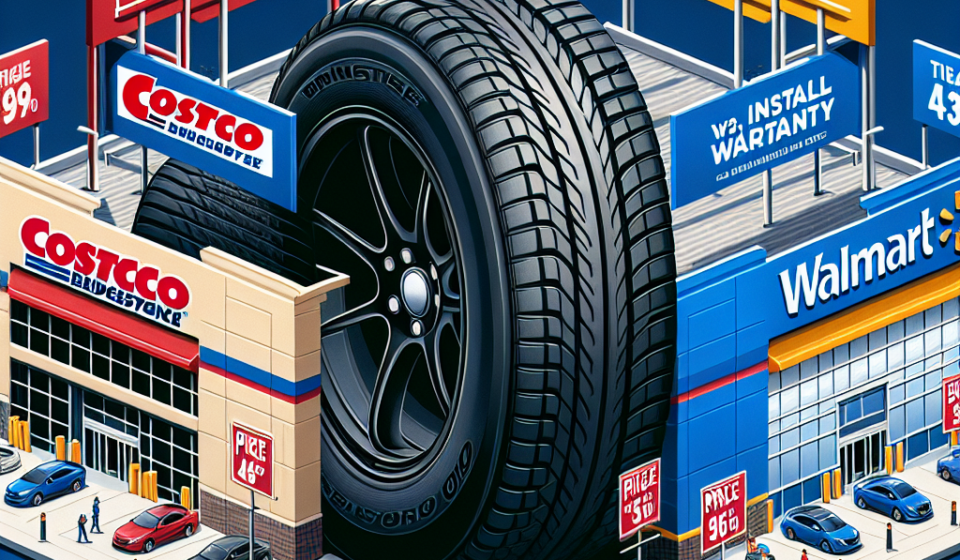

We all chase the lowest sticker price – until the bill arrives with unexpected charges, appointments that never materialize, or a warranty that only applies if you knew the fine print. The recent comparison of Bridgestone tire purchases at Costco vs. Walmart is a useful reminder: commoditized goods are frequently sold with very different service architectures, and the business that wins on total experience-not just price-wins the customer for the long term.
Context (the signal)
The story highlights a simple consumer choice: identical Bridgestone tires sold through two major retail channels show wide differences in headline price, installation fees, warranty terms, and fulfillment models. Walmart’s low sticker prices can be offset by installation costs, fragmented marketplace listings, and limited in-store fulfillment. Costco’s higher price often bundles installation, rotation, and road-hazard protection – transforming the purchase into a managed service.
Analysis – why this matters for architects, founders and CX leaders
1. Product vs. Service Architecture: At a systems level the tire is the product; installation, warranty, scheduling and returns are services. Many organizations still treat services as afterthoughts-bolted-on functions rather than first-class components in the product architecture. The result is customer friction and hidden total cost of ownership (TCO). Enterprises should model offerings as product-service systems where non-tangible services are as important as the SKU.
2. Marketplace complexity and identity: Walmart’s marketplace model illustrates a common architectural tension: reach vs. control. Allowing third-party sellers increases catalogue depth and price competition but dilutes the brand experience and complicates fulfillment. From an engineering perspective, this demands stronger metadata, vendor identity verification, and UX affordances that clearly surface who the seller is and what fulfillment options are available.
3. Trust and transparency as a differentiator: Consumers increasingly choose frictionless, predictable outcomes over marginal price savings. A bundled offering with lifetime rotations and clear road-hazard cover reduces cognitive load and fosters loyalty. Practically, this is a call for transparent pricing APIs, standardized service-level descriptors, and embedded checkout flows that surface all ancillary costs before payment.
4. Operational elasticity and edge fulfillment: If you sell a product that requires local execution (installation, calibration, inspection), your architecture must include real-world partners (service centers, contractors). That means onboarding, SLA monitoring, dispute resolution and digital scheduling capabilities. The trade-off is between building a proprietary network (control, quality) and orchestrating third-party providers (scale, complexity).
5. Brand & warranty management: For OEMs like Bridgestone, the channel mix impacts warranty enforcement and perceived quality. Brands should treat channel partners as extensions of their service layer and instrument warranty data to identify systemic issues early.
Local relevance – a quick Bharat perspective
In India, much of the automotive aftermarket still runs through unorganized garages and small dealerships. The lessons here are directly applicable: marketplaces that promise low prices but fail to integrate local service providers will struggle. There’s a huge opportunity for platforms to formalize service providers (digital onboarding, micro-insurance, appointment APIs) and bring predictable, accountable service to tier-2/3 cities and the Northeast. For policymakers and industry bodies, standardized labeling of bundled services and mandatory disclosure of installation/fulfillment options would reduce buyer confusion.
Actionable takeaways
– Design offers as product + service from day one; model TCO in your pricing flows.
– If you run a marketplace, surface seller identity, fulfillment options and hidden fees prominently.
– Invest in partner onboarding, SLA telemetry and a simple digital booking flow for local fulfillment.
– For brands: control critical service touchpoints or certify partners tightly to protect warranty and reputation.
– For startups: build solutions that reduce friction at the last mile – scheduling, insured technicians, and transparent warranties are high-value hooks.
Closing thought
Price is an entry ticket; predictability and trust buy repeat business. In a world where fulfillment spans both cloud APIs and street-level mechanics, winning requires system thinking – aligning product, service, partner networks and the user experience into one coherent architecture.
About the Author
Sanjeev Sarma is the Founder Director of Webx Technologies Private Limited, a leading Technology Consulting firm with over two decades of experience. A seasoned technology strategist and Chief Software Architect, he specializes in Enterprise Software Architecture, Cloud-Native Applications, AI-Driven Platforms, and Mobile-First Solutions. Recognized as a “Technology Hero” by Microsoft for his pioneering work in e-Governance, Sanjeev actively advises state and central technology committees, including the Advisory Board for Software Technology Parks of India (STPI) across multiple Northeast Indian states. He is also the Managing Editor for Mahabahu.com, an international journal. Passionate about fostering innovation, he actively mentors aspiring entrepreneurs and leads transformative digital solutions for enterprises and government sectors from his base in Northeast India.