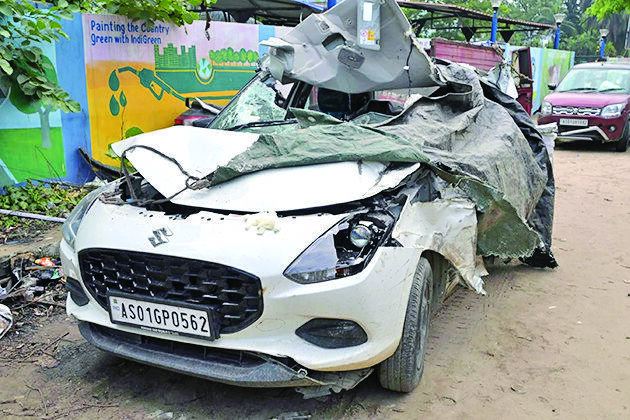

In the early hours of April 26, a speeding car ploughed into a stationary truck at Narengi, Guwahati, killing three young women instantly and exposing deep gaps in excise enforcement and traffic monitoring across the city. Police say the group had been at a bar‑cum‑restaurant in Bhangagarh until about 3:00 am — well past the legally permitted serving time — and CCTV footage and billing records confirm their presence. The driver fled the scene but was later arrested in Upper Assam after investigators reconstructed his route using GPS data and CCTV, officials said.
The crash has raised urgent questions about how a vehicle could travel through Guwahati at speeds of up to 135 km/h without interception, finally striking the truck at an estimated 96 km/h. DCP (Traffic) Jayanta Sarathi Bora told reporters that police intensified checks during the election period and have shifted checkpoints to avoid predictability, adding that “surveillance is ongoing, and the accused is cooperating during interrogation.”
Excise authorities insist rules are clear and enforced. An excise official said, “Bars with late‑night permission must stop serving by 12:30 am, and others by 10 pm. We conduct routine inspections, and CCTV footage is monitored.” Yet eyewitness accounts suggest a different reality. Gayatri Nath, who attended an event at the same venue weeks earlier, recalled delays and extended hours, saying the event “went on past midnight,” underscoring a culture where timelines and regulations are often flexible.
The tragedy in Narengi is part of a wider road‑safety crisis in Assam. At a state‑level road safety review chaired by Chief Secretary Dr Ravi Kota on April 28, officials disclosed that the state recorded 4,219 accidents and 1,008 fatalities in the first quarter of 2026 (January–March). More than 11 people die on Assam’s roads every day, with pedestrians accounting for one in five victims. Dr Kota warned that “crash severity remains high,” and urged stricter enforcement, improved road engineering and immediate corrective action at identified black spots.
Authorities have suspended the bar’s licence in the wake of the accident, a move framed as a step toward accountability. Families of the victims — identified as Puja Saha, Akanksha Saikia and Armina Ahmed — say such measures come too late. The Narengi crash highlights a persistent disconnect between policy and practice: bars operating beyond permitted hours, vehicles moving at lethal speeds through poorly monitored stretches, and enforcement that often appears reactive rather than preventive. As Guwahati’s nightlife and traffic grow, coordinated action between excise authorities and traffic police will be crucial to prevent further loss of life.
Original Source: https://assamtribune.com/guwahati/the-narengi-crash-and-the-cost-of-weak-enforcement-1611166
Category: Guwahati,Featured,More
Tags:
Publish Date: 2026-05-01 15:09:00