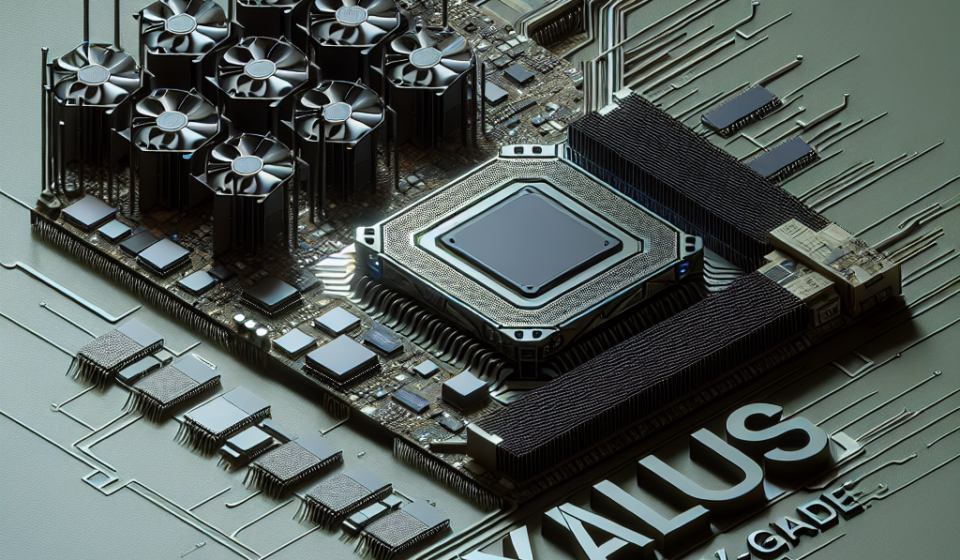

We obsess about compute density, rack-unit efficiency and peak FLOPS, but we rarely talk about the physical limit that quietly caps all of it: heat. The recent collaboration between a Trinity College Dublin spin‑out and a ruggedized defense-platform manufacturer is a timely reminder that thermal management – especially liquid cooling – is no longer a niche hardware detail. It is a core systems design problem with strategic, operational and procurement consequences for any organization trying to push compute to the edge.
Context: A compact signal
I recently came across a collaboration where an advanced liquid‑cooling specialist is integrating its architectures into rugged, deployable platforms intended for high‑performance computing (HPC) and AI workloads in demanding defence and industrial environments. The engineering challenge is simple to state and fiendishly hard to solve: deliver higher compute density, reliably, in harsh and energy‑constrained edge deployments.
Analysis: Why cooling is an architecture decision, not an afterthought
From an enterprise architecture standpoint, thermal management sits at the intersection of four domains: performance, availability, cost of ownership, and operational security.
– Performance vs. Availability: Pushing higher node density gives impressive benchmark numbers, but without a deliberate thermal strategy those same nodes will throttle, fail, or require overly conservative derating. Effective liquid cooling reduces thermal headroom risk and materially increases usable compute per cubic metre – but it does so while introducing new failure modes (leaks, pump failure, coolant degradation) that require architectural mitigation.
– Operational security and resilience: Edge systems in defence or mining aren’t just about compute; they’re about continuity under stress. A cooling solution must be part of the resilience plan: redundant pumps, graceful thermal shedding, hot‑swap modules, and remote diagnostics that remain functional when connectivity is intermittent.
– TCO and sustainability: Liquid cooling often lowers power usage effectiveness (PUE) and reduces energy cost per computation, a significant advantage as organisations face both carbon targets and rising electricity bills. The trade‑off is capital and skill investment: procurement teams must expand their RFP criteria beyond CPU spec to include fluid dynamics, MTBF figures for pumps and heat exchangers, and lifecycle coolant sourcing.
– Build vs. Buy: For most software‑led organisations, liquid cooling is not a strategic differentiator. Buy proven technology and master integration. For defence primes or OEMs selling systems into austere environments, it may be worth owning certain IP – but only after honest product‑market fit validation. Prematurely in‑sourcing thermal engineering creates long‑tail technical debt.
Actionable guidance for CTOs and founders
– Treat thermal architecture as a first‑class design artefact: include it in capacity planning, DR exercises, and procurement checklists.
– Demand observability: sensors for flow, temperature gradients, and coolant quality must feed into the same telemetry and alerting systems you use for application health. Thermal incidents must be diagnosable remotely.
– Plan for serviceability: edge deployments require field‑replaceable modules, spare parts logistics and trained technicians. Design with modularity and clear SOPs.
– Run integration POCs early: physics can break assumptions that look correct on paper. Short POCs with real workloads in representative environments will surface issues faster than lab modelling.
– Factor in lifecycle and supply chain risk: specialized coolants, pumps and heat exchangers can have constrained suppliers. Have alternate sources and local maintenance partners.
Relevance to India and Northeast deployments (a pragmatic note)
For India – and particularly geographies like the Northeast with challenging logistics and variable grid reliability – these are not academic concerns. Edge compute supporting surveillance, mapping, or disaster response will be deployed in high humidity, wide temperature swings and limited maintenance windows. Energy‑efficient cooling that reduces grid load while improving availability is highly relevant. That said, the right approach is not to import complexity blindly; it’s to adopt modular, serviceable systems and localize maintenance capabilities.
Takeaways
– Heat is a system‑level constraint that directly shapes cloud-to-edge strategy.
– Liquid cooling is increasingly a practical enabler of higher density and lower operational cost, not just an experimental technology.
– Integration, observability and lifecycle planning are where projects succeed or fail – not in CPU selection alone.
Closing thought
As compute pushes closer to the physical edge, the separation between infrastructure engineering and application architecture disappears. The organisations that win will be those that treat thermal design with the same rigor as API contracts and security models – because, in production, heat is an API that never lies.
About the Author Sanjeev Sarma is the Founder Director of Webx Technologies Private Limited, a leading Technology Consulting firm with over two decades of experience. A seasoned technology strategist and Chief Software Architect, he specializes in Enterprise Software Architecture, Cloud-Native Applications, AI-Driven Platforms, and Mobile-First Solutions. Recognized as a “Technology Hero” by Microsoft for his pioneering work in e-Governance, Sanjeev actively advises state and central technology committees, including the Advisory Board for Software Technology Parks of India (STPI) across multiple Northeast Indian states. He is also the Managing Editor for Mahabahu.com, an international journal. Passionate about fostering innovation, he actively mentors aspiring entrepreneurs and leads transformative digital solutions for enterprises and government sectors from his base in Northeast India.