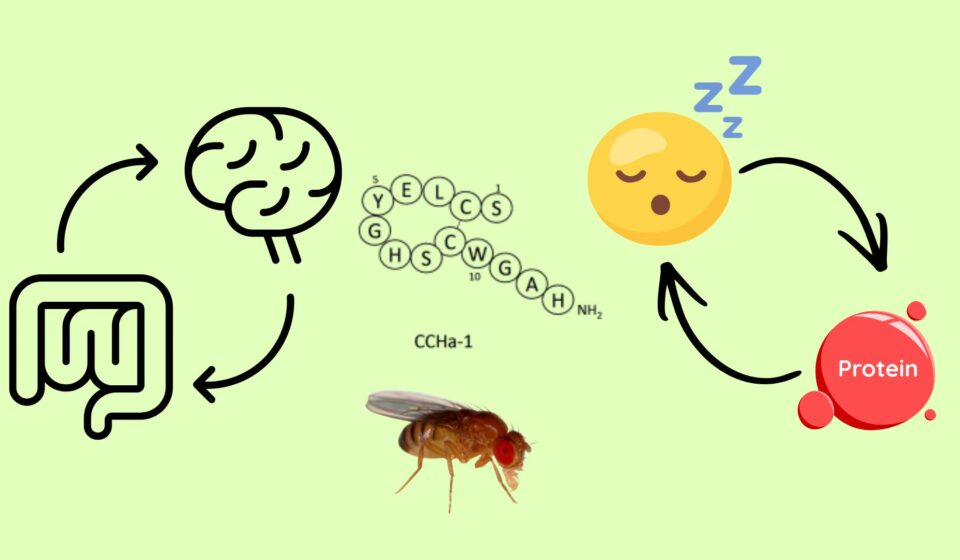

Scientists at the Indian Institute of Science Education and Research Thiruvananthapuram (IISER TVM), in collaboration with Okayama University, Japan, report that a small brain–gut signalling molecule called CCHamide1 (CCHa1) links dietary protein levels to sleep quality in fruit flies. Using flies that lack the gene for CCHa1, the team showed that loss of this protein sensor disrupts sleep, alters feeding and metabolism, and shortens lifespan, suggesting a conserved connection between nutrient sensing and sleep regulation.
CCHa1 is a neuropeptide — a small protein that modulates neuronal activity — expressed both in brain circadian clock neurons and in the gut. As Dr Nisha N Kannan, corresponding author and Associate Professor at IISER TVM, explains, “CCHa1 is a neuropeptide, a small protein involved in regulating neuronal processes.” In the gut it acts as a sensor of protein levels and relays that information to the brain, tying metabolic state to neural circuits that control behaviour.
To test CCHa1’s role in nutrient-dependent sleep, the researchers compared normal flies with ccha1 mutants and varied dietary protein. The mutants showed pronounced sleep fragmentation: they woke more frequently and took shorter naps. Under a high-protein diet the fragmentation became worse, while on low-protein food their sleep resembled control flies.
Lead author Swetha Gopalakrishnan said the team also probed gut-specific effects, noting that CCHa1 “plays an important role in consolidating sleep under high-protein food by sensing the protein content and regulating the food intake.” Manipulating CCHa1 levels specifically in the gut altered sleep fragmentation, supporting the idea that gut-derived protein sensing is a key regulator of sleep architecture in these flies.
Beyond sleep, ccha1 mutants overeat and store excess fat, which makes them more starvation-resistant but appears to create long-term metabolic stress. “The mutants overeat and also have high fat storage, which keeps them resistant to starvation; however, we believe this led to long-term metabolic stress and their bodies aged faster,” Gopalakrishnan adds.
The mutation also affected development and reproduction: pre-adult development was delayed, reproductive output increased, and lifespan shortened significantly. Dr Kannan says these findings show that changes in an organism’s ability to sense dietary protein can influence behaviour, food intake, metabolism and overall fitness.
While prior work has shown gut-derived CCHa1 signals to brain dopaminergic neurons to regulate sleep, the team notes it remains unclear whether the observed effects on sleep fragmentation and metabolism originate solely in the gut, the brain, or from gut–brain communication. Dr Kannan says future research will address these open questions.
Original Source: https://researchmatters.in/news/gut-brain-connection-tiny-peptide-shapes-how-flies-eat-sleep-and-survive
Category:
Tags:
Publish Date: 2026-04-30 06:00:00