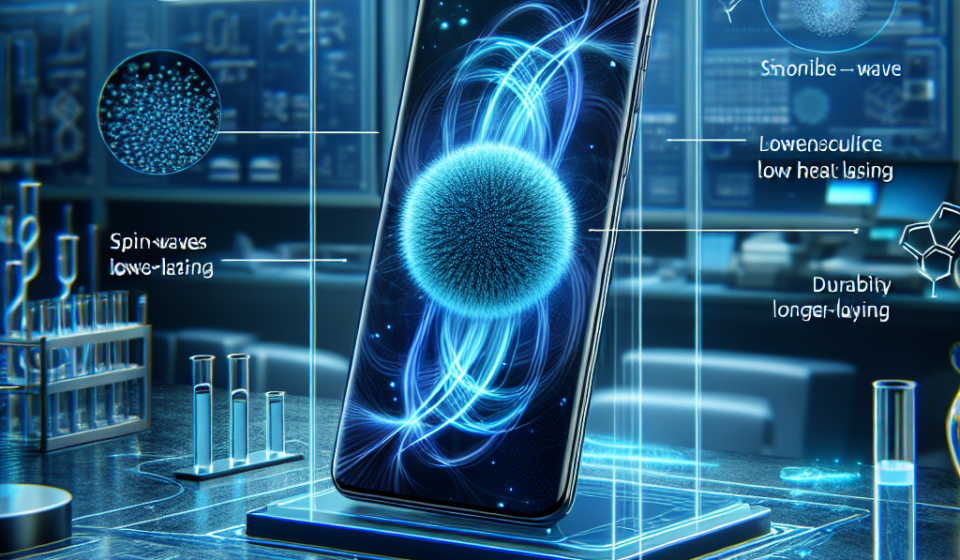

We’ve long accepted heat as the inevitable byproduct of digital progress: squeeze more performance into a smaller package and you’ll pay the price in thermals, throttling and battery drain. What if that constraint isn’t a law of nature but a design choice rooted in the materials we use – and therefore subject to being reimagined?
Context
Researchers at KAIST recently demonstrated a device-level approach to process information using spin waves (magnons) – tiny magnetic vibrations – instead of moving electrons. The work, published in a peer‑reviewed venue, shows reduced heat generation and the ability to switch frequencies rapidly across GHz bands, opening a different physical substrate for computation and signal processing.
What this means (from an enterprise architect’s lens)
Technological paradigms shift when the physics undergirding computation changes. Moving from charge-based (electronic) to spin-based (magnonic) processing is not merely a tweak to transistor design – it is the emergence of a new information medium. For architects and technology leaders, several strategic implications follow:
– The new bottleneck changes. Today we architect around thermal budgets, cooling strategies, and power-proportional scaling. A reduction in heat generation at the device layer could meaningfully change how we design form factors, on-device AI models, and even data-center rack densities. Imagine phones that sustain high-frame-rate gaming or continuous video transcoding without aggressive throttling – that affects product differentiation and user experience.
– Heterogeneous stacks become more attractive. Early adoption of magnonic components will almost certainly be incremental and domain-specific (RF front-ends, signal modulators, certain DSP tasks). This favors architectures that treat hardware as composable services: clearly-defined interfaces, hardware abstraction layers, and the ability to offload specific workloads to different substrates (CMOS, photonics, magnonics).
– Integration and supply‑chain risk rises. New physical principles require new manufacturing processes, materials, and test methodologies. Enterprises should expect longer qualification cycles, higher NRE (non-recurring engineering) costs, and vendor concentration early on. Risk-averse organizations will prefer modular designs and open standards to avoid vendor lock-in.
– Software and tooling must evolve. Current compilers, verification tools and performance models assume electron-based behavior. Magnonic devices will require new simulators, power models, verification suites and domain knowledge in nonlinear magnetodynamics. Investment in cross-disciplinary engineering (materials science + systems engineering) will be a competitive advantage.
Actionable guidance for CTOs and founders
– Monitor and stage investments: Treat magnonics as strategic optionality. Monitor reproducibility and roadmap from foundries; prioritize collaboration over premature in‑house bets.
– Architect for heterogeneity: Design microservices and hardware abstraction layers today so specific signal-paths can be migrated to alternative substrates when mature.
– Invest in thermal-first UX: Even as hardware improves, software-level thermal and power policies (adaptive sampling, progressive model fidelity) multiply gains.
– Partner with research and consortia: Universities and national labs will be first movers. Public–private collaborations de‑risk early access and help shape standards.
– Upskill for cross-domain work: Create small skunkworks teams combining device physicists, firmware engineers and system architects to translate breakthroughs into product specs.
Relevance for India and northeast ecosystems
For India – and particularly for regions where devices must tolerate higher ambient temperatures and power constraints – reducing device heat and extending battery life has immediate user impact. Lower thermal budgets make mobile-first services (education, telemedicine, video streaming) more reliable in the field. From an industry perspective, India’s ambitions in semiconductor design and assembly can benefit from early participation in standards and IP development around new substrates; startups and STPI-enabled incubators in the Northeast could position themselves as niche integrators (hardware+software) for low-power edge solutions.
A reality check
Breakthroughs in physical principles are exciting, but the path from lab prototype to mass-market silicon is long: integration with CMOS, yield scaling, reliability testing, and standards are multi-year efforts. I believe the sensible posture for product leaders is to prepare the software and systems architectures to embrace heterogeneity while watching closely for when fabrication and ecosystem maturity reach commercial readiness.
Closing thought
We’re witnessing a reminder that computation’s future is as much about the medium as about algorithms. Architecture that anticipates multiple substrates – not just faster transistors – will win the next decade.
About the Author Sanjeev Sarma is the Founder Director of Webx Technologies Private Limited, a leading Technology Consulting firm with over two decades of experience. A seasoned technology strategist and Chief Software Architect, he specializes in Enterprise Software Architecture, Cloud-Native Applications, AI-Driven Platforms, and Mobile-First Solutions. Recognized as a “Technology Hero” by Microsoft for his pioneering work in e-Governance, Sanjeev actively advises state and central technology committees, including the Advisory Board for Software Technology Parks of India (STPI) across multiple Northeast Indian states. He is also the Managing Editor for Mahabahu.com, an international journal. Passionate about fostering innovation, he actively mentors aspiring entrepreneurs and leads transformative digital solutions for enterprises and government sectors from his base in Northeast India.