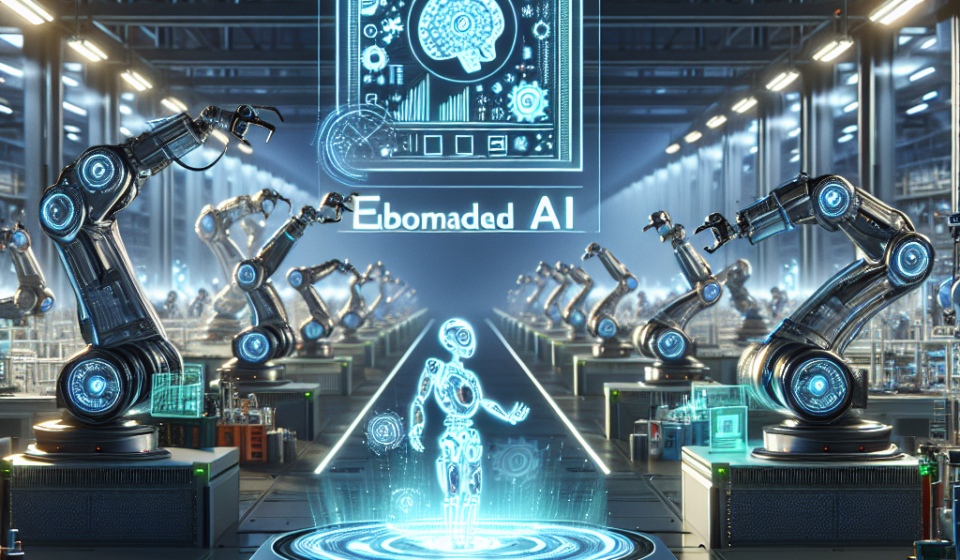

We are seduced by the idea that a single foundation model will soon replace decades of painstaking robot programming. That narrative misses the real architectural trade-offs industrial teams face today: flexibility versus determinism, data scale versus certification, and agility versus safety.
Signal (brief): Recent industry work on vision-language-action (VLA) or “embodied AI” models shows genuine progress – systems that take images + natural language and output robot actions – but most deployments in 2026 remain pilots. The technology promises rapid changeovers and generalization across parts, yet it introduces variance, heavy data needs, and new validation burdens.
Analysis – what this means for enterprise architecture and strategy
1) Embrace hybrid control as the pragmatic architecture. VLA models are excellent at perception, instruction parsing, and coarse task selection; classical controllers remain unmatched for millisecond-level torque control and certified safety. Treat VLA as a task-level planner that proposes targets; keep a deterministic, safety-rated motion layer to enforce limits, interpolation, and fail-safe behaviors. This preserves auditability while unlocking flexibility.
2) Data is the strategic bottleneck, not the model. High-performing embodied policies need teleoperation demos, sim data, and web video priors. That makes investment in inexpensive data pipelines – teleop rigs, synchronized camera/joint logging, and a sim + domain-randomization workflow – the highest-leverage early play. For most manufacturers, 50–300 hours of targeted demonstrations are the practical floor for usable fine-tuning; plan budgets and timelines accordingly.
3) Build for certifiability from day one. Neural policies break traditional FMEA assumptions. Define an Operational Design Domain (ODD), log perception inputs and action outputs, and wrap policies with a classical safety monitor that enforces workspace, velocity, and force constraints. These steps reduce downstream validation costs for IATF/ISO audits and shorten the path from pilot to production.
4) Hardware and deployment are system-design problems. Large VLA models favor GPU inference and operate at lower control frequencies than industrial controllers. The two-node architecture – an edge GPU node for perception/planning and a real‑time controller for actuation – is now the de facto approach. Evaluate thermal, EMI, and IP requirements early if you intend to deploy on factory floors.
Practical next steps for CTOs and Founders
– Start small: pick a high-mix, loose-tolerance task (mixed-SKU bin picking or coarse assembly) with clear KPIs and human-in-the-loop fallback.
– Invest in instrumentation: cameras, synced joint logs, and a basic teleop setup to collect 50–200 demonstration hours.
– Adopt a safety-wrapper pattern: VLA outputs ➜ validation/safety filter ➜ classical controller.
– Plan for auditability: capture inputs/outputs, version models, and define ODD boundaries.
– Evaluate build vs. buy: open models accelerate experimentation; commercial platforms can shorten time-to-pilot but add vendor lock‑in and certification questions.
A Bharat connection (why this matters to Indian industry)
For India’s MSMEs and discrete-job shops – including many in the Northeast – the business case for flexible automation is strong. High-mix, small-batch manufacturing benefits most from models that reduce changeover time. Frugal pilots that reuse existing robot arms, add a modest GPU node, and focus on perceptual generalization can democratize automation without replacing entire cells. Skill development is critical: local teleoperation teams and partnerships with regional engineering colleges will be the enablers.
Takeaways
– VLA is a capability shift, not an immediate replacement for deterministic controllers.
– Data and validation engineering matter more than headline model size.
– Hybrid architectures and safety wrappers are the practical path to production.
– For Indian manufacturers, targeted pilots can unlock productivity gains without wholesale capital replacement.
Closing thought: technology that combines human demonstrations, simulation, and language will reshape how factories think about work – but the winners will be those who treat embodied AI as a system-design problem, not a magic wand.
About the Author
Sanjeev Sarma is the Founder Director of Webx Technologies Private Limited, a leading Technology Consulting firm with over two decades of experience. A seasoned technology strategist and Chief Software Architect, he specializes in Enterprise Software Architecture, Cloud-Native Applications, AI-Driven Platforms, and Mobile-First Solutions. Recognized as a “Technology Hero” by Microsoft for his pioneering work in e-Governance, Sanjeev actively advises state and central technology committees, including the Advisory Board for Software Technology Parks of India (STPI) across multiple Northeast Indian states. He is also the Managing Editor for Mahabahu.com, an international journal. Passionate about fostering innovation, he actively mentors aspiring entrepreneurs and leads transformative digital solutions for enterprises and government sectors from his base in Northeast India.