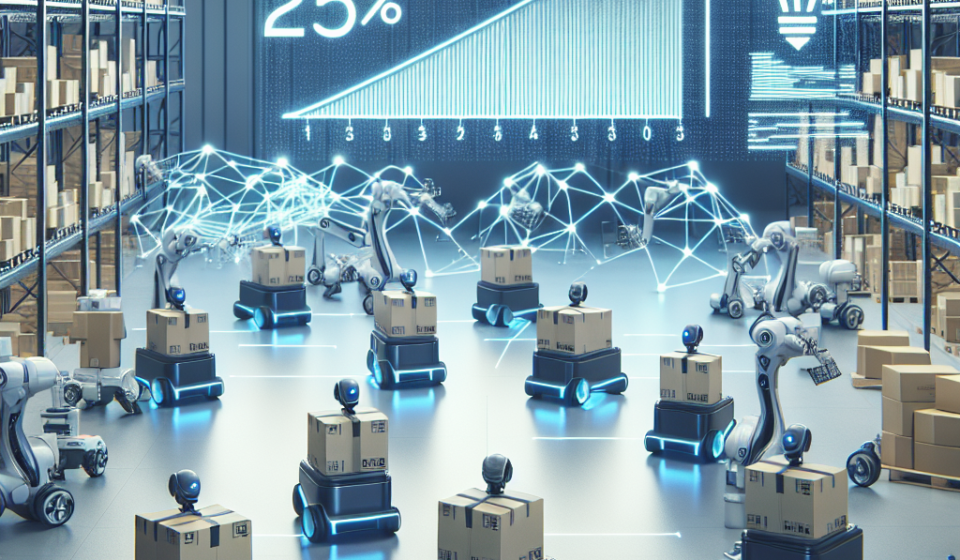

We celebrate robots – their speed, precision and the headlines they generate – but the real competitive advantage in modern warehouses comes from how those robots are orchestrated. A small collision or a local jam doesn’t just slow one arm; it can cascade into hours of lost throughput. That’s the problem a recent MIT–Symbotic study tackles with a compelling lesson for enterprise architects: intelligence at the decision-making layer – not just faster actuators – delivers disproportionate ROI.
The signal: researchers combined deep reinforcement learning to learn which robots should be prioritized in real time, and a classical planning algorithm to execute safe, low-latency motion plans. In simulation this hybrid approach raised throughput by roughly 25% over traditional methods, while showing adaptability to different layouts and robot densities.
Why this matters strategically
– Hybrid architectures win in production. Pure end‑to‑end learning is attractive in papers, but brittle and hard to certify for operational safety. The MIT work illustrates a pragmatic split: use ML where pattern recognition and long‑horizon trade-offs matter (priority decisions), and use deterministic planners for fast, auditable control. For enterprise architects, this pattern reduces both technical risk and regulatory exposure while preserving ML’s upside.
– The sim‑to‑real gap is the central operational risk. Gains reported in simulation don’t automatically translate on concrete floors. Fidelity of simulations, edge-case coverage, and the fidelity of robot and sensor models determine deployment speed and risk. I’ve seen projects stall not because the model was wrong, but because the operational team underestimated the physics and variability of a real site.
– Observability and a control plane are non‑negotiable. To deploy ML-guided scheduling, teams need high‑quality telemetry, deterministic replay, shadow testing, and rollback hooks. Without these, model drift and unusual congestion patterns become incidents rather than optimizations.
– Tradeoffs: throughput vs. predictability vs. safety. Choosing higher throughput via ML must be balanced against deterministic guarantees needed for worker safety and SLAs. The hybrid approach is a practical hedge – you get the learning-based prioritization but retain the conservatism of planners.
Practical guidance for CTOs and robotics product leaders
1. Start with a hybrid proof‑of‑concept in simulation, but design for immediate shadow deployment on a live floor. Let the learned prioritizer run in parallel for a period while the planner enforces actions.
2. Instrument everything. Capture per-robot telemetry, task timelines, and collision near-misses. These signals drive both model training and incident forensics.
3. Institutionalize model governance: drift detection, offline validation datasets drawn from production, and a retraining cadence tied to operational changes (new layouts, inventory skew, seasonal peaks).
4. Choose the build vs buy boundary pragmatically. If your differentiator is supply‑chain orchestration, invest in the decision layer. If robotics integration is a cost center, partner with specialists or system integrators.
5. Design human-in-the-loop fallbacks and clear escalation paths. When automation fails, people must be able to intervene safely and efficiently.
A note on India and last‑mile relevance
The idea scales beyond the largest automated warehouses. In India, where e‑commerce continues to grow and many fulfilment centres are retrofitted rather than ground‑up automated, the hybrid pattern is especially attractive: lightweight ML prioritizers can sit atop existing conveyor and AGV fleets to improve throughput without full retooling. For MSMEs and regional integrators, this creates a realistic, lower‑cost upgrade path to automation-led efficiency gains.
Takeaways
– Architect for hybrid intelligence: ML for strategy, classical algorithms for execution.
– Treat simulation as an engineering discipline, not just a research step.
– Invest in telemetry, governance, and safe human fallbacks before scaling.
Closing thought
In complex systems, intelligence is less about individual agents and more about choreography. When we get the choreography right – balancing learning with determinism, agility with safety – automation stops being a novelty and becomes a reliable lever for competitive advantage.
About the Author
Sanjeev Sarma is the Founder Director of Webx Technologies Private Limited, a leading Technology Consulting firm with over two decades of experience. A seasoned technology strategist and Chief Software Architect, he specializes in Enterprise Software Architecture, Cloud-Native Applications, AI-Driven Platforms, and Mobile-First Solutions. Recognized as a “Technology Hero” by Microsoft for his pioneering work in e-Governance, Sanjeev actively advises state and central technology committees, including the Advisory Board for Software Technology Parks of India (STPI) across multiple Northeast Indian states. He is also the Managing Editor for Mahabahu.com, an international journal. Passionate about fostering innovation, he actively mentors aspiring entrepreneurs and leads transformative digital solutions for enterprises and government sectors from his base in Northeast India.